Robert J. Morgan - Author, Pastor, Expositor

Some Timely Help from Martin Rinkart

August 21, 2010

I’ve had a hard time waking up and getting started this Saturday morning. It was an exhausting week, and I’ve felt vexed juggling church work, writing deadlines, family responsibilities, and care-giving. But last night and again this morning, I picked up a book I’d purchased in a London shop earlier this year.

It told the story of Martin Rinkart, a German pastor in the early 1600s. It was his misfortune to minister in the worst of times. He lived in a walled town into which hoards of refugees poured during the Thirty Years’ War. Great armies crossed the land, pillaging shops and farms, leaving ruin and desolation behind. Farming activities were so interrupted by the war that famine ensued throughout Saxony. Then the plague broke out. The other two ministers in town died, leaving Martin to care for the multitudes alone. All day he went from bed to bed, nursing the sick and comforting the dying. He conducted thousands of funerals, sometimes reading the funeral service over forty or fifty bodies at once. Among the eight thousand who perished in one particular year was his own wife. A year after the war ended, Martin himself died. But he left behind a remarkable hymn—one of my favorites, but one I hadn’t sung or thought about for awhile.

 It’s one of our greatest hymns of – thanksgiving!

 The writing of this hymn must have provided therapy and vigor for Martin’s own spirit. I especially like the prayer in the middle of verse 2: “And guide us when perplexed….”

The first verse is a declaration of praise:

Now thank we all our God,

With hearts and hands and voices;

Who wondrous things hath done,

In whom His world rejoices;

Who, from our mother’s arms,

Hath blessed us on our way

With countless gifts of love,

And still is ours today.

 The second verse becomes a prayer:

O may this bounteous God

Through all our life be near us,

With ever-joyful hearts

And blessed peace to cheer us,

And keep us in His grace,

And guide us when perplexed,

And free us from all ills

In this world and the next.

 The last verse is devoted to Trinitarian praise:

All praise and thanks to God

The Father now be given,

The Son, and Him who reigns

With Them in highest heaven:

The one eternal God,

Whom heaven and earth adore;

For thus is was, is now,

And shall be evermore.

 My recounting of the story above was aided by Elsie Houghton, Christian Hymn-Writers (Evangelical Press of Wales, 1982), chapter 4. If you want to hear the melody for this hymn, click here. For information about my own books of hymn stories, click here.

Share and Enjoy:
  • Twitter
  • Facebook
  • StumbleUpon
  • Technorati
  • Digg
  • del.icio.us
  • LinkedIn
  • Google Bookmarks
  • MySpace
  • email
  • Print

Near to the Heart of God

August 13, 2010

Near to the Heart of God Near to the Heart of God A couple of years ago, Andrea Doering, the outgoing (and outstanding) senior acquisitions editor at Revell Books, asked if I had any ideas for a devotional book based on hymns. I suggested a date-based approach to mining the riches of the hymnbook. I had in mind a cross between the concepts behind two of my other books: “On This Day” and “Then Sings My Soul.”

The result is a brand new devotional book, “Near to the Heart of God,” 366 stories about hymns presented day by day, each on a day connected with that hymn.

Here are some examples from among the January installments:

  • You might be surprised to learn that “Amazing Grace” was originally a New Year’s hymn. It was first presented on January 1, 1773, as part of a New Year’s sermon preached by John Newton in Olney, England.
  • The wonderful music for the hymn, “When I Survey the Wondrous Cross,” was written by Lowell Mason, the “Father of American Church Music,” who was born January 8, 1792.
  • The great hymn, “Rock of Ages, Cleft for Me,” was sung by the perishing passengers aboard the steamship London as it sank in a gale on January 11, 1866.
  • B.B. McKinney wrote the powerful invitational hymn, “Wherever He Leads I’ll Go,” during a Sunday School Convention on January 17, 1936, in Clanton, Alabama.
  • January 21 is the birthday of Edward Mote, a cabinetmaker and preacher, who wrote the favorite Gospel song, “The Solid Rock” (“My Hope is Built on Nothing Less”).

Out of the lives of composers, poets, hymnists, and out of the stories of the hymns themselves come 366 true stories, plus the words of these theological gems we call hymns — all with the purpose of encouraging your day with the deep, timeless truths of our Scriptures and our songbooks.

“Near to the Heart of God” will be released in October. Find out how you can reserve one of the first copies at an incredibly low price by clicking here.

Share and Enjoy:
  • Twitter
  • Facebook
  • StumbleUpon
  • Technorati
  • Digg
  • del.icio.us
  • LinkedIn
  • Google Bookmarks
  • MySpace
  • email
  • Print

London: Handel’s House

June 16, 2010

2010 London Day 1 027 300x225 London: Handels House  In my book, Then Sings My Soul, I told the remarkable story of how George Frideric Handel composed his famous oratorio, Messiah, in his London home in a time span of just about three weeks. Many people had thought Handel “past his prime,” but his friend, Charles Jennens, believed his best work was still ahead. “Handel says he will do nothing next winter,” said Jennens, “but I hope I shall persuade him to set another Scripture Collection I have made for him…. The subject is Messiah.”

Receiving the Scriptures, Handel was so deeply moved he closed the door of his London home and wrote Messiah – the whole thing! — in less than a month.

Today with my son-in-law, Eric Olsen, I had the opportunity of visiting Handel’s London home and lingering in the room in which Messiah was written. The house is located at 25 Brook Street within walking distance of Westminster Abbey. It was in a new upper-middle class townhouse in 1723 when Handel, a bachelor, rented it. He was thirty-eight years old. He lived there the rest of his life, dying in the upstairs bedroom in 1759.

The basement contained the kitchen. The first floor has two rooms. One was an interior room with a little window that let in some light. This was his composition room, and the room in which he wrote Messiah. The second room was his rehearsal and performance room where he entertained small groups.

Up a narrow set of stairs are two more rooms. One was his bedroom (with a chamber pot at the foot of the bed; there was no running water). Next door was his dressing room. His small staff of servants lived in the attic.

Until the 1990s, this house was not available for touring; but now it’s been acquired by the Handel House Museum and guests can sit and ponder Messiah in the very room in which Handel feverously composed it in the early fall of 1741. When we arrived this afternoon, a guest musician was playing the harpsichord and it sounded lovely.

Handel wasn’t a perfect man. He certainly loved his food and drink, and he was known to be short-tempered and would sometimes curse (in several languages) at his soloists. But he was dedicated to his Lutheran faith. He wrote music for the Christian faith. And he worked with all his heart to establish a Foundling Hospital for newborn babies who were abandoned on the streets of London.

Handel’s House is off the beaten tourist path, but worth a visit to all those who love the heritage of Christian music or whose hearts are stirred by the Hallelujah Chorus.

PS – G.F. Handel had some interesting neighbors. The townhouse attached to his was the home of rock star Jimi Hendrix who lived there in the late 1960s. And a couple of blocks away I found FDR and Winston Churchill whispering secrets about World War II.

2010 London Day 1 023 300x225 London: Handels House  

 2010 London Day 1 018 300x225 London: Handels House

Share and Enjoy:
  • Twitter
  • Facebook
  • StumbleUpon
  • Technorati
  • Digg
  • del.icio.us
  • LinkedIn
  • Google Bookmarks
  • MySpace
  • email
  • Print

In Times Like These

May 6, 2010

Today I’ve had to force my mind back onto my writing; and while it’s hard not to be preoccupied with all things flood-related, my project for Turning Point Magazine involved an old song that has encouraged me.

In the year 1943, Ruth Caye Jones, a pastor’s wife in Pennsylvania and the mother of five, was distressed by the headlines of her Pittsburgh newspaper. She saw the World War II causality lists and she knew the Allies were making slow progress through the boot of Italy. Supplies were rationed at home, and everyone was living under incredible strain.

Opening her Bible to 2 Timothy 3, Ruth studied the page and pondered the opening words. But know this, that in the last days perilous times will come. A song began composing itself in her mind. She jotted some lyrics on a small pad in her apron pocket. A series of notes also played in her mind. Only later did she realize they came from the old clock on the mantle with its iconic Westminster Chimes. Soon the notes and music congealed to become one of the most beloved Gospel songs of the 1940s and 1950s, “In Times Like These.”

In times like these we need a Savior;
In times like these we need an anchor.
Be very sure, be very sure
Your anchor holds and grips the Solid Rock!

This Rock is Jesus, yes, He’s the One.
This Rock is Jesus, the only One!
Be very sure, be very sure
Your anchor holds and grips the Solid Rock!

In times like these we need the Bible.
In times like these O be not idle.
Be very sure, be very sure
Your anchor holds and grips the Solid Rock!

This Rock is Jesus, the One.
This Rock is Jesus, God’s only Son!
Be very sure, be very sure
Your anchor holds and grips the Solid Rock!

Ruth’s song may have been inspired by 2 Timothy 3:1, but it’s based on her knowledge of another verse—Hebrews 6:19, which says: This hope we have as an anchor of the soul, both sure and steadfast….

Our lives are like the open seas—calm and pleasant one day; stormy and tempest-tossed the next. But in times like these we can be very sure our anchor holds and grips the Solid Rock.

Share and Enjoy:
  • Twitter
  • Facebook
  • StumbleUpon
  • Technorati
  • Digg
  • del.icio.us
  • LinkedIn
  • Google Bookmarks
  • MySpace
  • email
  • Print

One More Day’s Work for Jesus

August 18, 2009
jesuslovesmejacket  75705 150x150 One More Days Work for Jesus

This week I’m in Tampa, speaking at the Bible-Based Fellowship Church of Temple Terrace, a lively, friendly, Bible-loving church of mostly African-American worshippers, led by a terrific pastor named Earl Mason, who is a joy to me.  The meetings run through tomorrow night; so if you’re in the Tampa area, come on by!

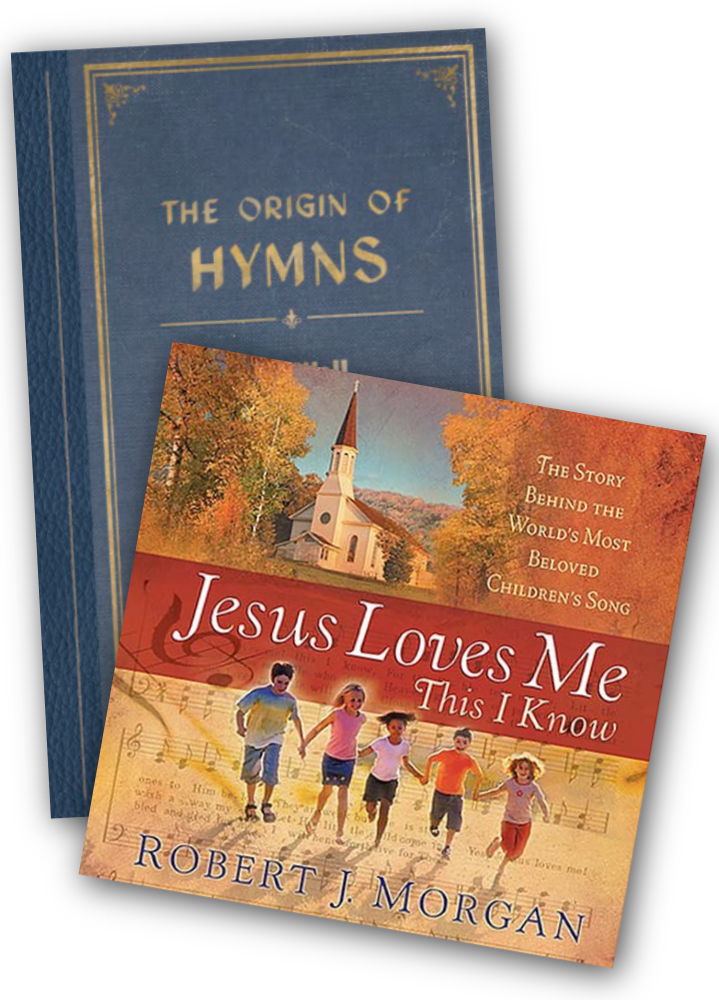
Recently I was pleased to receive a new printing of my book, Jesus Loves Me, which has now been released as a beautifully-illustrated paperback (if you’d like to purchase a copy you can click this link).  Perhaps it’s the cover, but many people assume this book is for children.  Well, children will enjoy it; but it’s really an adult book — a biography of two remarkable sisters named Anna and Susan Warner.

As children, the Warner girls watched their family’s wealth evaporate in the financial collapse of 1837.  Losing their mansion in New York City, the family was forced to move into a ramshackled house on the Hudson River, across from the Military Academy at West Point.  There the girls grew up exploring, reading, and working the land.  They eventually realized their family was in perpetual debt, so they began writing and selling stories.  In time, Anna and Susan became two of the most popular writers of the Civil War era.

It was in one of their books they created the words to the hymn, “Jesus Loves Me.”  But today I’d like to share another hymn they wrote.  A beloved minister, Pastor Adams, told the sisters he was very weary, having preached three times that day, conducted Sunday School, led a prayer meeting and a class meeting, and cared for his people from early morning until late afternoon.  But, he said, it was one more day’s work for Jesus.  Shortly afterward, the sisters sent him awonderful poem and hymn.  Here is the first verse and chorus.  It speaks of our daily mission of serving Christ:

One more day’s work for Jesus,
One less of life for me!
But Heav’n is nearer, and Christ is clearer
Than yesterday, to me.
His love and light fill all my soul tonight.

One more day’s work for Jesus,
One less of life for me!

Share and Enjoy:
  • Twitter
  • Facebook
  • StumbleUpon
  • Technorati
  • Digg
  • del.icio.us
  • LinkedIn
  • Google Bookmarks
  • MySpace
  • email
  • Print

O the Deep, Deep Love of Jesus

August 6, 2009
Samuel Francis

Today I’m happy to report that I am finally finishing a book project that has taken much more of my time and energy than anticipated.  The working title is “A Hymn a Day.”  It’s a selection of hymns for daily devotions, based on dates connected in some way with the hymns or their authors or composers.  The release date is a year off, but here’s a sample  — the installment for November 19:

I find it fascinating and comforting that the love of Jesus is described as being cube-shaped in Ephesians 3:18, perfect on all its sides, infinite in all its dimensions—long, high, wide, and deep.  Drawing from this verse, Samuel Trevor Francis, who was born in England on November 19, 1834, makes the love of Christ real to us in this immortal hymn.  His vivid image came from his own background.  As a child, Samuel wrote poems and sang in the church choir; but as a young man he struggled with questions and considered drowning himself in the River Thames.  Then he was wonderfully changed by a personal experience of the love of Christ.  He eventually became a London merchant; but his real love was hymn-writing and open-air preaching, which occupied him all his life, until his death at age 92.

O the deep, deep love of Jesus, vast, unmeasured, boundless, free!
Rolling as a mighty ocean in its fullness over me!
Underneath me, all around me, is the current of Thy love
Leading onward, leading homeward to Thy glorious rest above!

O the deep, deep love of Jesus, spread His praise from shore to shore!
How He loveth, ever loveth, changeth never, nevermore!
How He watches o’er His loved ones, died to call them all His own;
How for them He intercedeth, watcheth o’er them from the throne!

O the deep, deep love of Jesus, love of every love the best!
’Tis an ocean full of blessing, ’tis a haven giving rest!
O the deep, deep love of Jesus, ’tis a heaven of heavens to me;
And it lifts me up to glory, for it lifts me up to Thee!

…that you, being rooted and grounded in love, may be able to comprehend with all the saints what is the width and length and depth and height—to know the love of Christ that passes knowledge, that you may be filled with all the fullness of God.—Ephesians 3:17-19

Share and Enjoy:
  • Twitter
  • Facebook
  • StumbleUpon
  • Technorati
  • Digg
  • del.icio.us
  • LinkedIn
  • Google Bookmarks
  • MySpace
  • email
  • Print

In Age and Feebleness Extreme

July 23, 2009

charles wesley I’m in Ohio at my denominational convention, but I’m a little distracted by a writing deadline and by sermon preperation.  Here’s a story I was working on tonight.  It’s about the very last of the 9000 hymns that came from the pen of Charles Wesley, the Sweet Singer of Methodism.

Charles started writing verses immediately upon his conversion and during his lifetime he composed nearly 9,000 hymns—probably more than anyone else in history.  His associate, Henry Moore, described him this way:  “When he was nearly eighty he rode a little horse, grey with age….  Even in the height of summer he was dressed in winter clothes.  As he jogged leisurely along, he jotted down any thoughts that struck him.  He kept a card in his pocket for this purpose, on which he wrote his hymn in shorthand.  Not infrequently he has come to our house in City Road, and, having left the pony in the garden in front, he would enter, crying out, ‘Pen and ink!  Pen and ink!’  These being supplied he wrote the hymn he had been composing.” 

Despite the incredible quantity of his hymns, there remained a depth of quality that astounds us today, with hymns like:  “And Can it Be,” “O, For a Thousand Tongues,” “Rejoice the Lord is King,” the Easter anthem “Christ the Lord is Risen Today,” and the Christmas carol “Hark!  The Herald Angels Sing.”  In addition, Charles joined his brother John in traveling from one end of Britain to the other as open-air evangelists and as founders of the Methodist movement. 

Charles’ last hymn was composed on Saturday, March 29, 1788, the day he died. 

In January of that year, he’d found himself too weak for even short rides.  In February, he’d been confined to bed.  He was in no pain and showed no signs of specific illness; he was just worn out physically.  On March 29, he composed this one-verse hymn, “In Age and Feebleness Extreme,” and, too weak to write it down, dictated it to his wife Sally.  He slipped into unconsciousness.  As his daughter Sarah held his hand, the great Charles Wesley caught a smile from God and dropped into eternity.

In age and feebleness extreme,
Who shall a helpless worm redeem?
Jesus, my only hope Thou art,
Strength of my failing flesh and heart:
O could I catch one smile from Thee,
And drop into eternity!

Share and Enjoy:
  • Twitter
  • Facebook
  • StumbleUpon
  • Technorati
  • Digg
  • del.icio.us
  • LinkedIn
  • Google Bookmarks
  • MySpace
  • email
  • Print

A Prayer for our Marriages

July 2, 2009

Today I’ve run across a rare hymn on the subject of marriage and family life.  Marriage was ordained by God at the beginning of history as the foundation of home life and social order, and it must remain so until the end of time.  This unusual hymn, “O Blessèd Home Where Man and Wife,” was written by a Norwegian Lutheran pastor named Magnus B. Landstad, who compiled a new hymnal that was authorized for use in Norway on October 16, 1869.  Though seldom sung in American churches, the first three stanzas are a powerful sermon about the home, and the closing stanza offers a fitting prayer for holiness and happiness in our family life today.  What a great hymn to sing or quote at weddings!

O blessèd home where man and wife
Together lead a godly life
By deeds their faith confessing!
There many a happy day is spent,
There Jesus gladly will consent
To tarry with His blessing.

If they have given Him their heart,
The place of honor set apart
For Him each night and morrow,
Then He the storms of life will calm,
Will bring for every wound a balm,
And change to joy their sorrow.

And if their home be dark and drear,
The cruse be empty, hunger near,
All hope within them dying,
Let them despair not in distress;
Lo, Christ is there the bread to bless,
The fragments multiplying.

O Lord, we come before Thy face;
In every home bestow Thy grace
On children, father, mother,
Relieve their wants, their burdens ease,
Let them together dwell in peace
And love to one another.

Share and Enjoy:
  • Twitter
  • Facebook
  • StumbleUpon
  • Technorati
  • Digg
  • del.icio.us
  • LinkedIn
  • Google Bookmarks
  • MySpace
  • email
  • Print

Oh, To Live Exempt From Care by the Energy of Prayer!

June 20, 2009

Poetry has fallen on hard times, especially sacred poetry with traditional rhythm and rhyme.  But take a moment to read this one from a couple of centuries ago.  Its author, Josiah Conder was born in London September 17, 1789.  At age five, an ill-fated inculcation for small-pox blinded him in one eye and he was treated by the new medical practice of electrical shocking.  It must have worked, because he went on to become a powerful writer, hymnist, journalist, abolitionist, and a layman in the Congregational Church of England.  One of his hymns provides a powerful lesson about not worrying about tomorrow, and it contains that great line (later the title of a famous devotional book, Daily Strength for Daily Needs).  Jesus taught us to take life one day at a time—step by step, day by day, and moment by moment.  Conder found the same lesson in the Lord’s commands to the Israelites to gather up only enough manna for the present day.  This is actually an old English hymn; you can hear the melody here.

Day by day the manna fell;
O to learn this lesson well!
Still by constant mercy fed,
Give me Lord, my daily bread.

“Day by day,” the promise reads,
Daily strength for daily needs;
Cast foreboding fears away;
Take the manna of today.

Lord! my times are in Thy hand;
All my sanguine hopes have planned,
To Thy wisdom I resign,
And would make Thy purpose mine.

Thou my daily task shalt give;
Day by day to Thee I live;
So shall added years fulfill,
Not my own, my Father’s will.

Fond ambition, whisper not;
Happy is my humble lot.
Anxious, busy cares away;
I’m provided for today.

Oh, to live exempt from care
By the energy of prayer:
Strong in faith, with mind subdued,
Yet elate with gratitude!

Share and Enjoy:
  • Twitter
  • Facebook
  • StumbleUpon
  • Technorati
  • Digg
  • del.icio.us
  • LinkedIn
  • Google Bookmarks
  • MySpace
  • email
  • Print

Faith is the Victory!

June 13, 2009

john henry yates Faith is the Victory!  If you have accident-prone children, take comfort in the story of John Henry Yates.  His parents had immigrated to New York State from England; and John was born in Batavia, New York, in 1837.  His dad was a shoemaker and a traveling temperance lecturer.  His mom was a school teacher who loved poetry and literature. 

On several occasions, John gave his parents reason for grave alarm.

  • On Election Day, 1844, he fell from a high set of stone steps in a hotel and tumbled down into the cellar, fracturing his skull.  It wasn’t certain he would come to, as he was unconscious a long time.  He kept the broad scar as a lifelong souvenir of the incident.
  • In 1847, when his family was traveling by ship, a storm struck so powerfully that young John was thrown across the deck, breaking his leg. 
  • At 16, John brought down the curtain on a school play when, during a dramatic scene, he accidently fell on an open double-edged knife, piercing his right lung.  For three weeks, his life hung on a thread.

He survived it all, however; and at age 18, he began helping his aged parents in the shoe business.  About the same time his mother persuaded him to start writing poetry, which was immediately published in the Batavia newspaper, and soon in Harper’s Bazaar and other national magazines.  Before long his ballads, poems, songs, and hymns were being recited and sung across America. 

Despite his newfound fame, Yates kept his day job in retail sales, first in shoes, then working in a hardware store and finally managing a popular department store.  Only later in life did he finally leave the retail business to work for the local newspaper.

All the while, John was preaching here and there.  Beginning in his late teens, he served as a lay preacher in the Methodist church.  For many years, he traveled through western New York State, preaching in churches of all denominations and sharing his faith in Jesus Christ.

That faith was severely tested in February of 1878, when his wife and two sons all died within the space of one week from an outbreak of diphtheria.  He eventually remarried and kept going, giving living illustration that our faith in the promises of God and in our Lord Jesus gives us overcoming victory.

In 1891, Yates agreed to write Gospel songs exclusively for the great Christian song director, Ira Sankey, who directed the evangelistic campaigns for D. L. Moody. Many of his hymns became popular favorites.  Yates also switched from the Methodists to the Free Will Baptists and began pastoring near Batavia.

He passed away on September 5, 1900, and this marker rests over his grave:  In Memory of the Poet-Preacher Rev. John H. Yates… Born 1837 / Died 1900…  Faith is the Victory, Oh, Glorious Victory, That Overcomes the World.

John’s house Washington Avenue at State Street in Batavia is now on the historic register and serves as the home of a quaint independently-owned bookstore — Present Tense Books and Gifts.

Here is John Yates’ most enduring hymn – Faith is the Victory

Encamped along the hills of light,
Ye Christian soldiers, rise.
And press the battle ere the night
Shall veil the glowing skies.
Against the foe in vales below
Let all our strength be hurled.
Faith is the victory, we know,
That overcomes the world.

His banner over us is love,
Our sword the Word of God.
We tread the road the saints above
With shouts of triumph trod.
By faith, they like a whirlwind’s breath,
Swept on o’er every field.
The faith by which they conquered death
Is still our shining shield.

Faith is the victory! Faith is the victory!
O glorious victory, that overcomes the world.

PS – Check out my books on the history of hymns here.

Share and Enjoy:
  • Twitter
  • Facebook
  • StumbleUpon
  • Technorati
  • Digg
  • del.icio.us
  • LinkedIn
  • Google Bookmarks
  • MySpace
  • email
  • Print
Newer Posts »