A Study of Romans 5:6-11
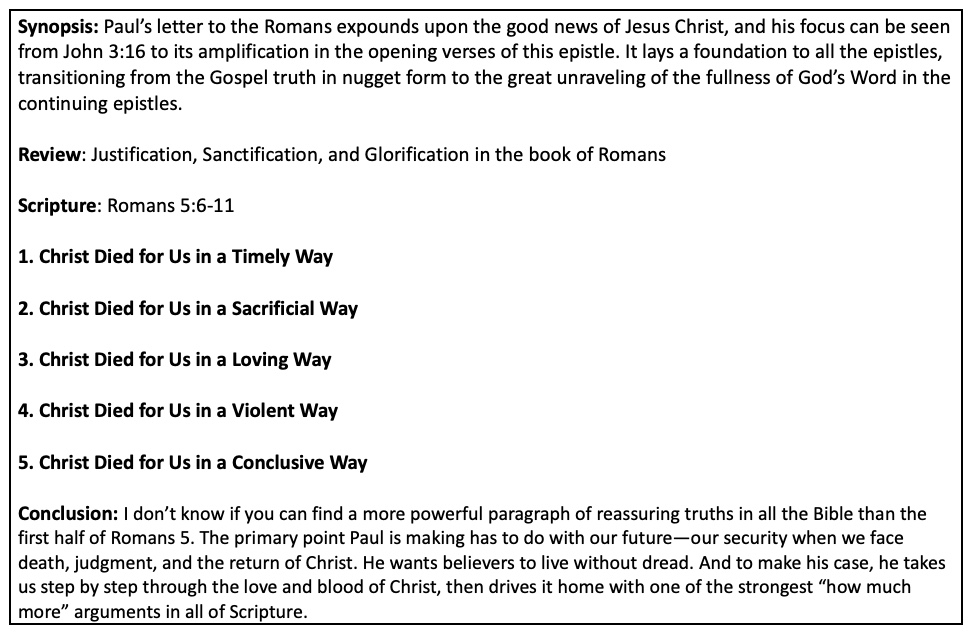
Review
Now, the theme of the book of Romans is the Gospel itself. The thesis statement is in Romans 1:16-17: “For I am not ashamed of the gospel, because it is the power of God that brings salvation to everyone who believes: first to the Jew, then to the Gentile. For in the gospel the righteousness of God is revealed—a righteousness that is by faith from first to last, just as it is written: “The righteous will live by faith.
So far in our studies of this incredible letter, we’ve followed the logic of the apostle Paul as he has dealt with the failure of men and women like us to live up to God’s standards of perfection and glory, which leaves us facing the wrath of His judgment. But then he says in Romans 3:21, “But now apart from the law the righteousness of God has been made known, to which the Law and the Prophets testify. This righteousness is given through faith in Jesus Christ to all who believe” (3:21-22).
Then having dealt with our failure and God’s offer of forgiveness in Romans 1 through 3, Paul highlights the concept of faith in Romans 4. He goes back to Abraham and tells us that even Abraham was saved by grace through faith. “Abraham believed God, and it was credited to him as righteousness” (Romans 4:3).
Now in chapter 5, Paul is dealing with our future. That’s a simplified outline of Romans, but it can help us, I think, follow the progress of Paul’s argumentation—failure, forgiveness, faith, and future. In our last Romans episode, we saw how Paul introduces this subject of what is ahead of us. We can review it by simply reading verses 1 through 5. These verses have become so therapeutic to me that I’ve memorized them.
Therefore, since we have been justified through faith, we have peace with God through our Lord Jesus Christ, 2 through whom we have gained access by faith into this grace in which we now stand. And we boast in the hope of the glory of God. 3 Not only so, but we also glory in our sufferings, because we know that suffering produces perseverance; 4 perseverance, character; and character, hope. 5 And hope does not put us to shame, because God’s love has been poured out into our hearts through the Holy Spirit, who has been given to us.
Having been justified, we boast about seeing the glory of God and about being glorified ourselves. We can accurately say there are three phases to our experience of salvation in Christ:
- Justification – This is what has already happened to us, as we saw in chapters 3 and 4. Because of the death of our Lord Jesus, we can receive His gift to us by faith—the gift of forgiveness of sins. All our sins are charged to Christ’s account, and all His righteousness is credited to our account. We are saved from the penalty of our sins.
- Sanctification is the next phase. We are being saved from the power of our sins. We are declared perfect in God’s sight through justification, but we are not perfect in our current lives. Our condition does not yet match our position. We are like a baby born to a king. We are officially a prince, but we have a long way to go before we can really assume the fullness of our rank. God is working with us, working on us, working in us, helping us to grow. We are being saved from the power of sin.
- Glorification will happen in its fullest way at the resurrection, when our bodies will rise from the ground, be transformed, be changed, take on their eternal nature, and be reunited with our souls. We will be fitted and equipped physically, mentally, spiritually, emotionally, and in every way for eternal life. We will be saved from the very presence of sin.
We have been saved from the penalty of sin; we are being saved from the power of sin; and we will be saved from the presence of sin. All of that is contained in the word salvation.
Glorification is what we are most looking forward to—we go around boasting in the hope of the glory of God. Let me read you Romans 5:2 from three different versions.
- The Contemporary English version says, “So we are happy, as we look forward to sharing in the glory of God.”
- The Expanded Bible says, “And we are happy [we rejoice; boast] because of the hope we have of sharing [or of experiencing] God’s glory.
- The J. B. Phillips Version puts this: “Through him we have confidently entered into this new relationship of grace, and here we take our stand, in happy certainty of the glorious things he has for us in the future.”
Between now and then we will pass through certain trials and sorrows, but even those will work out for our benefit.
Scripture – Romans 5:6-11
All of that brings us to the paragraph we’re going to study today—Romans 5:6-11. Let’s read it.
6 You see, at just the right time, when we were still powerless, Christ died for the ungodly. 7 Very rarely will anyone die for a righteous person, though for a good person someone might possibly dare to die. 8 But God demonstrates his own love for us in this: While we were still sinners, Christ died for us.
9 Since we have now been justified by his blood, how much more shall we be saved from God’s wrath through him! 10 For if, while we were God’s enemies, we were reconciled to him through the death of his Son, how much more, having been reconciled, shall we be saved through his life! 11 Not only is this so, but we also boast in God through our Lord Jesus Christ, through whom we have now received reconciliation.
The primary point Paul is making has to do with our future….
1. Christ Died For Us in a Timely Way
First, Christ died for us in a timely way. Verse 6 says: You see, at just the right time, when we were still powerless, Christ died for the ungodly. It’s a little difficult to know what was in Paul’s mind when he said, “at just the right time.” It seems to me the best possibility is that the exact, precise timing of the death of Jesus Christ had been precalculated from eternity past, and it occurred exactly on schedule. The apostle Paul devoted several verses in several different letters about this.
For example, Galatians 4:4 says, “But when the set time had fully come, God sent His Son, born of a woman, born under the law.” I’ve preached entire sermons about that verse, and how the coming of Jesus was timed to fall exactly into a propitious place in the history of the Jewish and Greco-Roman world. But there’s so much more to it, and much of it is beyond my comprehension. But this is a subject that fascinated the apostle Paul.
He said in 1 Timothy 2:5-6, “For there is one God and one mediator between God and mankind, the man Christ Jesus, who gave Himself as a ransom for all people. This has now been witnessed to at the proper time.”
Paul began his letter to Titus on this note, saying, “Paul, a servant of God and an apostle of Jesus Christ to further the faith of God’s elect and their knowledge of the truth that leads to godliness—in the hope of eternal life, which God, who does not lie, promised before the beginning of time, and which now at his appointed season he has brought to light through… preaching….”
Ephesians 1:9-10 says, “He made known to us the mystery of his will according to his good pleasure, which he purposed in Christ, to be put into effect when the times reach their fulfillment—to bring unity to all things in heaven and on earth under Christ.”
Here is 1 Corinthians 10:11: “These things happened to them as examples and were written down as warnings for us, on whom the culmination of the ages has come.”
The exact moment of the death of Jesus Christ—the very century, year, month, day, hour, and nanosecond—was the most carefully synchronized event in the entire sweep of the history of the vast universe. That tells us, of course, that God was absolutely determined to provide for the redemption of His people, His creation, His children when they were powerless to save themselves. You see, at just the right time, when we were still powerless, Christ died for the ungodly.
His death came at the right time for us all. It was the right time historically, and it was the right time spiritually for you and me.
2. Christ Died For Us in a Sacrificial Way
Second, Christ died for us in a sacrificial way. Verse 7 continues: Very rarely will anyone die for a righteous person, though for a good person someone might possibly dare to die.
Let’s put verses 6 and 7 together again: You see, at just the right time, when we were still powerless, Christ died for the ungodly. Very rarely will anyone die for a righteous person, though for a good person someone might possibly dare to die.
Someone might occasionally be willing to offer their lives for a good person, for a righteous person. But we were not good and righteous. We were ungodly. That makes the sacrifice of Jesus all the more stunning to us.
I think, by God’s grace, I might be willing to die for one of my children or grandchildren, but don’t ask me to die for Vladimir Putin. Don’t ask me to die for Kim Jong Un. Don’t ask me to die for Xi Jinping. There are among the most violent, ruthless, diabolical, murderous villains in the world today. I actually pray God will sweep them away with His judgment. Maybe I shouldn’t pray like that, but sometimes I take a cue from David’s imprecatory psalms when he prayed for his enemies.
But we were God’s enemies, yet Jesus sacrificed Himself for us. Why? Well, the next verse tells us.
3. Christ Died For Us in a Loving Way
Jesus died for us in a loving way. Verse 8 says: But God demonstrates his own love for us in this: While we were still sinners, Christ died for us.
Paul now brings the love of God to the forefront of the discussion. We usually lead with this, but Paul has said very little about God’s love so far in this letter. He began by addressing the Christians in Rome as people who “are loved by God.” But he said nothing more about God’s love in chapters 1, 2, 3, or 4. Now, here in chapter 5, he tells us the great motivating force that caused Jesus Christ to lay aside His glory, descend to the earth as a naked baby, grow up in poverty, and die at the hands of Roman soldiers. Behind it all was the love of God.
The love of God is greater far
Than tongue or pen can ever tell.
It goes beyond the highest star
And reaches to the lowest hell.
O love of God, how rich and pure!
How measureless and strong!
It shall forevermore endure—
The saints’ and angels’ song.
4. Christ Died For Us in a Violent Way
Fourth, Christ died for us in a violent way. Verse 9 begins: Since we have now been justified by his blood….
Jesus didn’t sink into a peaceful coma and pass away in a royal bedroom surrounded by friends and family. His body was torn apart, and the blood rolled down His body from His forehead, His back, His hands, His feet, and His side.
One of the best illustrations of this—maybe the very best literary illustration—is from C. S. Lewis’ novel, The Lion, The Witch, and the Wardrobe. You may know the story. The character, the boy Edmund is a traitor and has sided with the White Witch, betraying his siblings. The Witch rejoices in this and announces that Edmund now belongs to her. She cites what she calls the Deep Magic from the dawn of time, that every traitor belongs to her and she had the right to his blood.
But then the great lion, Aslan, steps forward and offers Himself in Edmund’s place. He says, “Take Me instead.” With great fanfare, the Witch has Aslan tied to the Stone Tablet and slain. She thinks she has won. But, as Lewis puts it, she did not know there was a Deeper Magic from before the dawn of time—that if a willing, innocent victim dies in the place of a traitor, death itself begins to work backward.
There is a true doctrine that says sin brings death and guilt demands judgment. But there is a deeper doctrine woven into the moral fabric of reality from before the dawn of time—that the shed blood of an innocent victim can atone for the sin of the guilty.
That’s why in the Garden of Eden, God slaughtered an innocent animal to provide clothing to cover the shame of Adam and Eve. That’s why Abel offered a lamb as a sacrifice for sin. That’s why the Passover Lambs were slain. That’s why Leviticus 17:11 says, “The life is in the blood,” and Hebrews 9:22 says, “Without the shedding of blood, there is no remission of sin.”
This is the deeper magic that Satan did not know, but has now been revealed to us in Scripture, and Romans 5:9 says, “We have now been justified by his blood….”
As far as I can tell from the Scripture, from the standpoint of cost and suffering, obtaining our justification was the most difficult thing God has ever done. He had no difficulty at all in creating the universe. He said, “Let there be light, and there was light.” It was easy for Him to part the waters of the Red Sea. It was a light lift for Him to bring Lazarus back from the dead. Simply a thought from His mind, a word from His mouth, or a touch of His finger, and great miracles unfold.
But providing salvation for guilty, traitorous humans was another matter. To do that, God Himself had to come down from Heaven, be supernaturally conceived in a human woman, be born in poverty, live a pure and righteous life in a dirty world, be stripped and flogged and suspended to wooden crossbeams by spikes in His hands and feet, and somehow die for us in a way that involved extreme loss of blood from His tortured body.
And can it be that I should gain
an interest in the Savior’s blood?
Died He for me, who caused His pain?
For me, who Him to death pursued?
Amazing love! How can it be
that Thou, my God, should die for me?
5. Christ Died For Us in a Conclusive Way
But now, as we continue verse 9, we are coming to Paul’s primary point in this paragraph. Christ died for us in a conclusive way. He died for us in a way that provides, insures, and guarantees our everlasting life with Him in the New Heavens, New Earth, and City of New Jerusalem. Paul wants us to be secure and unafraid of the future. He wants us to be assured. Verse 9 continues: Since we have now been justified by his blood, how much more shall we be saved from God’s wrath through him!
Remember that the body of the book of Romans begins with the subject of God’s wrath. He says in Romans 1:18, “The wrath of God is being revealed from heaven against all the godlessness and wickedness of people, who suppress the truth by their wickedness.” In Romans 2:5, he warned us against storing up wrath against ourselves in the day of God’s wrath by having a stubborn and unrepentant heart. We talked about the subject of God’s wrath. It isn’t a matter of God’s having a temper tantrum. It is His proper judicial response to evil. There are many preachers today and many hymnwriters who want to avoid or deny or overlook or water down this subject. But the apostle Paul never did. Perhaps his best description of God’s wrath is found in 2 Thessalonians, chapter 1, when he said this to the believers who were being abused and oppressed by their persecutors:
6 God is just: He will pay back trouble to those who trouble you 7 and give relief to you who are troubled, and to us as well. This will happen when the Lord Jesus is revealed from heaven in blazing fire with his powerful angels. 8 He will punish those who do not know God and do not obey the gospel of our Lord Jesus. 9 They will be punished with everlasting destruction and shut out from the presence of the Lord and from the glory of his might 10 on the day he comes to be glorified in his holy people and to be marveled at among all those who have believed. This includes you, because you believed our testimony to you.
In Romans 5:9, Paul is telling us that the return of Christ will not fill the believer with fear or dread. Why? Because if Jesus has already done the greatest work—shedding His blood to justify us—then He will certainly do the lesser work: glorifying us and bringing us safely home. Paul is using a “greater-to-lesser” argument.
Imagine I take you to the gym and introduce you to a man who can bench-press three hundred pounds. Then I ask him, “Could you hand me that ten-pound weight?” If he can lift three hundred pounds off his chest, handing me ten pounds is effortless. And if Christ has carried the crushing weight of our sin in order to justify us, then we can be sure He will carry us all the way into glory.
He goes on to restate this for emphasis in the next verse, verse 10: For if, while we were God’s enemies, we were reconciled to him through the death of his Son, how much more, having been reconciled, shall we be saved through his life!
We were God’s enemies, yet He brought us into a relationship of peace and friendship with Him. If He did that, He will most certainly save us from condemnation when He returns. If He justified us at the cost of His blood, how much more will He save us forever when He comes again through the process of glorification.
Let’s review the progression of Paul’s logic. He begins with our failure—that we are hopeless sinners. Then He talks about the forgiveness God offers us, and He goes on to describe the faith we can place in Christ for salvation. Now in chapter 5, he is talking about our future. We have the most exhilarating future that God Himself could possibly design for us, and that should remove all fear, all guilt, all shame, all sense of failure. The one who has justified us when we were enemies, how much more will He glorify us now that we are friends.
Conclusion
Now we come to Paul’s summary statement in verse 11 as he wraps up this paragraph of Romans: Not only is this so, but we also boast in God through our Lord Jesus Christ, through whom we have now received reconciliation.
Notice how the great apostle brings everything full circle. He began the chapter by saying, “Therefore, since we have been justified through faith, we have peace with God through our Lord Jesus Christ….” And he ends the paragraph by saying, we have “received reconciliation” through our Lord Jesus Christ. We have been reconciled to Him and have peace with Him. And as a result, we boast, we glory, we exalt, and we praise God.
I devoted several days of my Quiet Time to this paragraph, and I want to end by comparing verse 2 with verse 11.
In verse 2, Paul said, “We boast in the hope of the glory of God.” In verse 11, he said, “We boast in God.” It’s wonderful to rejoice and praise God because of our future hope, because of what He plans to do for us and with us in glory. But how much better to rejoice in Him alone, to focus on who He is and the immeasurable, unfathomable attributes that are displayed to us. Because of His infinite qualities, we have
- Peace with God with all its implications;
- Access to His grace in all its dimensions;
- Assurance of the future with all its glories;
- A new perspective on the difficult days and moments of suffering;
- We have His salvation cascading over our lives in three tenses—justification, sanctification, and glorification;
- We have a glimpse of how He demonstrated His love toward us in that while we were still sinners, Christ died for us;
- And we have the sustaining, uplifting knowledge that if He saved us while we were His enemies, He will most certainly welcome us into His eternal Kingdom now that we are His friends.
I don’t know if you can find a more powerful paragraph of reassuring truths in all the Bible than the first half of Romans 5. The primary point Paul is making has to do with our future—our security when we face death, judgment, and the return of Christ. He wants believers to live without dread. And to make his case, he takes us step by step through the love and blood of Christ, then drives it home with one of the strongest “how much more” arguments in all of Scripture.
Next time, we’ll look at the last paragraph of the chapter in which Paul explains all this again using one of the most unusual comparisons and contrasts in the Bible. He puts Adam and Jesus side by side and draws an amazing list of lessons. I hope you’ll join us then, and share this with others.
In the meantime, please go to my website, Robertjmorgan.com, and check out the links for my new book, The Origin of Hymns.
Thanks for digging into the riches of the Bible with me.