
A Study of Romans 6:1-14
Opening
Hello everyone! Are you dead to sin? Sometimes it doesn’t feel that way, does it? So why does the Bible speak in those terms? Let’s plunge into Romans 6 for the answer.
Introduction
This is our sixteenth session on the book of Romans, so let’s review. Paul begins this letter with a lengthy and eloquent prologue, then he spends 64 verses telling us we have all sinned and are facing the wrath of God. In chapter 3, verse 21, he breaks into the Good News, concisely explaining justification by grace through faith. In chapter 4, he expounds on the concept of being saved by faith using Abraham as an example, and in chapter 5 he tells us the benefits that come from this experience and explains that while we once belonged to the family of Adam, now we belong to the family of one man, Christ Jesus. Now in the first half of Romans 6, he is going to proceed to tell us that when we belong to the family of Christ, we have died to sin.
But what does Paul mean by that? Sometimes we don’t feel very dead to sin. Well, let’s read these verses to get the lay of the land, and then we’ll break it down—Romans 6:1-11.
Scripture
What shall we say, then? Shall we go on sinning so that grace may increase? 2 By no means! We are those who have died to sin; how can we live in it any longer? 3 Or don’t you know that all of us who were baptized into Christ Jesus were baptized into his death? 4 We were therefore buried with him through baptism into death in order that, just as Christ was raised from the dead through the glory of the Father, we too may live a new life.
5 For if we have been united with him in a death like his, we will certainly also be united with him in a resurrection like his.
6 For we know that our old self was crucified with him so that the body ruled by sin might be done away with, that we should no longer be slaves to sin— 7 because anyone who has died has been set free from sin.
8 Now if we died with Christ, we believe that we will also live with him. 9 For we know that since Christ was raised from the dead, he cannot die again; death no longer has mastery over him. 10 The death he died, he died to sin once for all; but the life he lives, he lives to God.
11 In the same way, count yourselves dead to sin but alive to God in Christ Jesus. 12 Therefore do not let sin reign in your mortal body so that you obey its evil desires. 13 Do not offer any part of yourself to sin as an instrument of wickedness, but rather offer yourselves to God as those who have been brought from death to life; and offer every part of yourself to him as an instrument of righteousness. 14 For sin shall no longer be your master, because you are not under the law, but under grace.
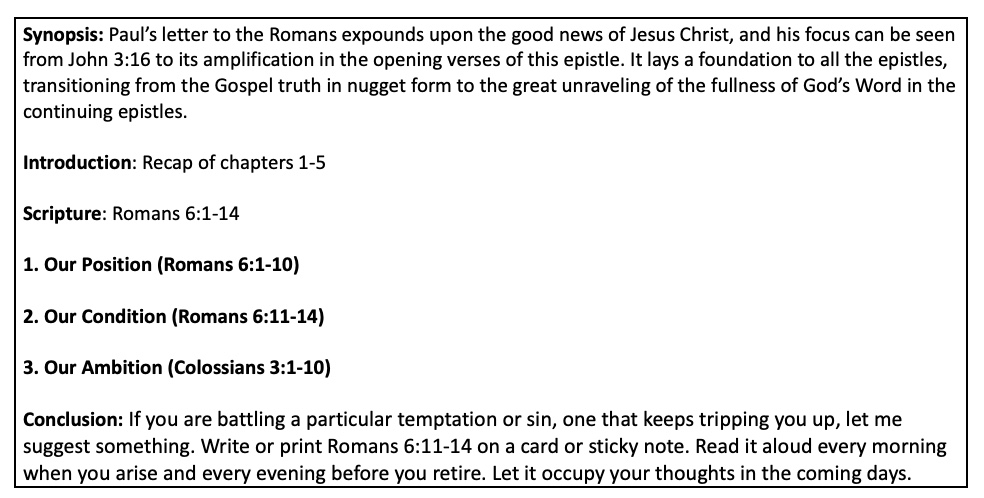
1. Our Position (Romans 6:1-10)
That’s the passage, and I come back to my primary question. What does the apostle Paul mean when he says we have died to sin? Years ago I heard a preacher speak about this in a sermon—I can’t remember who it was. But he said that a dead person is immune to temptation. Let’s say you have a man who is absolutely addicted to fried food. His doctor warns him to stay away from it. The man weighs far more than he should, but his weakness is fried food. He loves fried catfish, and fish and chips, and onion rings. He gorges himself on it and dies from a heart attack. There he is laying in the casket. You can run down to the diner and get a plate of fried chicken and French fries with all the aroma of mom’s kitchen. You could wave it in front of his nose, but he has no reaction. He is dead now to fried food. That’s the way it should be for those of us who are dead to sin.
That was his illustration, but it isn’t true to life. We know we are still vulnerable to temptation.
So if we have died to sin, why aren’t we dead to sin? What does Paul mean?
Correctly interpreted, what Romans 6 is telling us is invaluable to our spiritual progress. When we understand what Paul is saying, we have a much stronger grasp on what the Lord is doing in our lives. We have a stronger understanding of the victory He wants to give us. Dr. Douglas Moo and many other commentators believe that Paul is here beginning his topic of sanctification. Until now, he has been explaining the first phase of salvation—justification, or being saved from the penalty of our sins. Now he is going to talk about the second phase of salvation—sanctification, or being saved from the power of our sins.
Dr. Moo wrote, “Subduing the power of sin is the topic of Romans 6… The Christian’s freedom from sin’s tyranny or lordship dominates the entire chapter…. Paul makes clear that the new status enjoyed by the believer (justification) brings with it a new influence and power that both has led and must lead to a new way of life (sanctification).”
So let’s begin with verse 1, and notice that this verse links Paul’s argument with his previous paragraph. In Romans 5, he has told us that what Jesus did for us is much greater than the damage Adam inflicted on us. “Where sin increased,” he said, “grace increased all the more” (Romans 5:20). “Just as sin reigned in death, so also grace might reign through righteousness to bring eternal life through Jesus Christ our Lord” (Romans 5:21).
Now, some people were accusing Paul of preaching what theologians call antinomianism. That word comes from the prefix anti, or against, and nomos, the law. It’s the belief that now that we’re living under grace, we have no obligation to the law. That is, we don’t have to live by God’s moral law. We’ve been forgiven past, present, and future, so we can live however we want and it’s fine. In fact, the more we sin, the more God’s grace is actively involved in our lives. So let’s sin so that grace may abound.
Now, that may seem ludicrous to you. But remember the mindset of the early Christians, especially the early Jewish Christians who still valued the Jewish Law, the Torah, with its dietary regulations and its calendar and its rite of circumcision. Here Paul was saying that Christ has released us from the Law, so Gentiles don’t have to come to Christ through Judaism. They can bypass the Mosaic regulations and be saved simply by grace through faith. So they were accusing Paul of teaching that Christians no longer had to be obedient to God’s commands. They could live any way they wanted. Paul is going to address this.
What shall we say, then? Shall we go on sinning [shall we persist in sin? Shall we insist on continuing to sin?] so that grace may increase? By no means! We are those who have died to sin; how can we live in it any longer?
Paul does not say we are dead to sin, but that we died to sin—and the aorist tense of the verb indicates a once-for-all act in the past. Paul is building on the point he had made in the last chapter. He is saying, “We are dead to sin in the sense that we are no longer in Adam, but in Christ.” He is not saying we have already been glorified. He is not saying we are currently sinless. He is not saying we are immune to temptation. He is speaking of the once-for-all act of justification. We are no longer citizens of the realm of sin and death. Dr. Moo wrote, “Paul uses the language of ‘realm transfer….’ Believers are transferred from the realm in which sin rules.”
Dr. John Murray wrote, “What the apostle has in view is the once-for-all definitive breach with sin which constitutes the identity of the believer…. If we view sin as a realm or sphere, then the believer no longer lives in that realm or sphere…. The believer died to sin once and he has been translated to another realm.”
This is about a change in our position which will begin to show up as changes in our condition.
Look at the verse again: We are those who have died to sin; how can we live in it any longer? In other words, we have been delivered from the realm of sin and death, so it is not right for us to live any longer in a sinful lifestyle. It is no longer appropriate. It no longer fits who we are.
Paul goes on to explain this further in verses 3 and 4:
3 Or don’t you know that all of us who were baptized into Christ Jesus were baptized into his death? 4 We were therefore buried with him through baptism into death in order that, just as Christ was raised from the dead through the glory of the Father, we too may live a new life.
His primary reference here is not to water baptism. He is talking about the fact that our water baptism represents our spiritual baptism into Christ. The word “baptize” literally means “to plunge.” Think of plunging a dipper into a punch bowl, or of a diver plunging into the water. We have been plunged into Jesus Christ. Our old selves were crucified with Him on the cross, and we have new life because He came from the grave.
Water baptism illustrates this. It represents this. It is an outer symbol that signifies this internal change. When I was a student at Columbia International University, I attended the First Baptist Church where Dr. Edwin Young was the pastor. I noticed that every time he performed a baptism, he said some words. I had never heard this before at a baptism, but it made sense to me. When I became a pastor I continued his example. He would call the person’s name and say, as he baptized them, “Buried with Christ in death and raised to walk in newness of life.”
At the moment that person came to Christ, he or she was plunged into Jesus by the Holy Spirit. They were plunged into the salvation experience. And now, their water baptism was a visible symbol for all to see, representing the invisible work God had done in their hearts.
So when we are saved, we die to our life in Adam and we begin to live our new life in Christ. We were baptized into His death and raised to walk in newness of life. This is a description of our new position. Our new citizenship. Our new realm of reality and of life. Verse 5 continues:
5 For if we have been united with him in a death like his, we will certainly also be united with him in a resurrection like his.
Jesus died and rose to a new life. When we are saved, we die to our old life and are raised to live a new life, to live in newness of life. This is our spiritual resurrection. Once we were dead in sin, but now we’re alive in Christ. And one day, even our physical bodies will be resurrected just as His.
We were buried with Christ, and we are raised with Him. Being united with Him in His death implies our justification. Being united in His resurrection implies our “newness of life” and refers to our sanctification.
Dr. Murray wrote in his commentary: “The apostle is not dealing here with our physical death and resurrection; he is dealing with our death to sin and our resurrection to spiritual life, as is apparent from the preceding context and will become even more apparent in the verses that follow.”
What Paul is saying in verse after verse is that when we leave the family of Adam and join the family of Christ, we are delivered from the realm of sin and death and placed in the realm of newness of life. Paul now restates all of this in verses 6 and 7:
For we know that our old self [that is, who we were in Adam] was crucified with him so that the body ruled by sin might be done away with, that we should no longer be slaves to sin— 7 because anyone who has died has been set free [or justified] from sin.
We have been set free from sin’s penalty and sin’s power. We can still sin and we do still sin, but that sin is inappropriate for us because we’re no longer under its tyranny. We are no longer slaves to sin.
8 Now if we died with Christ, we believe that we will also live with him.
Let me paraphrase this: “Since who we were in Adam is now covered with the blood of Christ, our new selves can enjoy the power of Jesus both now and forever.”
Verse 9: For we know that since Christ was raised from the dead, he cannot die again; death no longer has mastery over him. 10 The death he died, he died to sin once for all; but the life he lives, he lives to God.
In other words, the death and resurrection of Christ changed Him completely. And it should change us completely too. We are no longer in Adam; we are in Christ. We are no longer living in the realm of the dead; we are living in the realm of the living. We are no longer facing the wrath of God; we are reigning in life through the grace of God. We have been saved from sin’s penalty, and we are progressively being saved from sin’s power. We can live in victory, for we have been raised with Christ to walk in newness of life.
As I understand it, that is what Paul has been saying in Romans 6:1-14. He is talking about our new position of being in union with Christ.
2. Our Condition (Romans 6:11-14)
But now in verses 11-14, he’s going to talk about our condition. He is going to say that we should be intentional that our daily spiritual condition corresponds to our eternal spiritual position. In other words, since we have died to sin by being removed from its penalty and power, we should live like that. Look at verse 11: In the same way, count yourselves dead to sin but alive to God in Christ Jesus.
The word “count” means to “realize, to reckon, to understand, to apprehend.” And the verb is in the present imperative—”keep on counting, keep on thinking in this way.”
Verse 12 says, “Therefore do not let sin reign in your mortal body so that you obey its evil desires. 13 Do not offer any part of yourself to sin as an instrument of wickedness, but rather offer yourselves to God as those who have been brought from death to life; and offer every part of yourself to him as an instrument of righteousness. 14 For sin shall no longer be your master, because you are not under the law, but under grace.
Now here we are beginning to understand. We are beginning to realize that even though we have been delivered from the realm of sin and death and judgment and wrath, and even though we are now in Christ, we can still allow sin to dominate our lives. We have to work hard to live up to our calling. We have to offer ourselves afresh every day to God. We have to decide that we’re going to live in victory over the temptations that still chase after us.
3. Our Ambition (Colossians 3:1-10)
And that brings us to our ambition. Paul made this same point in Colossians 3:1-10. He reminded the Colossians of their position in the first four verses:
Since, then, you have been raised with Christ, set your hearts on things above, where Christ is, seated at the right hand of God. 2 Set your minds on things above, not on earthly things. 3 For you died, and your life is now hidden with Christ in God. 4 When Christ, who is your life, appears, then you also will appear with him in glory.
And then he told them that if they had really died with Christ and been raised with Him through salvation, they should stop some sinful practices in their lives: Verse 5 says, “Put to death, therefore, whatever belongs to your earthly nature: sexual immorality, impurity, lust, evil desires and greed, which is idolatry…. You used to walk in these ways, in the life you once lived. But now you must also rid yourselves of all such things as these: anger, rage, malice, slander, and filthy language from your lips. 9 Do not lie to each other, since you have taken off your old self with its practices 10 and have put on the new self, which is being renewed in knowledge in the image of its Creator.”
Conclusion
In other words, Paul is not preaching a doctrine of sinless perfection. He is simply saying that sin is not appropriate for the Christian. It is not appropriate for us to have sex outside the boundaries of a covenant marriage between a man and a woman. It’s not appropriate or right for a Christian to indulge in impurity and pornography. It’s not in keeping with our new life in Christ to let our lust for sex lead us into sin. It’s no longer appropriate to lose our tempers, fly into rages, slander others, or use filthy language. Our new way of life doesn’t include lying to each other. We have a new ambition now—to walk in newness of life and live in consistent victory over known sin through the power of the indwelling Holy Spirit.
That is the first half of Romans 6. The second half is much the same except that the metaphor changes—and we’ll look at that in our next episode. In the meantime, if you are battling a particular temptation or sin, one that keeps tripping you up, let me suggest something. Write or print Romans 6:11-14 on a card or sticky note. Read it aloud every morning when you arise and every evening before you retire. Let it occupy your thoughts in the coming days:
Therefore do not let sin reign in your mortal body so that you obey its evil desires. Do not offer any part of yourself to sin as an instrument of wickedness, but rather offer yourselves to God as those who have been brought from death to life; and offer every part of yourself to him as an instrument of righteousness. For sin shall no longer be your master, because you are not under the law, but under grace.