
A Study of Romans 6:15-23
Opening: Hello everyone. Many years ago, it was actually in 1943, a well-known preacher came into the vestry of Westminster Chapel in London and asked Dr. Martin Lloyd-Jones when he was going to preach a series of expository sermons on the epistle to the Romans. Dr. Lloyd-Jones answered, “When I have really understood chapter 6.”
Romans chapter 6 is not an easy chapter to understand. But we can say this: It clearly falls into two sections, each of which begins with a similar rhetorical question. The first section tells us we have died to sin and are alive to Christ. And the second section tells us that we have been set free from the bondage of sin and we are now servants and slaves of God.
Scripture
15 What then? Shall we sin because we are not under the law but under grace? By no means! 16 Don’t you know that when you offer yourselves to someone as obedient slaves, you are slaves of the one you obey—whether you are slaves to sin, which leads to death, or to obedience, which leads to righteousness? 17 But thanks be to God that, though you used to be slaves to sin, you have come to obey from your heart the pattern of teaching that has now claimed your allegiance. 18 You have been set free from sin and have become slaves to righteousness.
19 I am using an example from everyday life because of your human limitations. Just as you used to offer yourselves as slaves to impurity and to ever-increasing wickedness, so now offer yourselves as slaves to righteousness leading to holiness. 20 When you were slaves to sin, you were free from the control of righteousness. 21 What benefit did you reap at that time from the things you are now ashamed of? Those things result in death! 22 But now that you have been set free from sin and have become slaves of God, the benefit you reap leads to holiness, and the result is eternal life. 23 For the wages of sin is death, but the gift of God is eternal life in Christ Jesus our Lord.
Five Steps
Romans 6 divides into two parallel sections—verses 1 – 14 and verses 15-23. They both address the same subject. Let’s compare verse 1 with verse 15.
- Verse 1 says: What shall we say? Shall we go on sinning that grace may increase?
- Verse 15 says: What then? Shall we sin because we are not under the law but under grace?
The issue Paul is confronting in both paragraphs is this—if we do not have to adopt the Jewish law to be saved and if we are not saved by keeping the law, what will constrain our behavior? If we have grace and more grace, why not just sin more and more?
- In verses 1-14, Paul tells us we died to sin and are now alive to Christ.
- In verses 15-23, he tells us we have been set free from the slavery of sin and have become slaves of God.
He is basically dealing with the same subject, but he approaches it using two different kinds of illustration in order to drive home the point. In this second paragraph, I believe I can follow Paul’s logic here by breaking it down in five steps.
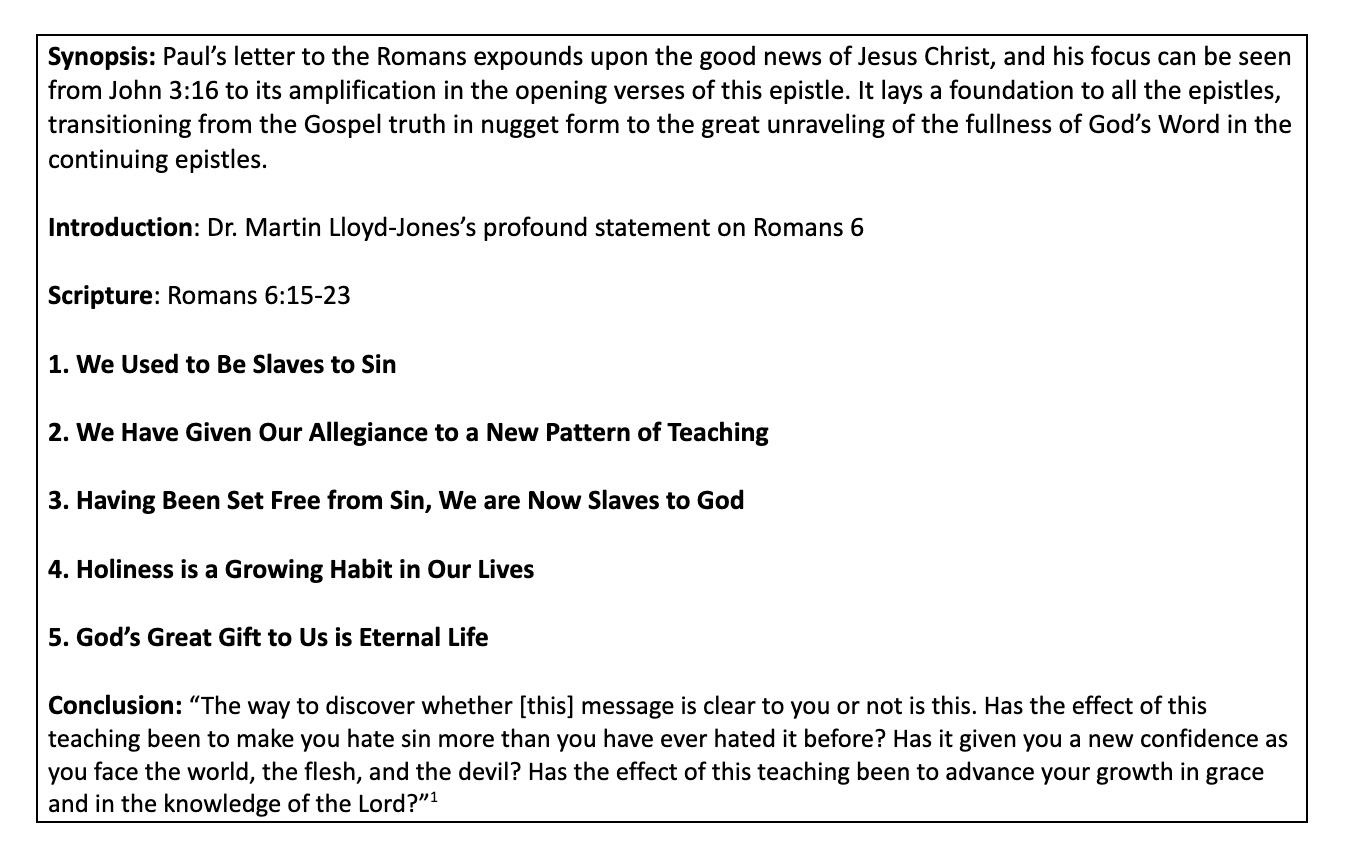
1. We Used to be Slaves to Sin (Verses 16-17)
First, he tells us we used to be slaves to sin. Look at verses 16 and 17: Don’t you know that when you offer yourselves to someone as obedient slaves, you are slaves of the one you obey—whether you are slaves to sin, which leads to death, or to obedience, which leads to righteousness? But thanks be to God that, though you used to be slaves to sin….
Every one of us who knows Christ as Savior used to be a slave to sin. We inherited Adam’s sinful nature, and sinning came to us naturally. Before we came to Christ, we might have thought we were making our own choices, but sin was setting the agenda.
One example today is the wave of sin and shame that engulfed anyone who ever knew Jeffrey Epstein. He was born in Brooklyn about the same time I was born in Tennessee. His parents were Jewish. His mother was a school aide and his father was a gardener for the New York City Parks. Epstein excelled in math, and his teachers liked him because he was smart and always smiling. He was a gifted pianist. He began teaching math in Manhattan, but he was caught making inappropriate advances toward the female students. He landed on Wall Street and managed to pull in wealthy clients. For decades, he engaged in disgusting and illegal and repulsive behaviors, and even had his own secret fantasy island. Everyone who ever associated with him is now disgraced and discredited. Here was a man enslaved to every vile passion imaginable, and he drew others into his filth. He was not controlling anything. His sinful passions were controlling him—all the way to his suicide or murder in a New York jail.
I hope to never know anyone so vile, but there’s a problem with that. Without Christ, I, too, am enslaved with sin. One day it might be my temper erupting at a loved one. Another day it might be an addiction, causing me to do something self-destructive. Another day, it might be a secret habit, a bitter feeling toward someone, a spell of unbridled anxiety, or a tendency to spend money I don’t have. I might become a work-driven achiever who measures my worth by productivity.
But when you and I found Christ, we found freedom from being enslaved by sin.
This is what Paul told the Corinthians in 1 Corinthians 6:9-11: “Do not be deceived: Neither the sexually immoral nor idolaters nor adulterers nor men who have sex with men nor thieves nor the greedy nor drunkards nor slanderers nor swindlers will inherit the kingdom of God. And that is what some of you were. But you were washed, you were sanctified, you were justified in the name of the Lord Jesus Christ and by the Spirit of our God.”
We once were slaves to sin. But then something happened. We have now given our allegiance to a new pattern of teaching.
2. We Have Given Our Allegiance to a New Pattern of Teaching
Verse 17 says: But thanks be to God that, though you used to be slaves to sin, you have come to obey from your heart the pattern of teaching that has now claimed your allegiance.
Paul used this phrase one other time, in 2 Timothy 1:13. He said, “What you have heard from me, keep as the pattern of sound teaching, with faith and love in Christ Jesus.” He is talking essentially about the message of the Gospel. It’s the Gospel that has the power to break the bondage of sin. He is talking about the very truths he is outlining here in Romans.
As I prepared this message, I read the testimony of a woman named Kathy Ireland. She was one of the world’s top supermodels. She had one of the most recognized faces in America. She was on the cover of Sports Illustrated, and she starred in multiple films and built a business empire. But one day she was alone in a Paris apartment, and she opened her suitcase and saw that her mother had packed a Bible along with her clothes. Kathy had never read the Bible before, but she opened it to Matthew and began reading. It took a while for the message of the Gospel to really grip her, but once it did it set her free.
Today Kathy is a mother and grandmother who leads a weekly Bible study. She said that she learned to have her morning Quiet Time by setting her alarm 15 minutes earlier. But, she said, “That 15 minutes [has become] an hour.”
She said, “Our lives come in seasons. Sometimes we have to say no to good things to say yes to great things. Even in business, there’s been betrayal. There’s been misplaced trust. But God is my boss. His word is my Plumb line. Being in the modeling industry, I saw how fickle it was, and our outward appearance is temporary. I didn’t want to earn a living on how someone else thought that I looked. That’s not my identity. I hope whatever I do points others to Jesus. That’s why I’m here another day.”
Kathy was in a profession known for its superficial and compromising aspects, but notice what set her free. It wasn’t self-improvement or success or money. It was the Gospel itself!
3. Having Been Set Free from Sin We Are Now Slaves to God
So we were once slaves to sin, but now we have given our allegiance to a new pattern of teaching—the Gospel. And that brings us to the third step in this passage. Having been set free from sin, we are now slaves to God. Being saved involves a complete change of ownership. Paul states this in three ways.
First, he tells us we are slaves to obedience. Verse 16 says, Don’t you know that when you offer yourselves to someone as obedient slaves, you are slaves of the one you obey—whether you are slaves to sin, which leads to death, or to obedience…?
Second, verse 18 says, You have been set free from sin and have become slaves to righteousness. And he goes on to repeat this in verse 19: I am using an example from everyday life because of your human limitations. Just as you used to offer yourselves as slaves to impurity and to ever-increasing wickedness, so now offer yourselves as slaves to righteousness leading to holiness.
Third, we are slaves to obedience, to righteousness, and ultimately to God. Verse 22 says, But now that you have been set free from sin and have become slaves of God….
Now, I know that sounds harsh to our modern ears with our understandable revulsion to slavery. But notice how Paul says in verse 19, “I am using an example from everyday life because of your human limitations.” He was saying, “This is an illustration. It is one way of describing our relationship with God. It’s true He is our Creator; He is our Redeemer; He is our Heavenly Father; He is our King; He is our Maker, Defender, Redeemer, and Friend.
But He is also the Master who liberated us from the tyranny of sin, and He calls us to serve and obey Him. The apostle Paul called himself a doulos or servant or slave of God at the beginning of Romans, Philippians, and Titus. He referred to himself in this way in Galatians 1:10.
Dr. Murray J. Harris wrote an entire book about this. He wrote, “‘Freedom in slavery’ is an unsettling yet exquisite Christian paradox, comparable to that other quintessential Christian paradox, strength in weakness. Just as the Christian’s strength comes to its zenith of perfection in the ‘weakness’ of acknowledged dependence on God, so the Christian’s freedom finds its consummation in exclusive and wholehearted devotion to Christ and His people…. So then, in true Christian liberty, freedom from is immediately succeeded by freedom for. We are set free from slavery to sin precisely in order to be free to choose slavery to Christ, a slavery of perfect freedom.”
He went on to say, “In the New Testament the two notions, slavery and freedom, are presented not as mutually exclusive but as potentially complementary ideas. Christians have been freed from their natural slavery to sin so that they may embrace slavery to righteousness, a slavery in which true freedom reaches its zenith.”
Dr. Lloyd-Jones says something similar: “A Christian is, in a sense, a slave; but he is not a slave in the same sense as he was before. There is a difference…. This is a paradox, the paradox of the Christian faith and the entire Christian position. The Christian is not a free man, he is a man who so to speak is under the tyranny of love. He says the love of Christ constrains me.”
In other words, being a slave to righteousness, to obedience, and to God simply means that the Gospel has freed us from the dictatorship to our sin and shame and addictions and self-destructive impulses. He has delivered us from all this so that we might serve Him, obey Him, and give Him our devotion. Who wouldn’t want that exchange?
4. Holiness is a Growing Habit in our Lives
The fourth step in the progress of this passage is this—we are growing in holiness. Holiness should be a growing habit in our lives. We were growing in sinfulness, more entrenched, more devious in our sinfulness and in the death that it brings. But that changed when we pledged our allegiance to a new pattern of teaching and became slaves to a wonderful Master. Now we are growing in the right direction, growing in wisdom and maturity and happiness, and holiness. Look at how this is stated in the passage.
Verse 19 says, Just as you used to offer yourselves as slaves to impurity and to ever-increasing wickedness, so now offer yourselves as slaves to righteousness leading to holiness.
And again in verse 22: But now that you have been set free from sin and have become slaves of God, the benefit you reap leads to holiness….
Over the past few months I’ve been reading a book entitled Rediscovering Holiness in my Daily Quiet Time. I only read a paragraph or maybe a page at a time. It’s by J. I. Packer, and this is what he says:
Holiness begins with the heart. Holiness starts inside a person, with a right purpose that seeks to express itself in a right performance. It is a matter not just of the motions that I go through but also of the motives that prompt me to go through them. The holy person’s motivating aim, passion, desire, longing, aspiration, goal, and drive is to please God, both by what one does and by what one avoids doing.
I cannot produce true holiness from the outside in but from the inside out. Someone may give me a list of rules to follow, and I may try to follow them. We all know that rules have their place. But we don’t develop holiness by keeping a list of rules. It’s the Holy Spirit working within us that produces both the will and the ability to do God’s good pleasure. We have to work on it; that’s true. Peter told us that God has given us everything we need for a godly life; but that we must make every effort to grow in godliness (see 2 Peter 1:3-8). But it all begins when we realize we are slaves to God.
5. God’s Great Gift to Us is Eternal Life
And that leads us to our final summarizing point—God’s great gift to us is eternal life. Romans 6:22-23 says: But now that you have been set free from sin and have become slaves of God, the benefit you reap leads to holiness, and the result is eternal life. For the wages of sin is death, but the gift of God is eternal life in Christ Jesus our Lord.
We often say that John 3:16 is the Gospel in a nutshell, but we can say Romans 6:23 is the book of Romans in a nutshell. I’ve used this verse to lead people to faith in Christ because every element of the Gospel is there—sin and its wages; death; God’s gift; eternal life; and the importance of naming Jesus Christ as Lord.
Conclusion
Dr. Martyn Lloyd-Jones said in his lectures on this chapter that if we grasp Romans 6, it should have a profound effect on us. The first half of the chapter talks about how we have died to sin and have become alive to Christ. The last half of the chapter talks about how we are no longer enslaved to sin; we are slaves of God.
“The way to discover whether [this] message is clear to you or not is this. Has the effect of this teaching been to make you hate sin more than you have ever hated it before? Has it given you a new confidence as you face the world, the flesh, and the devil? Has the effect of this teaching been to advance your growth in grace and in the knowledge of the Lord?”
I believe this is a chapter that I need to read and study on a regular basis. It takes a lifetime to grasp the depth of what it means that we have died to sin; we are now walking in newness of life; we are no longer slaves to sin, but we are slaves to Christ—but it is a servanthood of love and life that extends throughout this life and forever in eternity.
It’s really summed up in that wonderful little children song “Jesus Loves Me, This I Know.” The words of that song were written by two sisters, Anna and Susan Warner, who lived on Constitution Island across the Hudson River from the Military Academy at West Point. Some years ago I visited West Point and researched the history of the Warner sisters and wrote their story in a little book called Jesus Loves Me. It’s one of the most beautifully illustrated books I’ve ever written with pictures from their home. For years, this book has been sold at the museum for the Warner sisters on Constitution Island. When the gift store there ran out of copies we realized the book was out of print, and we commissioned a new printing. We shipped a quantity of these books to West Point, but we also kept a fresh inventory for you.
This would be a great gift to give to anybody, young or old. You can find information about it on my website at robertjmorgan.com.