A Study of Romans 4:18-25
Introduction
I want to begin and end this message by quoting from a couple of books that have had a lasting impact on me. The first quotation will give the principle I want to articulate in this sermon, and at the end of the message I’ll give you a powerful story from another book that illustrates this. So that is the scheme we’ll follow. First, a quotation from Knowing God by J. I. Packer. Then we’ll dive into the last part of Romans 4. Then we’ll end with a story from the autobiography of Dr. David Thompson, which is titled On Call.
The J. I. Packer quote is one I’ve shared before. There have been few times in my life in which I read something in a book that seriously advanced my thinking and my Christian faith. I will never outlive what Dr. Packer wrote in his chapter about God’s truthfulness.
In the days when the Bible was universally acknowledged in the churches as “God’s Word written,” it was clearly understood that the promises of God recorded in Scripture were the proper, God-given basis for all our life of faith, and that the way to strengthen one’s faith was to focus it upon particular promises that spoke to one’s condition.
Latter-day Puritan Samuel Clarke, in the introduction to his Scripture Promises; or, the Christian’s Inheritance, A collection of the Promises of Scripture under their proper heads, wrote as follows: A fixed, constant attention to the promises, and a firm belief of them, would prevent solicitude and anxiety about the concerns of this life. It would keep the mind quiet and composed in every change, and support and keep up our sinking spirits under the several troubles of life. . . . Christians deprive themselves of their most solid comforts by their unbelief and forgetfulness of God’s promises. For there is no extremity so great, but there are promises suitable to it, and abundantly sufficient for our relief in it. A thorough acquaintance with the promises would be of the greatest advantage in prayer. With what comfort may the Christian address himself to God in Christ when he considers the repeated assurances that his prayers shall be heard! With how much satisfaction may he offer up the several desires of his heart when he reflects upon the texts wherein those very mercies are promised! And with what fervor of spirit and strength of faith may he enforce his prayers, by pleading the several gracious promises which are expressly to his case!
When I read that paragraph, I began to understand that the Christian life was a life of faith; that our disposition and attitude and responses were to be grounded on the promises of God; and that faith was not simply an abstract word. It was living as though every situation of life was known in advance to God and that He had given us certain promises for every circumstance. And that faith was being fully persuaded that God would do as He had promised.
Where did the Puritans learn this? Where did Samuel Clarke learn it? Where did J. I. Packer learn it? Where do you and I come to grips with the power of a life of faith? It’s in the last part of Romans, chapter 4. We sometimes say, and rightly so, that Hebrews 11 is the “Faith Chapter” of the Bible. But we can call the passage we’re coming to in Romans the “Faith Paragraph” of the Bible. Let’s read Romans 4:18-25:
18 Against all hope, Abraham in hope believed and so became the father of many nations, just as it had been said to him, “So shall your offspring be.” 19 Without weakening in his faith, he faced the fact that his body was as good as dead—since he was about a hundred years old—and that Sarah’s womb was also dead. 20 Yet he did not waver through unbelief regarding the promise of God, but was strengthened in his faith and gave glory to God, 21 being fully persuaded that God had power to do what he had promised. 22 This is why “it was credited to him as righteousness.” 23 The words “it was credited to him” were written not for him alone, 24 but also for us, to whom God will credit righteousness—for us who believe in him who raised Jesus our Lord from the dead. 25 He was delivered over to death for our sins and was raised to life for our justification.
Background
The apostle Paul here is harkening back to the story of Abraham in the book of Genesis. God waited until Abraham was 75 years old to call him to the Land of Canaan and to give him a promise that he would become a father. Abraham and his wife Sarah were in their seventies, and they had never had children. They had wanted to become parents, but no children had ever come. Then when Abraham was 75 the Lord appeared to him and said, “I will make you into a great nation…” (Genesis 12:1-4).
“Wonderful!” Abraham must have thought. “I’m going to be a father after all. Who would have thought?”
But five or so years passed. Sarah wasn’t getting any younger, nor was Abraham. In Genesis 15, we have the next stage in this saga:
After this, the word of the Lord came to Abram in a vision: “Do not be afraid, Abram. I am your shield, your very great reward.”
2 But Abram said, “Sovereign Lord, what can you give me since I remain childless and the one who will inherit my estate is Eliezer of Damascus?” 3 And Abram said, “You have given me no children; so a servant in my household will be my heir.”
4 Then the word of the Lord came to him: “This man will not be your heir, but a son who is your own flesh and blood will be your heir.” 5 He took him outside and said, “Look up at the sky and count the stars—if indeed you can count them.” Then he said to him, “So shall your offspring be.”
6 Abram believed the Lord, and he credited it to him as righteousness.
This is the passage Paul is referring to in Romans 4. Even after this, Abraham still didn’t have a son at the age of 99! Genesis 21:5 says, “Abraham was a hundred years old when his son Isaac was born to him.” There was a quarter century of waiting, but Abraham trusted God. Now with that as background, let’s dive into our passage in Romans. I want to show you four descriptions of Abraham’s faith.
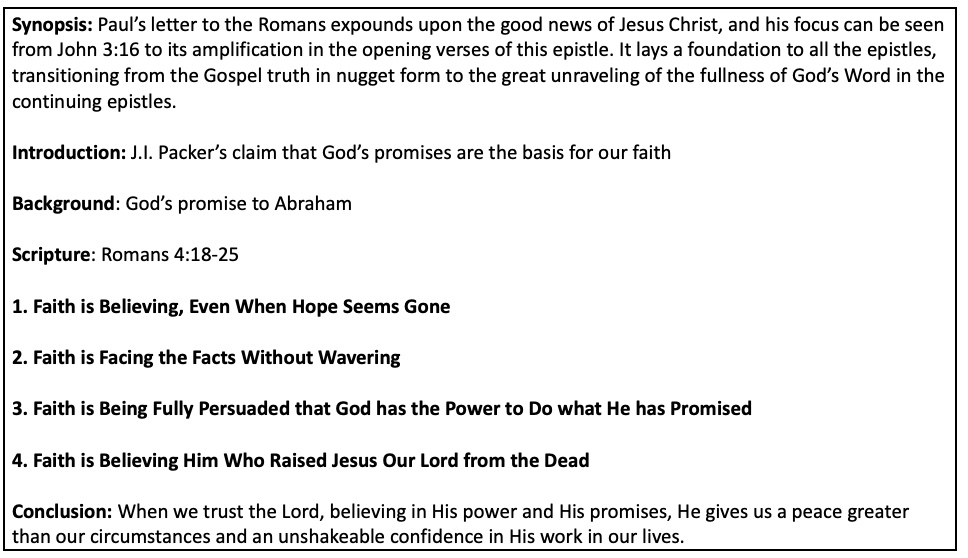
1. Faith is Believing Even When Hope Seems Gone
Look at verse 18: Against all hope, Abraham in hope believed and so became the father of many nations, just as it had been said to him, “So shall your offspring be.”
Faith is believing even when hope seems gone. Now, it’s important to remember that we aren’t talking about human hope here. We aren’t talking about wishful thinking or wistful thinking. Abraham did not say, “Well, Sarah and I may be up in years, but we’re not going to give up. I may be a hundred years old, but, by golly, I’m going to stay positive.”
He was saying, “What I am hoping for is impossible. But God has given me a specific promise, and nothing is impossible for Him. So I am going to place my utter faith in Him, knowing God is as good as His promise; and His promise is as good as He is.
The hope that connected itself with Abraham’s faith was based on a specific promise God had given him. Luke Garrett, with his incredible voice, used to sing: “His Word will stand; His Word will stand, though stars should fall and mountains turn to sand.”
And God honored his faith. In fact, Abraham could not possibly have understood the far-reaching ways in which God would keep His promise. It seemed hopeless that Abraham at the age of one hundred and Sarah at the age of ninety could have a child. But God did not just promise them a son. He told them their descendants would be like the stars of the sky. So Abraham, against all hope, believed. And so Isaac was born. And from Isaac came Jacob. And from Jacob came the twelve tribes of Israel. And from the twelve tribes of Israel came millions who still inhabit the land of Israel today. And from the descendants of Abraham came the Messiah, and from the Messiah came the church—and that includes you and me. The cascading floodwaters that flowed from Abraham are still gushing through the world; and here we are, still talking about a specific nomadic man who lived 4,000 years ago, who against all hope, in hope believed and so became the father of many nations, just as it had been said to him, “So shall your offspring be.”
You may have a situation in your life that seems hopeless. Your dreams, your longings, seemed to have turned to dust. But God has given us promises in the Bible. Those promises are the foundation for our entire life of faith, and faith is the foundation for our hope, for our optimism.
Years ago, when I was facing a crisis, I found a quotation in a book. I can no longer remember its source, but the quotation said, “Faith takes the most optimistic view of any situation.”
Is there a situation in your life right now that needs optimism? Take into account one of God’s promises, such as:
- Job 42:2, that God can do all things.
- Ephesians 1:11, that God works all things in conformity with the purpose of His will.
- Romans 8:28, that God works all things for the good of those who love Him.
- 1 Peter 4:11, so that in all things God may be praised through Jesus Christ.
2. Faith is Facing the Facts Without Wavering
So faith is believing even when all hope seems lost. Second, faith is facing the facts without wavering. Look at verses 19-20: Without weakening in his faith, he faced the fact that his body was as good as dead—since he was about a hundred years old—and that Sarah’s womb was also dead. Yet he did not waver through unbelief regarding the promise of God….
Recently I met a man named Tim Timmons, who is a wonderful Christian musician who co-wrote the song, “Even If.” His story is told in the upcoming movie, I Can Only Imagine 2. In the movie, Tim was invited to go on tour with MercyMe many years ago; and he went, though he had been diagnosed with incurable cancer. He found the passage in the Bible about Shadrach, Meshach, and Abednego, who refused to bow down to King Nebuchadnezzar and his statue. Nebuchadnezzar threatened to throw them in the furnace used for firing the bricks. They said, “King Nebuchadnezzar, we do not need to defend ourselves before you in this matter. If we are thrown into the blazing furnace, the God we serve is able to deliver us, and he will deliver us from his majesty’s hand. But even if he does not, we want you to know, Your Majesty, that we will not serve your gods or worship the image of gold you have set up.”
Tim took that as his own commitment. God is able to deliver me from this cancer, but even if he does not, I will still belong to Him alone.” Out of that he wrote the song, “Even If.” The chorus says:
I know You’re able and I know You can
Save through the fire with Your mighty hand
But even if You don’t
My hope is You alone
Amazing, Tim is still alive and still singing for and serving the Lord. But notice the kind of faith he has. He faced the fact that he might die. He did not have a verse of Scripture that said, “Tim, I am going to heal you of cancer and let you live to be as old as Abraham.” But Tim did believe God could heal him, and might heal him immediately. But even if He didn’t, his times are in God’s hands.
When Katrina was in her last days, we thought she was passing away in the hospital, but the Lord raised up and gave her another month. As I pushed her wheelchair into the house following that final hospital visit, we were both thinking of the very same Bible verse. We compared notes, and both of us were saying to ourselves, “Our times are in His hands.”
We have to face the fact that our lives on this earth are brief and full of trouble. And God is able to deliver us. But even if He doesn’t, our faith is in Him. Our hope is in Him.
Without weakening in his faith, Abraham faced the fact that his body was as good as dead—since he was about a hundred years old—and that Sarah’s womb was also dead. Yet he did not waver through unbelief regarding the promise of God….
3. Faith is Being Fully Persuaded that God Has the Power to Do What He Has Promised
Faith is believing even when hope seems gone. It is facing the facts without wavering; and third, it is being fully persuaded that God has the power to do what He has promised. That’s verbatim from verse 21, which says: …being fully persuaded that God had power to do what he had promised. This is why “it was credited to him as righteousness.”
Abraham wasn’t just persuaded. He was fully persuaded. Not half-heartedly. Not partially. He was fully persuaded. In my years of study, this is the best definition of biblical faith I have ever found in the Word of God.
A young man sat in my office one night this week. He said, “I had thought that God wanted me to start my own business, to go into business for myself and serve Him in that way. But recently, I’ve had the impression He might want me to prepare to serve him in professional ministry, as a pastor or something. I’m confused. I don’t know what to do.”
I quoted Proverbs 3:5 and 6 to him, verses I had previously asked him to memorize. “Trust in the Lord with all your heart and lean not unto your own understanding. In all your ways acknowledge Him and He shall direct your paths.”
I told him, “God has not promised to show you in the next six hours what you’ll be doing six years from now—or sixty. But He has promised to direct your path. If you feel confused, you’re not trusting that He has the ability to do that. You can take steps in both directions. As you take the next step or two or three, the Lord will increasingly help you know what He wants you to do. But you don’t have to anguish over the decision. This is one of the two or three most important decisions of your life—your vocation, your life’s work. It is inconceivable that the God who has promised to direct your paths would forget to do just that. Your job now is to trust in Him with all your heart, lean not unto your own understanding, and in all your ways acknowledge Him.” He will take it from there.
I could see a sense of understanding and relief come over the young man’s face.
In my new book, God Hasn’t Forgotten You, I remind my readers of what Elizabeth said to her younger niece, the virgin Mary, who came to visit her. She said, “Blessed is she who has believed that the Lord would fulfill His promises to her” (Luke 1:45).
We are people who are to be characterized by utmost persuasion. We’re to be fully persuaded that God will fulfill His promises to us. The apostle Paul, later in this book of Romans, said, “For I am persuaded that neither death nor life, nor angels nor principalities, nor things present nor things to come, nor height nor depth, nor any other created thing, shall be able to separate us from the love of God which is in Christ Jesus our Lord” (Romans 8:38-39 NKJV).
In his final known letter, Paul said, “For this reason I also suffer these things; nevertheless I am not ashamed, for I know whom I have believed and am persuaded that He is able to keep what I have committed to Him until that Day” (2 Timothy 1:12 NKJV).
’Tis so sweet to trust in Jesus,
And to take Him at His word;
Just to rest upon His promise,
And to know, Thus says the Lord!
Jesus, Jesus, how I trust Him!
How I’ve proved Him o’er and o’er;
Jesus, Jesus, precious Jesus!
O for grace to trust Him more!
4. Faith is Believing Him Who Raised Jesus our Lord from the Dead
So faith is believing even when hope seems gone. It is facing the facts without wavering; it is being fully persuaded that God has the power to do what He has promised; and finally it is believing in Him who raised Jesus our Lord from the dead. It is the resurrection of Jesus Christ that ratifies, confirms, insures, and authenticates the power of God to keep His promises.
Simon Peter wrote, “Praise be to the God and Father of our Lord Jesus Christ! In his great mercy he has given us new birth into a living hope through the resurrection of Jesus Christ from the dead, and into an inheritance that can never perish, spoil or fade. This inheritance is kept in heaven for you, who through faith are shielded by God’s power until the coming of the salvation that is ready to be revealed in the last time. ” (1 Peter 1:3-5).
Second Corinthians 1:20 says, “For no matter how many promises God has made, they are ‘Yes’ in Christ. And so through him the ‘Amen’ is spoken by us to the glory of God.”
Eugene Peterson paraphrases 2 Corinthians 1:20 in this way: “Whatever God has promised gets stamped with the Yes of Jesus.”
If Almighty God could keep His promise to Jesus Christ to raise Him from the dead, if He could take that tortured, disfigured, mangled, lifeless corpse, and in a moment of extraordinary power, revive and restore and reconstruct it into a glorified, imperishable, eternally alive person who would rise in the Heavens to be King of kings and Lord of lords… if He can do that—He can certainly take care of you in whatever difficulties you may face. We just have to learn to trust Him. Let me close with the story I promised at the beginning of this episode.
Conclusion
Recently I came across a collection of missionary biographies that included the memoir of missionary physician Dr. David Thompson. I’ve read a lot of missionary biographies in my life, but Dr. Thompson’s book began in a way that gripped my heart. His parents were serving as missionaries in Vietnam, and David was a pre-med student at Geneva College in Beaver Falls, Pennsylvania. It was 1968, a cold February morning. The college cafeteria was still nearly empty when David sat down for breakfast. Another student entered the cafeteria and came right to him, telling him there was an urgent, long-distance telephone call for him in the Dean’s office, and the Dean was holding the line open.
David went immediately to the Dean’s office, where the Dean and several faculty members had gathered. He picked up the phone. “Hello?”
“Hello, David? Is that you?”
“Yes.”
“David, this is headquarters in New York. I don’t know how to tell you this, but there has been heavy fighting in Vietnam over the Tet holidays. We have just received news that your mother and father have been killed by the communist forces.”
David felt a gray mist shroud his mind. He returned to his dormitory room and locked the door, and he kept asking one question over and over—why? Why?
He said, “As I wept alone in my college room, I heard God speak to me for the first time in my life. Although I did not hear a voice or audible words, I knew and understood what He was saying to me. ‘David, do you trust Me?’ What did that have to do with anything, I wondered. Of course, I trusted Him! Didn’t He know that I had given my life to Him and followed His ways obediently from the time I was five years old? Even as a child, had I not trustingly invited Him to live in my heart? As I waited, He spoke again. “’David, do you trust Me?’ What was I supposed to answer? I had already dedicated myself to serve Him as a missionary doctor.”
David had other things to consider too.
One further question remained in my mind: What would happen to my brothers and sisters? At 19, I was the oldest son. My sister Judy was one year older than I, but Dale was 16, Laurel was 11 and Tom was only eight. I understood that they had left [Vietnam] for the Mission boarding school in Malaysia only three days before the attack and were safe. Who would care for them now? Who would help them to understand why they could never go home again? I could not even talk to them, let alone comfort them as an older brother. What about it, Lord? How about some answers?
God answered me, but it was not what I wanted to hear. For the third time, He asked, “David, do you trust Me?” I understood what it was He wanted from me. It was impossible; it was heartless; it was unfair! How could God ask such a thing of anyone? I could not do what He asked. I would not! My mind, my emotions, my spirit rebelled. God wanted me to thank Him. No, I could never, never thank Him that my parents were lost to me. He was asking for the ultimate expression of my trust. There followed a great struggle in my heart. On the one hand I loved God and wanted to please Him in everything, but on the other hand, I was heartbroken over the loss of the two most precious people in my life. I could not conceive of any good coming out of their death. They had been in their mid 40s, at the peak of their effectiveness as missionaries. They had just learned Vietnamese, their fifth language, after English, French, Cambodian and Hmong. How did that make sense? Yet I knew that I did not have to understand God’s ways to accept them. I knew that if I did not surrender, I could not go on walking with the Lord in the same way as before.
There were many people praying for me that day. No doubt it was their prayers that brought me to the place where I finally surrendered. “Lord, I do not understand and I don’t feel any real thankfulness in my heart for what You allowed to happen to my parents and me. But because You ask, because I trust You, because I love You and because I know You really love me, I will thank You for letting this happen.”
Those were the hardest words I had ever spoken. Not really expecting anything to happen, I was surprised to feel peace pouring over my soul like a healing balm. To my amazement, the turmoil that moments before was tearing my heart apart began to abate. Something supernatural was happening. My parents were still dead. I was still alone in my room. My brothers and sisters and I were still orphaned and separated by oceans. But in my heart was a feeling that I can only describe as restful.
Dr. David Thompson went on to become a powerful and beloved missionary physician who only looks back in praise and forward in anticipation of what the Lord can do. He knows it will be worth it all when we see Jesus.