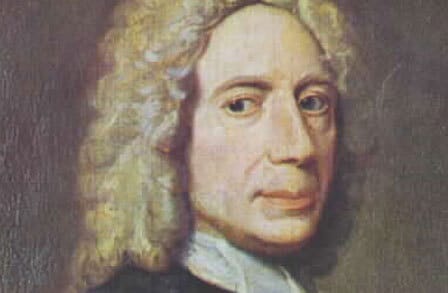
Watts the Child
Isaac Watts was born on a summer’s day in 1674 into an English family that was being persecuted for their faith. Isaac Watts Senior was a dealer in cloth and clothing. He and his wife, Sarah, were devout followers of Christ in Southampton, England, a harbor town about 80 miles southeast of London. They were dissenters, which meant they didn’t attend the State Church of England—the Anglican Church. They attended an independent or nonconformist church.
King Charles II was in power in those days, and he outlawed all church gatherings except the official State Church. Dissenting congregations like Baptists, Quakers, and Congregationalists were forbidden to meet. Those who did meet were persecuted, and Isaac Watts Sr. often found himself in jail, because he would not bow to the king’s demands.
Isaac Sr. was actually in jail when Isaac Jr. was born.
When Isaac Jr. was nine years old, his father was again oppressed. The boy wrote in his journal, “My father persecuted and imprisoned for non-conformity six months.”
During this time, Isaac Sr. wrote to his family, and we have a copy of his letter. It’s quite long and I am not going to read the entire thing, but even the excerpt I’ve chosen is lengthy. But the boy, Isaac Watts, the oldest of the children, cherished it and later included it in his writings.
The imprisoned father wrote, saying:
My dear children,
Though it has pleased the only wise God to suffer the malice of ungodly men, the enemies of Jesus Christ (and my enemies for His sake), to break out so far against me as to remove me from you in my personal habitation, thereby at once bereaving me of that comfort, which I might have hoped for in the enjoyment of my family in peace, and you of that education, which my love as a father and duty as a parent required me to give; yet such are the longings of my soul for your good and prosperity, especially in spiritual concernments, that I remember you always in my daily prayers addressed to the Throne of Grace.
Though I cannot speak to you, yet I pray for you; and hope my God will hear me, and, in due time, bring me to live again among you…. However, we must endeavor, by patient waiting, to submit to His will without murmuring, knowing that all His works are the products of infinite wisdom; His designs are the advancement of His own glory; and His ends towards His people are their sanctification….
I would have you know that you have yet a father that loves you.…
First, I charge you frequently to read the holy scriptures; not as a task or burden laid on you, but get your hearts to delight in them. There are the only pleasant histories which are certainly true and greatly profitable; there are abundance of precious promises made to sinners; there are sweet invitations and counsels of God and Christ to come in and lay hold of them; there are the choice heavenly sayings and sermons of the Son of God, the blessed prophets, and apostles.
Above all books and writings, account the Bible the best, read it most, and lay up the truths of it in your hearts….
The sum of all the counsel I can give you is contained in that blessed Word of God, which pronounces a blessing to those that read and hear it, and keep the things that are therein written.
Second, consider seriously and often, the sinful and miserable estate you are in by nature, from the guilt of original sin, which came by the fall of our first parents; also of the increasing of that guilt by your own transgressions, and that you are liable to eternal wrath thereupon; also think of the way of fallen man’s recovery by grace; according to the foundational principles of the true Christian religion that you learned in your catechism; and beg of God by prayer, to give understanding in them, and faith to believe in Jesus Christ, and a heart willing to yield obedience to His gospel commands in all things.
Though you cannot tell how to pray as you should, yet be not afraid nor ashamed to try… Prayer is the best remedy for soul diseases and the best weapon for a saint’s defense!
Third, learn to know God according to the discoveries He has made of Himself in and by His Word, in all His glorious attributes and infinite perfections; especially learn to know Him in and through the Lord Jesus Christ, and to be acquainted with this blessed Redeemer of God’s elect, who has paid so great a price as His own blood for the ransom of your souls….
Fourth, remember that God is your Creator, from whom you received life and being; and as such, you are bound to worship Him…. The earlier you begin to devote yourselves to his service, the abler you will be to perform it acceptably, the greater will be your honor here and your glory hereafter….
Lastly, I charge you to be dutiful and obedient to your superiors — to your grandfather and both grandmothers; but, in a special manner, to your mother, to whose care and government God has wholly committed you in my absence; who, as I am sure, dearly loves you….
Consider, she is left alone to bear all the burden of bringing you up; and is, as it were, a widow. Her time is filled up with many cares, therefore do not grieve her by any rebellious or disobedient ways…. Love one another. You that are older help to teach the younger; and you that are younger, do not scorn the teachings of the older. These things I charge and command you with the authority and love of a father. Now, commending you to God, and what I have written to His blessing upon your hearts, through Jesus Christ, with my dear love to your mother…, I am your very loving father, ISAAC WATTS, London, the 21st of May, 1685.
This man was not a pastor or vicar. He was a cloth merchant. But his spiritual influence was profound, and in that environment Isaac Watts and his siblings grew up.
Watts the Precocious Poet
Isaac Watts Jr was a brilliant child. He learned Latin by age four, Greek by age nine, French by age ten, and Hebrew at age thirteen. At an early age, he began making up rhyming sentences in his head without writing them down. For a while, he rhymed everything he said. It drove his parents crazy. One day his father, during a time he wasn’t imprisoned, decided to break Isaac’s habit by punishing him. He laid him over his knees to spank him, and young Isaac cried, “O father, do some mercy take, and I will no more verses make!”
Isaac attended grammar school in his hometown where his teacher was a local Anglican minister. At the age of fourteen, Isaac wrote in his journal that he had trusted Christ as his Savior. He finished school two years later. He was already thinking about writing hymns, which few people dared to in those days.
During these times, congregations did not sing hymns or any lyrics outside of biblical texts—almost exclusively the Psalms—which were versified for singing. A hundred years earlier, John Calvin had become a powerful Reformation leader in Geneva, and he recommended singing the Psalms in church. He did not forbid singing hymns and may have even written a hymn himself, but his followers took a dogmatic approach against hymns in Reformed churches. The Puritans had adopted the same standard in England. They only sang versified portions of the Psalms.
For example, Psalm 23 in the Sternhold & Hopkins Psalter, which the Watts family would have used in church, had them singing a version of Psalm 23 that said: “The Lord is only my support, and He that doth me feed: / How can I then lack anything whereof I stand in need?”
All these Psalms would have been sung to a small handful of tunes that were used over and over, and the singing was done in an awkward way. The song leader would sing a line, then the congregation would repeat it. Then the next line, and the next. Musical instruments were also prohibited, and congregational singing declined everywhere.
When Isaac was sixteen, he returned with his family from Southampton’s Above Bar Congregational Church and complained about the ugly singing. His father challenged him to—“give us something better.”
Isaac Jr. had been studying Revelation 5, and that very afternoon he wrote a hymn entitled “Behold, the Glories of the Lamb.” The words said, according to its publication in 1707:
Behold the glories of the Lamb
Amidst His Father’s throne;
Prepare new honors for His name,
And songs before unknown.
Let all that dwell above the sky,
And air, and earth, and seas,
Conspire to lift Thy glories high,
And speak Thine endless praise.
He wrote that when he was sixteen!
Watts the Student
About that time, questions arose about Isaac’s further education. There were only two universities in England—Oxford and Cambridge. Isaac had gained a strong reputation in Southampton, and a wealthy man offered to finance his entire schooling. But only Anglicans could attend the universities. Neither Oxford nor Cambridge would enroll Dissenters.
Isaac held to his beliefs—and to those of his father—and he enrolled instead in a smaller school for Nonconformist youth—Newington Academy, in London. Leaving home was an emotional transition for Isaac and he battled loneliness and homesickness. But he thrived in the Academy as he studied Latin, Greek, Hebrew, mathematics, history, geography, natural science, rhetoric, ethics, metaphysics, anatomy, law, and theology.
All the while, he was still writing poems of all kinds.
Four years later, Isaac, age nineteen, graduated and returned home to Southampton where he lived for two years, studying the Bible, walking through the countryside, and writing hymns for the Above Bar Church. His health was frail, and he suffered headaches and periods of exhaustion. He prayed about what to do with his life. Because he hadn’t attended Oxford or Cambridge, his options for ministry were limited. And he was considered too young for a pulpit appointment.
Watts the Tutor
An opportunity opened in 1696, when Watts was twenty-two. John Hartopp was a wealthy English landowner, a member of Parliament, and a committed Nonconformist. He had an estate just north of London called Stoke Newington, and he invited Isaac to live there and tutor his six children. Isaac did so, and he attended church with them each Sunday at a church in a wealthy part of London. It was called Mark Lane Independent Chapel.
Isaac was now living on an estate, tutoring children, attending Mark Lane Chapel, and writing hymns. In March of 1700, when Isaac was twenty-five, his brother, Enoch, wrote him from Southampton, pleading with him to publish a collection of his hymns. Enoch’s letter is worth reading:
Dear Brother,
In your last letter you hinted that you might be willing to bless the public by publishing your hymns. I cannot tell you how much I wish you were more than merely inclined—I wish you would fully resolve to do it.
I am convinced that anyone who reads your hymns—unless he is a fool or an atheist—will gain a high opinion of the person who wrote them. So while you serve the church at large, you will also win the respect of wise and thoughtful people.
Second, consider the poor quality of most hymn-writing currently in circulation. Recent writers seem to drain devotion rather than stir it. Some reduce hymn singing to dull indifference; others practically put people to sleep. What we need—what the age needs—is a strong and lively pen like yours to awaken the church’s worship and revive devotion that is fading.
Nothing helps the heart rise toward heaven like sacred poetry. It lifts us above ourselves….
Your hymns… present the old truths of Scripture in fresh beauty—truth clothed in language that feels new and appealing. It makes ancient truth feel young again…. I have long believed: if King David were speaking English today, he would gladly choose your style….
And since we are speaking of music, I have this thought: some people cannot distinguish fine music from clumsy noise. In the same way, the unlearned may not sense the difference between excellent hymns and poor ones. That should comfort you if you worry that your hymns will fall into unworthy hands. Some will not appreciate them, many will find them acceptable, but those who have taste and spiritual discernment will find them precious.
And finally, if my reasoning does not persuade you, then at least listen to what your wise friends in London say. I’m sure you have many there who are urging you as well, and their judgment will be stronger than mine.
May Almighty God keep you in His care. Please believe me, dear brother, that I remain, Your most affectionate kinsman and friend,
Enoch Watts
Watts the Pastor
Isaac was thinking about this, but he was also being drawn into the ministry of pastor. On his twenty-four birthday, July 17, 1698, he stood in the pulpit at Mark Lane Chapel and preached his first sermon. Soon he was asked to become assistant pastor; and when the pastor resigned two years later, the church asked Isaac Watts to become his replacement.
The problem was that Isaac was a sickly young man who had taken five months away to regain his strength. He didn’t think his health would allow him the pastorate, but the church kept sending messages to him.
Finally Isaac wrote to them, saying, “But your perseverance in your choice and love, your constant profession of edification by my ministry, the great probability you show of building up this famous and decayed church of Christ, if I accept the call, and your prevailing fears of its dissolution if I refuse, have given me ground to believe that the voice of this church is the voice of Christ by you… I accept your call, promising in the presence of God and his saints, my utmost diligence in all the duties of a pastor, so far as God shall enlighten and strengthen me…”
He was ordained on March 17, 1702, at the age of twenty-seven. He moved from Hartopp’s estate into the home of Thomas Hollis, another wealthy nonconformist, because it was closer to the church.
One of the reasons Watts’ hymns can be called “singable theology” is because many of his hymns flowed from his sermon preparation. Issac wrote many of his hymns to summarize and conclude his sermons. For example, one of his sermons was entitled, “Sins and Sorrows Spread Before God.” In the sermon, he said:
Prayer is a [tonic] that revives and exalts our natures, when the spirit, broken with sorrows and almost fainting to death, draws near to the Almighty Physician and is healed and refreshed. The mercy-seat in heaven is our surest and sweetest refuge in every hour of distress and darkness on earth. This is our daily support and relief while we are passing through a world of temptations and hardships in the way to the promised land. It is good for us to draw near to God.
At the end of his sermon, he offered a summarizing hymn for the congregation to sing. The hymn that day ended with this stanza:
Arise, my soul, from deep distress,
And banish every fear;
He calls thee to His Throne of Grace,
To spread thy sorrows there.
Another series of sermons was titled, “The Hidden Life of the Christian.” Watts dealt with the inner and spiritual life of believers, which must be kept fresh by constant devotion and by meeting with the Lord in the secret place. His closing hymn has this opening verse:
O happy soul, that lives on high,
While men lie groveling here!
His hopes are fixed above the sky,
And faith forbids his fear.
Watts also wrote a book for pastors in which he said:
The duties of a pastor are chiefly such as these: preaching and laboring in the word and doctrine; praying earnestly for his flock in public and private; administering the seals of the covenant of grace, baptism, and the Lord’s supper; being ready in season and out of season, teaching and exhorting, comforting and rebuking with all long-suffering and doctrine; contending for and preserving the truth; approving himself an example to the flock; visiting the sick and the poor; praying with them and taking care of them; making inquiries into the state of his flock, especially as to spiritual affairs; endeavoring to stir up and promote religion in their households and families; and laboring, by all means and methods of Christ’s appointment, to further their faith and holiness, their comfort and increase.
Watts the Publisher
But Isaac Watts wasn’t able to do all of that. He was sickly and frail. So in July 1703, the church provided him with an assistant, Samuel Price, who served alongside him for the rest of Isaac’s life, a period of almost four decades. After Isaac passed away, Price lived another seven years, and he had one request. When he died, he wanted to be buried as close to Watts as possible. Only a few Watts historians remember this man’s name now, but it was his loyal service that made Isaac’s ministry possible.
Five years into his ministry, in 1707, Isaac published the first edition of Hymns and Spiritual Songs. He was thirty-two years old. These were hymns Isaac had been writing from his teenage years, and they included two hymns that are among the greatest in the English language:
When I survey the wondrous cross
On which the Prince of Glory died,
My richest gain I count but loss,
And pour contempt on all my pride.
Were the whole realm of nature mine,
That were a present far too small;
Love so amazing, so divine,
Demands my soul, my life, my all.
And this great hymn:
Alas! and did my Savior bleed?
And did my Sovereign die?
Would He devote that sacred head
For such a worm as I?
Was it for crimes that I have done
He groaned upon the tree?
Amazing pity! grace unknown!
And love beyond degree!
But drops of grief can ne’er repay
The debt of love I owe;
Here, Lord, I give myself away—
’Tis all that I can do.
A new edition of Watts’ hymns came out two years later, and it included the great classic, “Come, We That Love the Lord.”
Two years later, in 1711, Isaac published another book of hymns, this time for youngsters—Divine Songs Attempted in Easy Language for the Use of Children. Four years later, in 1715, Watts published a textbook on the Bible, entitled A Short View of the Whole Scripture History.
Watts the House Guest
Through it all, Isaac’s health continued to decline. In 1712, a wealthy couple, Sir Thomas and Mary Abney, invited the thirty-eight-year-old pastor to rest and relax on their estate, which was located about four miles from Mark Lane Chapel. The house was large and accommodating, and the grounds included extensive gardens as well as meadows and pastures. Isaac went to their home intending to stay a couple of weeks, and they gave him his own set of rooms. He ended up living there for the next thirty-six years, and that’s where he died.
With Samuel Price looking after the church, and Sir Abney and his family and staff looking after Isaac, the great hymnist and pastor was able to steward his health, take long walks, study, pray, compose hymns (which he did less and less) and write books, which he did more and more.
In 1719, Watts published The Psalms of David Imitated in the Language of the New Testament. He had begun thinking about this project while serving as a tutor in the Hartopp home. Here we find our great hymns: “O God, Our Help in Ages Past,” which was inspired by Psalm 90; and “Joy to the World,” which was adapted from Psalm 98. We also discover two of my favorite hymns here—“Jesus Shall Reign Where’er the Sun,” taken from Psalm 72; and from Psalm 104 we have the great creation hymn:
I sing the mighty power of God,
That made the mountains rise,
That spread the flowing seas abroad,
And built the lofty skies.
I sing the wisdom that ordained
The sun to rule the day;
The moon shines full at His command,
And all the stars obey.
In 1724, Isaac published his best-known book, Logic, or the Right Use of Reason. It became one of the most influential textbooks of the eighteenth century and remained in use for over one hundred years. It became a leading textbook in the two universities that had not allowed Watts to enter—Oxford and Cambridge.
A companion book came out two years later, The Improvement of the Mind, in which Watts taught students how to read profitably, to take notes, to build knowledge slowly, to engage in healthy conversation, and to become a humble and wise thinker.
As the Wesleyan Revival spread across England and the Great Awakening through the American colonies, Watts’ songs were spread abroad, and many churches began forming choirs to sing Watts’ songs.
But did Isaac Watts ever fall in love and marry? Well, he did fall in love with a woman who had become his pen pal. She loved his writings and became enamored with his ideas. It was an exciting day when she came to meet him—at least, until she arrived. She found him so small—he only stood five feet tall—and so odd-looking that she told him she simply could not marry him, and went back home, breaking his heart.
Watts the Legend
In the 1740s, Watt’s health continued declining, and in his letters he spoke of being confined to bed and suffering from insomnia. In 1743, he wrote to Phillip Doddridge, saying, “I thank God I am so far recovered from that severe and dangerous illness, which seized me a fortnight ago, that I can sit in my chamber and dictate this letter. If God raise me up to any usefulness I am cheerfully ready; if not, I cheerfully resign every thing that is mortal at His order.”
As he lay on his deathbed, his assistant noted down his last statements, one of which was this: “It is a great mercy to me that I have no manner of fear or dread of death. I could, if God please, lay my head back and die without terror this afternoon or night. My chief supports are from my view of eternal things and the interests I have in them. I trust all my sins are pardoned through the blood of Christ. I have no fear of dying; It would be my greatest comfort to lie down and sleep and wake no more.”
And that’s what he did on November 25, 1748 at the age of 74. The pastor at his funeral said, “While he is now celebrating the new songs of heaven, how many thousands of pious worshippers this day are lifting up their hearts to God in the sacred songs he taught them upon earth!”
And I would say, “How many of us are still lifting our hearts to God using the incredible singable theology of this unusual man.” I want us to keep on singing them—and adding to them. We must sing our newest, finest songs of theology and worship without losing the treasures of the past. That’s why I’ve written The Origin of Hymns. Within its pages, you’ll read some observations about Isaac Watts and many others who have blessed us with timeless lyrics and songs that will endure the ages. I’ll give you a summarized history of Jewish and Christian hymnody, and I’ll show you how to develop the hymnbook habit in your own life. Please order several copies today. Give one to your pastor, your worship leader, and maybe to a special friend.
The Origin of Hymns: It is Well With My Soul.
Thanks for digging into the riches of church history with me.