
A Study of Romans 4:1-17
In his memoir, entitled On Call, Dr. David Thompson told about an unnamed American missionary who drove through a Cambodian village in 1932, needing a place to spend the night. A crowd gathered around, and the village chief appeared. People listened as the missionary shared the Gospel with them, but only one man was responsive, a young man named Lop. He talked with the missionary for hours, and late in the evening he bowed his head and gave his life to Jesus Christ. The next day as the missionary prepared to leave, Lop asked him when he would be back. With a heavy heart, the missionary said he didn’t know. The young man was visibly distressed. The missionary gave him some rudimentary instructions, and he told him to pray for God to send someone to the village who could share more about Jesus.
The missionary drove away, leaving Lop as the only Christian there. As the years passed, the religious leaders and village elders tried to persuade Lop to return to Buddhism. They took measures to punish and isolate him. Yet Lop continued to follow Christ as best he could, always praying for God to send someone to teach him and his village more about Jesus.
Meanwhile in western Pennsylvania, a boy named Carl was growing up. His father was a coal miner and an alcoholic. When the boy was four, his drunken father ran over a child, went to jail, and hanged himself. Carl’s mother remarried, but her new husband disliked Carl and beat him.
One day Carl’s mother passed a Christian and Missionary Alliance church and was drawn in by the singing. That day she met Jesus as Savior. The change in her life was so great that Carl, who was sixteen, went to church with her and made the same decision. His stepfather greeted the news by snatching a loaded shotgun and ordering Carl to leave. Carl found lodging in someone’s attic and spent his time working and going to church. One day a missionary spoke about the needs in Southeast Asia, and Carl dedicated himself to be a missionary. He attended Nyack Missionary Training Institute; then he with his new bride made their way to Cambodia.
And looking for a place to serve, wouldn’t you know Carl’s family entered the village where Lop had been praying for seventeen years! When he saw the new couple, he burst into tears and began shouting, “You’ve come! You’ve come! You’ve come for me.”
In time, Lop became the head of the church that was established in this village. His testimony brought many to Christ. He served God faithfully and joyfully until 1975, when the Khmer Rouge swept over the land, killing Lop and all who were known to be Christians.
Dr. David Thompson, who became a medical missionary to Southeast Asia, concluded the story by saying, “I write this story as I heard it from Carl’s own lips. Carl Edward Thompson was my father.”
Missionaries like that have taken around the world for the last 2000 years is the message of the Gospel, and the best theological and practical treatise of the Gospel ever written is the book of Romans, the first and foundational epistle in the New Testament
Review
The first half of Romans 1 is the prologue of the book, which ends in verses 16 and 17 with the theme: For in the Gospel the righteousness of God is revealed—a righteousness that is by faith from first to last, just as it is written: “The righteous will live by faith.”
The apostle Paul then starts the body of his book in Romans 1:18 by saying, The wrath of God is revealed from heaven against all the godlessness and wickedness of people…. And he goes on for sixty-four verses—sixty-four!—demonstrating how evil, vile, wicked, unholy, and wretched we are in and of ourselves. That section goes from Romans 1:18 to Romans 3:20; then we come to the greatest paragraph ever written—Romans 3:21-26, which begins:
But now apart from the law the righteousness of God has been made known, to which the Law and the Prophets testify. This righteousness is given through faith in Jesus Christ to all who believe… for all have sinned and fall short of the glory of God, and all are justified freely by his grace through the redemption that came by Christ Jesus. God presented Christ as a sacrifice of atonement, through the shedding of his blood—to be received by faith.
And that brings us to Romans 4. Let’s read the first part of this chapter, beginning in Romans 4:1:
What then shall we say that Abraham, our forefather according to the flesh, discovered in this matter? If, in fact, Abraham was justified by works, he had something to boast about—but not before God. What does Scripture say? “Abraham believed God, and it was credited to him as righteousness.”
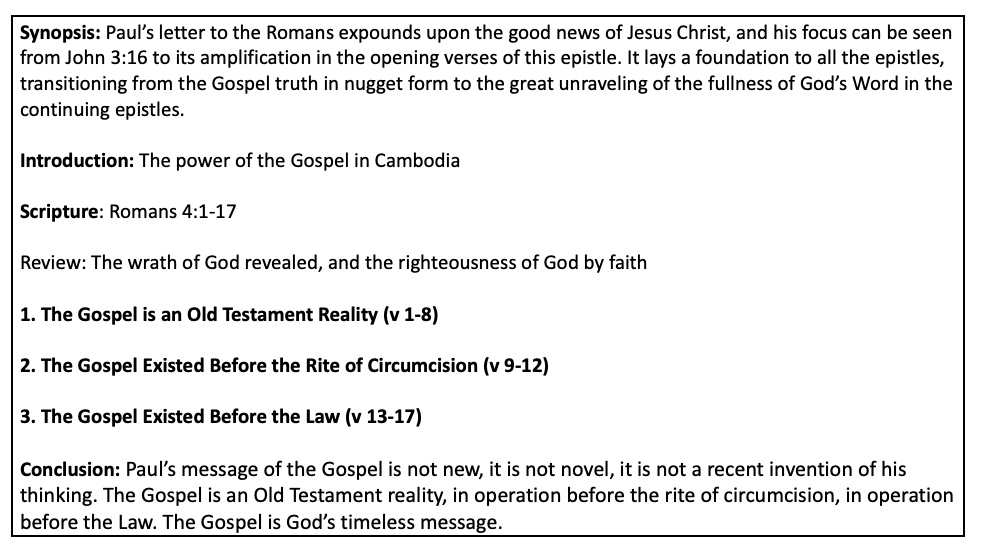
1. The Gospel is an Old Testament Reality (Romans 4:1-8)
The point Paul wants to stress now is that the concept of being saved by grace through faith is not a new calculus. It’s not a new method God has introduced to us. This is not a doctrine that Paul invented. This is the way it has always been, even in the days long before Jesus died and rose again. The Gospel is an Old Testament reality.
Even Abraham was saved by grace through faith. Let me paraphrase verses 1-3: “What happened to Abraham in terms of his relationship to God. Did he work his way into Heaven? Did he live such a sinless life that he was accepted by God on the basis of his works? If so, he has a lot to boast about, but, no, he can’t do that. He was saved through faith. He believed God and it was credited to him as righteousness. God imputed righteousness to Abraham because Abraham simply believed what God said.
The quotation Paul uses comes from Genesis 15, which is the story of the covenant or agreement God made with Abraham. Let’s read that for context. Here is Genesis 15:1-6:
After this, the word of the Lord came to Abram in a vision: “Do not be afraid, Abram. I am your shield, your very great reward.” But Abram said, “Sovereign Lord, what can you give me since I remain childless and the one who will inherit my estate is Eliezer of Damascus?” And Abram said, “You have given me no children; so a servant in my household will be my heir.”
Then the word of the Lord came to him: “This man will not be your heir, but a son who is your own flesh and blood will be your heir.” He took him outside and said, “Look up at the sky and count the stars—if indeed you can count them.” Then he said to him, “So shall your offspring be.” Abram believed the Lord, and he credited it to him as righteousness.
This is the language of justification. Abraham was extremely old, and so was his wife Sarah. Hebrews 11:12 says he was “as good as dead.” My first visits to a nursing home were when I was a boy and went with my dad to see my great-aunt Hannah Paul at Ivy Home. She died in 1961 when I was about nine, and she was over ten times that age. As I recall, she didn’t have much of her mind left, and she and dad would get into the funniest conversations. She’d say, “John, how did ye’ git here with the river all a’flooded?” I forgot what my dad said, but they both laughed and laughed. Since then I’ve been in a lot of nursing homes. What if there was an old couple, as old as Aunt Hannah, who had a double room in the nursing home—he was in one hospital bed and she was in the other. What if I went in and told them they were going to have a baby?
They would have laughed and laughed and thought I was the one who didn’t have much mind left. Yet God appeared to Abraham in a dream, gave him that promise, and Abraham believed Him. And based on his faith, God conferred on him justifying righteousness.
In verses 4 and 5, Paul states the principle that is true throughout the entirety of the Bible: Now to the one who works, wages are not credited as a gift but as an obligation. However, to the one who does not work but trusts God who justifies the ungodly, their faith is credited as righteousness.
This illustration is simple enough for any of us to understand. Recently I had some workers in my home and they worked very hard and did a very good job. When they finished, I said, “How shall I pay you?” They wanted to be paid using a mobile payment app. I had never done that before, so someone helped me do it. I paid them, say, a thousand dollars. It was not a gift. It was an obligation. I was obligated to pay them. But what if I used that mobile payment app to send someone money as a sheer gift. I was not obligated. They had done nothing for me, but I just punched a few buttons and sent them a thousand dollars.
God has no obligation to save us from ourselves and from our sins. He is not obliged to do that at all. We have not and we cannot earn it. But if we simply trust God, He does it for us. Our faith results in God crediting our sins to Christ and His righteousness to us.
Here’s the way The Living Bible put it: “But didn’t [Abraham] earn his right to heaven by all the good things he did? No, for being saved is a gift; if a person could earn it by being good, then it wouldn’t be free—but it is! It is given to those who do not work for it. For God declares sinners to be good in his sight if they have faith in Christ to save them from God’s wrath.”
Both before the cross and after the cross, the only way of walking with God in a holy relationship was by grace through faith. Martyn Lloyd-Jones says, “…the purpose of this fourth chapter is to show that under the Old Testament dispensation this way of salvation was not merely predicted, it was also God’s way of dealing with men, and saving them, at that time also.”
He went on to say, “This is a very important point…. The Old Testament does not merely prophecy and predict this way of making men righteous by imputing the righteousness of Christ to them, and justifying them by faith—that was God’s way of forgiving men and dealing with them even in the time of the Old Testament dispensation itself. The apostle feels constrained to establish this point.”
“This is the first time in the Bible that the doctrine of justification by faith only is stated clearly,” says Dr. Lloyd-Jones. “Had you always thought that the doctrine of justification by faith only was only to be found in the New Testament? Had you realized that it is found in Genesis 15:6? That is the first place in which it is stated clearly and explicitly, though it is there implicitly before that.”
What does Lloyd-Jones mean when he says the doctrine of justification can be seen implicitly before Abraham? Well, before Abraham there were men and women who had a relationship with God. There was godly Abel; there was Enoch, the man who walked with God; there was Noah. All these people knew God, but how? They believed what He told them. They believed in God and it was credited to them as righteousness.
They were saved by grace through faith on the basis of what Christ would do in the future, even as we are saved by grace through faith on the basis of what Christ did for us in the past. The cross is at the center of everything. It is at the center of history. It is at the center of justification. It is at the center of grace. May we never boast except in the cross of Jesus Christ our Lord!
Now, Paul is going to give us another example from the Old Testament. He is going to do exactly what Matthew did with the opening words of the New Testament. Matthew 1:1 says, “This is the genealogy of Jesus the Messiah, the son of David, the son of Abraham.” God made special covenants with these two men, and they were the greatest men in the Old Testament. God told both of them they would be in the line of transmission of the Messiah. Abraham and David were a thousand years apart. David and Jesus were a thousand years apart. In 2000 BC, God said to Abraham, in essence, “I’m going to make a covenant with you. A descendent of yours will be the greatest blessing the world has ever known.” In 1000 BC, God said to David, “I’m going to make a covenant with you. A descendent of yours will be the greatest blessing the world has ever known.” A thousand years later, the New Testament opens with the words, “This is the genealogy of Jesus the Messiah, the son of David, the son of Abraham.”
So here in Romans 4, Paul says, “If you want an example of how people are justified, look at Abraham and then also look at David.” Romans 4:6-8 says: David says the same thing when he speaks of the blessedness of the one to whom God credits righteousness apart from works…. And now Paul quotes from Psalm 32: “Blessed are those whose transgressions are forgiven, whose sins are covered. Blessed is the one whose sin the Lord will never count against them.”
Psalm 32 did not say, “Blessed are those who never sin and whose relationship with God is based on their own perfect life.” No, blessed are those who, although they are full of evil, discover that God is willing to forgive their sins, cover their transgressions, take them off the Ledger, and erase the record of them in the divine books. Blessed are those whose sins the Lord will never count against them.
When we are justified, the Lord will never count our sins against us.
Notice that word “count.” It is the key that connects the paragraph about Abraham to the paragraph about David. The words “count” and “credit” are the same basic Greek word. When we trust God for salvation, He credits it to our account as righteousness. And at the same time He counts or credits our sins to Jesus. This is an accounting term.
It shows us the two sides of justification. Do you remember what I said in an early episode about the doctrine of double imputation?
God took our sins and put them on Christ; and He took Christ’s righteousness and put it on you. He counted your sins as though Christ committed them; and He counted Christ righteousness on you by grace through faith.
Now look here at Romans 4:3: “Abraham believed God and it was credited to him or counted to him as righteousness.” And now verse 8: “Blessed is the one whose sin the Lord will never count against them.”
Abraham shows us how the righteousness of Christ is posted to our account; and David shows us how our sins are posted to Christ’s account. Here in these two examples we have that glorious doctrine of double imputation—or of the posting of divine realities to both sides of our Ledger book. In Christ, our assets are posted. We believe God and it is counted to us as righteousness. In Christ, our liabilities are cancelled. We believe in God, and our sins are no longer counted against us.
This is justification, but it was not earned or merited by either David or Abraham. We have stories in the Old Testament in which both of these men failed. Both of them were imperfect sinners like we are. Yes they were justified on both sides of the Ledger sheet.
2. The Gospel Existed Before the Rite of Circumcision (Romans 4:9-12)
Now, to expound further on the point, Paul says that this happened before the covenant of circumcision was given. In an earlier episode I talked about the Jewish practice of circumcision and what it signified. But circumcision was not introduced in the Bible until Genesis 17. As we have just seen, Abraham was pronounced justified in Genesis 15. So Paul goes on to say in the next verse of Romans 4—verses 9 and following:
Is this blessedness only for the circumcised, or also for the uncircumcised?
In other words, is the blessedness of justification only for the Jewish race or is it also for the rest of humanity?
We have been saying that Abraham’s faith was credited to him as righteousness. Under what circumstances was it credited? Was it after he was circumcised, or before? It was not after, but before!
Abraham’s justification occurred long before the ritual of circumcision.
And he received circumcision as a sign, a seal of the righteousness that he had by faith while he was still uncircumcised.
So Paul now reaches a conclusion.
So then, he is the father of all who believe but have not been circumcised, in order that righteousness might be credited to them.
In other words, Gentile or non-Jewish Christians can also call themselves the children of Abraham because they have followed Abraham’s example of believing God.
12 And he is then also the father of the circumcised who not only are circumcised but who also follow in the footsteps of the faith that our father Abraham had before he was circumcised.
So let’s summarize what Paul has said so far. Everyone on earth is facing the wrath of God, but He has devised a way for us to be restored to fellowship with Him. It isn’t by living a perfect life, but is by grace through faith. When we place our faith in Jesus, our sins are transferred to His account and His righteousness if transferred to our account. But this isn’t a New Testament invention. This is the way it was in the Old Testament too. For example, Abraham believed in God and God justified Him by counting his faith as righteousness. David believed in God, and God did not count his sins against him.
In Abraham’s case, this happened before he was circumcised. So Abraham is our father in two ways. He is the father of believing Jews; but he is also the father of believing Gentiles who have followed his example of faith.
3. The Gospel Existed Before the Law (Romans 4:13-17)
Now Paul is going to take the next logical step. Six hundred years after Abraham, in about the year 1400, God gave Abraham’s descendants the Torah, the Law. But just as the Gospel predates circumcision, so the Gospel predates the giving of the Law. Look at verses 13, 14, and 15:
13 It was not through the law that Abraham and his offspring received the promise that he would be heir of the world, but through the righteousness that comes by faith. 14 For if those who depend on the law are heirs, faith means nothing and the promise is worthless, 15 because the law brings wrath. And where there is no law there is no transgression.
What does Paul mean by the word “Law”? Here is a simple explanation. God is pure and perfect, holy and righteous. He created us to reflect His righteousness. But how can we measure our godliness? How can we recognize it? How can we know what is right and wrong, holy and unholy? God brought His holiness down us by means of the Law—the Ten Commandments and the other commands in the Torah that expand on the Ten Commandments. If a person perfectly kept every detail of the Law with the right attitudes and disposition, they would truly be a perfect person.
But, of course, that works against us because none of us have kept the Law. Paul spent 64 verses telling us that. So the Law opens us to the wrath of God. But long before the Law was given, Abraham received a promise from God, and that promise was credited to Him as righteousness.
Let’s read verses 13-15 again in that light: 13 It was not through the law that Abraham and his offspring received the promise that he would be heir of the world, but through the righteousness that comes by faith.
The Law had not yet been given when Abraham lived, received the promise of God, and believed it. So the Gospel of justification by grace through faith predates the Law.
Verse 14: For if those who depend on the law are heirs [that is, those who inherit all God has to give us], faith means nothing and the promise is worthless, 15 because the law brings wrath. And where there is no law there is no transgression.
Paul doesn’t mean there that no one sinned before the Law was given in the Torah in 1400 BC. Rather, he means that sin was not as clearly defined and as easy to measure before the Law was given. The great apostle is simply restating what he had written earlier to the Galatians. Let me read Galatians 3:6-11, where Paul is saying the same things in very similar words:
6 So also Abraham “believed God, and it was credited to him as righteousness.” 7 Understand, then, that those who have faith are children of Abraham. 8 Scripture foresaw that God would justify the Gentiles by faith, and announced the gospel in advance to Abraham: “All nations will be blessed through you.” 9 So those who rely on faith are blessed along with Abraham, the man of faith.
10 For all who rely on the works of the law are under a curse, as it is written: “Cursed is everyone who does not continue to do everything written in the Book of the Law.” 11 Clearly no one who relies on the law is justified before God, because “the righteous will live by faith.” 12 The law is not based on faith; on the contrary, it says, “The person who does these things will live by them.” 13 Christ redeemed us from the curse of the law by becoming a curse for us, for it is written: “Cursed is everyone who is hung on a pole.” 14 He redeemed us in order that the blessing given to Abraham might come to the Gentiles through Christ Jesus, so that by faith we might receive the promise of the Spirit.
Conclusion
So to summarize Romans 4:1-17, Paul’s message of the Gospel is not new, it is not novel, it is not a recent invention of his thinking. No, rather it is the way God has always brought men and women to Himself, in the Old Testament as well as in the New; before the cross as well as after; in the world of the ancients and in our world today.
The Gospel is an Old Testament reality, in operation before the rite of circumcision, in operation before the Law. Every single person that we will meet throughout the endless ages of glory will have the exact same testimony: I was saved by grace through faith. The Gospel is God’s timeless message.
The other evening, I had two young men in my office, both of them 22 years old. They wanted to study this book of Romans, so we walked through some of this material. When we finished, one of the young men looked at me and said, “I have never realized until now what a terrible person I am and what a wonderful Savior Christ is, that He loved me so much.”