
A Study of Romans 8:15-16
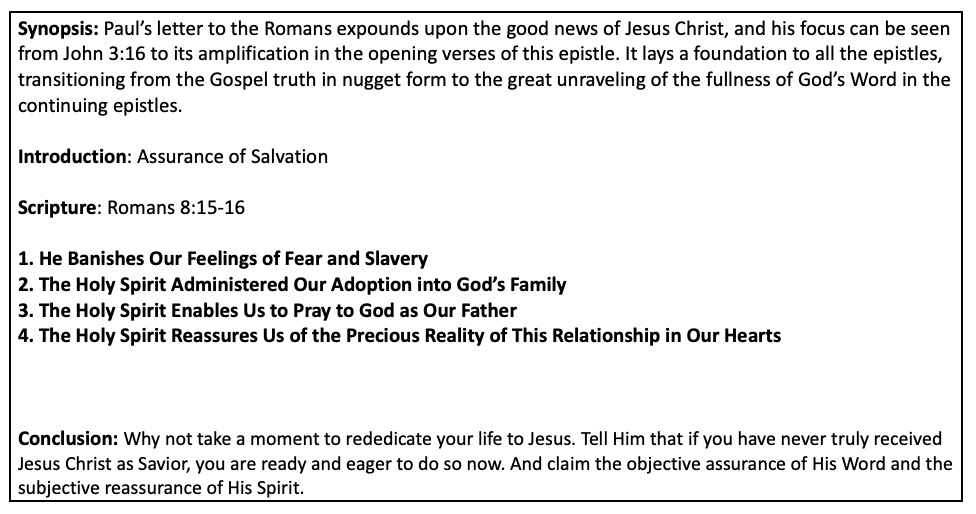
Our Bible study today is one glorious paragraph in Romans, chapter 8. Grab a Bible if you can, and let’s read it—Romans 8:15-16:
15 The Spirit you received does not make you slaves, so that you live in fear again; rather, the Spirit you received brought about your adoption to sonship. And by him we cry, “Abba, Father.” 16 The Spirit himself testifies with our spirit that we are God’s children.
Introduction: For the last several years I’ve been teaching at the Billy Graham training center at the Cove in Asheville, North Carolina, and at every session people submit written questions. Recently when I was there I was surprised at the number of questions that came to me about reassurance and about knowing for sure that we are truly saved. The questions were like these: How do I know that I’m really going to heaven? How do I truly know that I’ve received Jesus Christ as my savior? Most of the attendees of these conferences are seasoned believers, so I was somewhat curious and wondered if this represented a widespread need among the children of God.
One of the operations of the Holy Spirit in our lives is to provide us with inner reassurance. Some commentators say that the primary purpose of this entire section of Romans, Romans 5 through 8, is to give us the security, certainty, and reassurance that we need, so that we never worry about our future destiny or about what is happening to us as time goes by or after we pass away.
Certainly this is a major emphasis for the apostle Paul. In chapter 5, verse 17, he said: “For if, by the trespass of the one man, death reigned through that one man, how much more will those who receive God’s abundant provision of grace and of the gift of righteousness reign in life through the one man, Jesus Christ!”
In chapter 6, verse 5, he said, “For if we have been united with Him in a death like His, we will certainly also be united with Him in a resurrection like His.”
In chapter 7, he wrote of his own struggle with temptation, but he said, “Who will rescue me from this body that is subject to death? Thanks be to God, who delivers me through Jesus Christ our Lord!”
Romans 8 begins by telling us there is now no condemnation to those who are in Christ Jesus, and it ends by telling us that nothing can separate us from the love of God, which is in Christ Jesus our Lord.
Now in the passage we are approaching, the brilliant apostle is going to tell us about the role of the Holy Spirit in providing this reassurance. We have already seen in this chapter how the Holy Spirit helps us in so many ways. He imparts life to us and sets us free from the law of sin and death. He gives us new desires and governs our minds. He lives within us and makes Christ real to us. He is standing by to resurrect our mortal bodies at the last day. In the meantime, He enables us to put to death the misdeeds of our body. He also leads and guides us through life.
Now we’re coming to the next thing he does and let’s just take this passage verse by verse and phrase by phrase, beginning with verse 15.
1. He Banishes Our Feelings of Fear and of Slavery.
First, He banishes our feelings of fear and slavery. Verse 15 begins: “The Spirit you received does not make you slaves, so that you live in fear again.” If you think that you can get to heaven by living a good life, then you are in constant fear that you will mess up and fall short of the goal.
Even as Christians we all sin, and fail, and fall far short of the goal. Our standard is Jesus Christ. We want to be like Him and to live like Him. We want to walk like Him and talk like Him. We want to be Christlike in our attitudes and in our behaviors. But every day we mess up.
Ruth Graham once said to me, “The closer to heaven we get the closer to hell we feel.” That was such a strange thing to say, so I asked her what she meant. Since then I have realized that this is a spiritual dynamic at work in people who are maturing in the Lord. We are not going to be perfect in this life, but our desire to please the Lord grows as we grow spiritually. And when we recognize how sinful we still are–when we have a moment when we lose our temper, or we look at something we shouldn’t, or we let our mind dwell on some fantasy, or we eat or drink more than we should, or we say a bad word, or we oversleep on Sunday morning, or we miss our devotions, or we get into an argument we should have avoided—well, all these things bother us. We feel guilty and frustrated.
These are occasions for repentance and rededication. But these are not moments in which we fear that God has thrown us out of His family or no longer loves us. The Lord does not want us walking around, constantly depressed because we are not yet glorified. He does not want us wallowing constantly in guilt. He does not want us thinking that we are no longer a part of His family.
He wants us to learn the practice of repentance and rededication, and the Holy Spirit helps us with that. I believe this is the essence of Romans 8:15: “The Spirit you received does not make you slaves, so that you live in fear again.”
That’s why it is so terribly important that the Christian learn to truly appreciate the infinite scope of the forgiveness of God and the power of the blood of Jesus Christ.
There are two great hymns that have helped me a great deal with this personally. One is by the British hymnist, Henry Lyte. I’ve visited his former home in England, which is now a hotel. I’ve had high tea there. He wrote a wonderful hymn that says:
Praise, my soul, the King of heaven;
To His feet thy tribute bring.
Ransomed, healed, restored, forgiven,
Evermore His praises sing.
That’s a wonderful verse, but the next one is the one I continually return to.
Praise Him for His grace and favor
To our fathers in distress.
Praise Him still the same as ever,
Slow to chide and swift to bless.
When I have a sense of failure in my life, as I often do, I frequently go back to that wonderful aspect of God’s grace for which we praise the Lord. He is slow to chide and swift to bless. I believe it’s the Holy Spirit who brings that phrase to my mind.
The other hymn was written by Frederick W. Faber and the first line says: “There’s a wideness to God’s mercy like the wideness of the sea.” The words of this hymn are helpful, but the image of that opening phrase is very encouraging to me.
Let me summarize with two practical points.
First, the deeper the sin, the deeper and more thorough must be our repentance, restitution, and rededication. Not all sins are the same. It’s one thing to say a swear word when you stub your toe and another thing to tumble into a pornography addiction. The blood of Christ is sufficient for every sin, but some sins produce far more serious consequences and may require counseling, church discipline, accountability, major changes in lifestyle, and time for healing and restoration.
Second, in any event, God does not want us living as slaves to our fear, guilt, and shame. This verse says: “The Spirit you received does not make you slaves, so that you live in fear again.” We cannot live in constant discouragement over our imperfections. We should be growing out of them. We should be making progress. We should be in the process of putting to death the misdeeds of the body through the empowerment of the Holy Spirit. But we must not let our mistakes, missteps, and failures define who we are. Those things are under the blood of Christ, and when we confess our sins he is faithful and just to forgive us of our sins and to cleanse us from all unrighteousness. So we pick ourselves up, practice repentance and rededication, and we continue growing in Christ. The Spirit we received does not make us slaves again, so that we live in fear or defeat or shame or regret.
Dr. Douglas Moo said: “The Spirit that believers received does not bring about again that anxiety and fear of judgment which they suffered in their pre-Christian state.”
2. The Holy Spirit Administered Our Adoption into God’s Family.
Second, the Holy Spirit administered our adoption into God’s family. Look at verse 15 again: The Spirit you received does not make you slaves, so that you live in fear again; rather, the Spirit you received brought about your adoption to sonship.
Dr. J. I. Packer says something about the doctrine of adoption that is truly surprising. He says that spiritual adoption is an even greater and higher privilege than justification. Justification brings us into a right legal standing with God and declares us righteous in His sight. But adoption brings us right into His family and enables us to call Him our Father.
In his classic book, Knowing God, Packer says, “What is a Christian? The question can be answered in many ways, but the richest answer I know is that a Christian is one who has God as Father.”
He wrote, “Our understanding of Christianity cannot be better than our grasp of adoption…. And the stress of the New Testament is not on the difficulty and danger of drawing near to the holy God, but on the boldness and confidence with which believers may approach him…. Adoption is the highest privilege that the gospel offers.”
Packer says that justification is a forensic idea, conceived in terms of law and viewing God as the Judge. But adoption is a family idea, conceived in terms of loving and viewing God as Father. He wrote, In adoption, God takes us into His family and fellowship—He establishes us as His children and heirs. Closeness, affection, and generosity are at the heart of the relationship. To be right with God the Judge is a great thing, but to be loved and cared for by God the Father is greater.”
When we are saved, we become citizens of God’s Kingdom. But there is a simultaneous theological reality that takes place, and that is adoption. We also become members of God’s family and we can call Him now Father.
3. The Holy Spirit then Enables Us to Pray to Him as Our Father
Third, not only does the Holy Spirit banish our feelings of fear and slavery, and not only is He the officiating agent that facilitates our adoption into God’s family; but He is also the one who teaches us to pray to God as our Father. Look at verse 15 again: The Spirit you received does not make you slaves, so that you live in fear again; rather, the Spirit you received brought about your adoption to sonship. And by him we cry, “Abba, Father.”
In the Old Testament, people prayed but they did not typically approach God as their Father. In the book of Psalms, for example, when David and the other writers addressed God in prayer, they used phrases like:
- O Lord
- My God
- My King
- God Almighty,
- Sovereign Lord
- My Rock
- My Fortress
- My Refuge
- The Holy One of Israel
But when Jesus came, when He prayed in the gospels, He openly addressed almighty God as His Father. And furthermore, He extended that same privilege to us. And it is the Holy Spirit who reassures us as we approach the Throne of Grace and as we make our requests known unto God that we can call Him, “Our Father.” We can say, “Abba, Father.” Abba is a very family-centered name for one’s father.
4. The Holy Spirit Reassures Us of the Precious Reality of This Relationship in Our Hearts.
Fourth, the Holy Spirit reassures us of the precious reality of this relationship in our hearts. Let’s read verse 15 again, then press into verse 16:
The Spirit you received does not make you slaves, so that you live in fear again; rather, the Spirit you received brought about your adoption to sonship. And by him we cry, “Abba, Father.” 16 The Spirit himself testifies with our spirit that we are God’s children.
This is both an objective and a subjective experience.
Let me use this example. Suppose you had been incarcerated in a prison for five years, but one day a guard tells you that your attorney has come to see you. You are taken to a visitation room, and there he is, waiting for you. He pulls out a document. He says that you have been pardoned by the governor. You are now a free person. Your record has been expunged, and you never have to go back to your prison cell again.
You might say, “Are you kidding me? Are you telling me the truth? I don’t believe it. It cannot be true.”
But your attorney would do two things for you. First of all, he would show you the official document signed by the governor with your name on it and with all of the provisions stipulated for your pardon.
And second, your attorney would reassure you that it’s true. He would say, “I have just come from the governor’s office, and I can tell you this is absolutely true. You do not have to live as a prisoner anymore. I have come with a change of clothes for you, and you can believe what I tell you. For a long time I have not only been your attorney, but I am also your friend. I would not lie to you. Believe me, this is true.”
And so you would have something objective—the official paper, signed and sealed. And you would also have the subjective comfort of your advocate’s reassuring word.
The Holy Spirit comes to us with a document. It’s the Gospel, the Word of God, signed and sealed with the blood of Jesus Christ. It says:
- And this is the record: That God has given us eternal life, and this life is in His Son—1 John 5:11 (RGT)
- Whoever believes in the Son has eternal life—John 3:36
- Very truly I tell you, whoever hears my word and believes in him who sent me has eternal life and will not be judged but has crossed over from death to life—John 5:24
- Therefore there is now no condemnation to those who are in Christ Jesus—Romans 8:1
We have verses of assurance like that throughout the Scripture, and the Word of God is our official document that we have been both justified and adopted.
But second, our advocate, the Holy Spirit, also bears witness to our hearts and tells us that this is true. When we look up to heaven and say, “Our Father,” we have a sense of reality. We know that we are God’s children because we have an inner peace that is inexplicable apart from the reassuring presence of the Holy Spirit. Our assurance rests objectively on the Word of God and is reinforced subjectively by the witness of the Spirit of God.
Conclusion:
Let me close with a story about myself and one about Katrina. Whenever I share my testimony I explain that I do not remember a time when I was not trusting Christ as my Savior. I grew up in such a Gospel-saturated environment that I do not remember a particular moment when I asked Jesus to come into my life. I have no recollection of a moment of conversion.
But I do recall a time when I was eleven or twelve years old. We had a week-long series of evangelistic services at our church, which happened twice a year. On this occasion, the evangelist told us that not everyone who says they are a Christian is actually going to heaven. Just because you go to church doesn’t mean you are a born-again Christian. He may have based his sermon on Matthew 7:21, when Jesus said, “Not everyone who says to me, ‘Lord, Lord,’ will enter the Kingdom of heaven, but only the one who does the will of My Father who is in heaven.”
He urged us to make certain that we have trusted Jesus as Savior. I became very anxious about whether or not I had really ever received Jesus as my Savior. I went home that night very troubled, but I was too shy to talk to my parents about it. Instead I went into the bathroom where I knew I would have privacy and I closed the door and knelt down. I prayed something like this: “Dear Lord, I believe I have taken Jesus as my Savior, but if not, I want to do so right now.”
I still recall that moment and how I went to bed that evening with peace in my heart that I was truly saved and going to heaven. Even in my childhood heart, the Holy Spirit was coming to give me reassurance based upon the objective reality of God’s written Word. To the best of my knowledge, I’ve never since then doubted the reality of my salvation.
My wife, Katrina, wrote about her conversion in our book, The Strength You Need. She said: “I grew up in a Finnish home in a Finnish community in West Paris, Maine, and I attended a Finnish-speaking church with my mother. When I was nine, a Sunday School campaign stressed Scripture memory, and I won a free week at Camp Clear in Cape Cod, Massachusetts. While there one night at a campfire meeting, the speaker presented the gospel. He said Jesus died on the cross for our sins and rose again on the third day. That’s when I gave my life to the Lord.”
One evening, perhaps a year or less before she went to heaven, Katrina was having a particularly difficult day. Her multiple sclerosis had left her swinging back and forth on an emotional pendulum, from red hot anger to abject depression. She was frustrated with her inability to control her emotions, and she finally broke down in tears and said, “Robert, I don’t believe I’m really saved.”
Well, I did not have any doubt about her salvation. I had seen her live it out throughout all of our lives together. But somehow the Lord enabled me to handle that moment. I said, “This is a really rough patch, and I believe you are born again and going to Heaven. But I understand you have doubts about that, so let’s just pray.”
And I led her in a simple prayer, recommitting her life to Christ and reclaiming her sense of assurance. She was not being saved all over again. We are saved once-for-all. But she reaffirmed her faith and regained her sense of the reality of the promises of God.
Perhaps you need that too. Why not take a moment to rededicate your life to Jesus. Tell Him that if you have never truly received Jesus Christ as Savior, you are ready and eager to do so now. And claim the objective assurance of His Word and the subjective reassurance of His Spirit.
Spend some time in the reality of Romans 8:15-16: The Spirit you received does not make you slaves, so that you live in fear again; rather, the Spirit you received brought about your adoption to sonship. And by him we cry, “Abba, Father.” The Spirit himself testifies with our spirit that we are God’s children.