
A Study of Romans 7:1-6
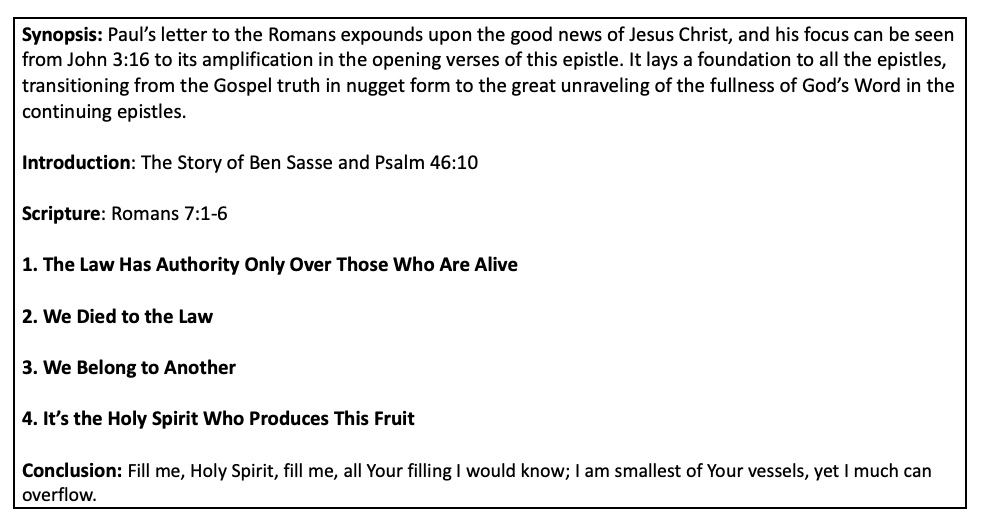
Introduction
Perhaps you’ve read about the condition of Ben Sasse, the former senator from Nebraska, who resigned from the Senate to become president of the University of Florida. He announced in December of 2025 that he had been diagnosed at age 54 with terminal stage four pancreatic cancer. He recently was interviewed by the Wall Street Journal at the MD Anderson Cancer Center in Houston. He says that he regrets that he missed so many family dinners and ball games because of his workaholism. He said that if he could live all over again he would be a much more serious Sabbatarian. He quoted Psalm 46:10: “Be still and know that I am God.” But he also said that he takes all his faults and failures to Jesus. He said, “I’m in need of the grace that only Jesus Christ’s historical death and resurrection can provide.”
There is no doubt that this man—Ben Sasse—has read the book of Romans. He has lived by it, and now he is resting in its truths as he faces death. After the prologue, Paul spent 64 verses convincing his readers how sinful we all are, but then he announced an answer to our dilemma—the historical death and resurrection of Jesus Christ.
He said: “But now apart from the law the righteousness of God has been made known, to which the Law and the Prophets testify. This righteousness is given through faith in Jesus Christ to all who believe…. For all have sinned and fall short of the glory of God, and all are justified freely by his grace through the redemption that came by Christ Jesus. God presented Christ as a sacrifice of atonement, through the shedding of his blood—to be received by faith…. He did this to demonstrate his righteousness at the present time, so as to be just and the one who justifies those who have faith in Jesus” (Romans 3:21-26).
In chapter 4, Paul explained that Abraham and David were justified in this same manner—by grace through faith. In chapter 5, he explained the transaction that takes place when we are saved. We are, as it were, airlifted from the family of Adam to the family of Christ. Paul said, “For if, by the trespass of the one man [Adam], death reigned through that one man, how much more will those who receive God’s abundant provision of grace and of the gift of righteousness reign in life through the one man, Jesus Christ!” (Romans 5:17).
Romans 6 illustrates this by giving us two parallel pictures. In the first half of the chapter, Paul said that when we are transferred from Adam to Christ, we died to sin. He does not mean that we are dead to sin or to temptation. We are still capable of sin, and we do sin. But when we are in Christ we no longer live in the realm of sin. We are not yet removed or delivered from the presence of sin, but we have been saved from its penalty and we are being saved from its power. We no longer live under sin’s rule, even though we still struggle with its presence.”
And he says, “Therefore, do not let sin reign in your mortal body so that you obey its evil desires. Do not offer any part of yourself to sin as an instrument of wickedness, but rather offer yourselves to God as those who have been brought from death to life.”
In the last half of Romans 6, he tells us we have been liberated from the slavery of sin and are now slaves to righteousness, to obedience, and to God. And he ends chapter 6 with that glorious and summarizing verse 23: “For the wages of sin is death, but the gift of God is eternal life in Jesus Christ our Lord.”
Now today, we are coming to Romans 7:1-6, so let’s read it and plow into it.
7 Do you not know, brothers and sisters—for I am speaking to those who know the law—that the law has authority over someone only as long as that person lives? 2 For example, by law a married woman is bound to her husband as long as he is alive, but if her husband dies, she is released from the law that binds her to him. 3 So then, if she has sexual relations with another man while her husband is still alive, she is called an adulteress. But if her husband dies, she is released from that law and is not an adulteress if she marries another man.
4 So, my brothers and sisters, you also died to the law through the body of Christ, that you might belong to another, to him who was raised from the dead, in order that we might bear fruit for God. 5 For when we were in the realm of the flesh, the sinful passions aroused by the law were at work in us, so that we bore fruit for death. 6 But now, by dying to what once bound us, we have been released from the law so that we serve in the new way of the Spirit, and not in the old way of the written code.
The Law Has Authority Only Over Those Who Are Alive
Paul begins by making a very obvious point. The law has authority only over those who are alive. Verse 1 says: Do you not know, brothers and sisters—for I am speaking to those who know the law—that the law has authority over someone only as long as that person lives?
In our nation that isn’t quite true. With diabolical genius, our government has devised ways with estate taxes and death taxes to hold us liable to the Internal Revenue Service even after we are dead. But in general, and in the Roman world of Paul’s readers, and truly in our own world, the law only has authority over us while we are alive. If I am on the FBI’s most wanted list, they have authority to track me down and arrest me as long as I’m alive. But they cannot arrest me if I am dead. A police officer cannot give me a ticket after I am dead. I cannot be charged with any crime after I am dead.
The apostle Paul does not use any of those illustrations. He uses the illustration of the legal commitment of our marriage vows. Verse 2 says: For example, by law a married woman is bound to her husband as long as he is alive, but if her husband dies, she is released from the law that binds her to him.
We even have that written into our marriage vows. We commit ourselves to another till death do us part. I’ve always thought that was a little grim, so when I officiate a marriage I usually say as long as we both shall live. But it means the same thing. If your spouse dies, then you are no longer legally bound to him or her. And if you want to get married again, there is no biblical or legal reason that would prevent you from doing so.
So verse 3 continues: So then, if she has sexual relations with another man while her husband is still alive, she is called an adulteress. But if her husband dies, she is released from that law and is not an adulteress if she marries another man.
So far, we’ve been able to follow Paul’s argument.
We Died to the Law
That is the first step in Paul’s argument. The second step is that when we received Jesus Christ as Savior, we died to the law. Look at verse 4: So, my brothers and sisters, you also died to the law through the body of Christ, that you might belong to another, to him who was raised from the dead, in order that we might bear fruit for God.
What does Paul mean when he said that we died to the law? Paul does not mean we can live any way we want to, that we can live in a lawless way. He has made this point before in the book of Romans. In the last chapter, Romans 6 and verse 15, he said, “What then? Shall we sin because we are not under the law but under grace? By no means!”
No, let’s look at verse 4 very carefully. He is addressing Christians here. He said, “So, my brothers and sisters.” He is addressing those who are in Christ. What does he mean when he said, “We died to the law.” He’s simply recapitulating what he has been saying throughout this epistle. We died to the idea that we can be saved by keeping the law—we can never meet the demands of a holy God. We died to the concept that we can ever get to heaven by living a good life. Even more, we died to the law as a binding covenant authority over us. The Law is no longer the governing framework of our relationship with God.
Furthermore, we died to the punishment demanded by the law. We died to our fear of being condemned as lawbreakers. More precisely, we died to the law’s authority and jurisdiction, and therefore to its governing power.
How did that happen? It happened because Jesus Christ bore the wrath of the Law when He died for our sins. Look at verse 4 again: So, my brothers and sisters, you also died to the law through the body of Christ—the body of Christ who was crucified for us.
We Belong to Another
Now, Paul is going to advance his argument one more step. First, he said that the law has authority over us only as long as we are alive. Then he said we died to the law. And next he is going to say we are now free to belong to another. So, my brothers and sisters, you also died to the law through the body of Christ, that you might belong to another, to him who was raised from the dead….
We are no longer united in marriage to the demands of the Law as a means of salvation; we are now united in marriage to Him who died to free us from the Law and was raised again. So what is our new obligation? It is to bear fruit for God. Look at verse 4 in its entirety again: So, my brothers and sisters, you also died to the law through the body of Christ, that you might belong to another, to him who was raised from the dead, in order that we might bear fruit for God.
Here is my paraphrase: My brothers and sisters in Christ. The demands of the law are no longer the means by which we’re to have a relationship with God. We died to that, and we have married Jesus Christ, who bore our sins on the cross and who rose from the dead. And now we’re to live the kind of life envisioned by law, but it now shows up as the fruitfulness of our Christian life. For example, the law says we are not to murder. And Jesus pointed out that it’s not just the outward observance, but the inward attitude. We’re not even to hate someone. We cannot keep that command. But now that we belong to Christ, His love is reproduced in us and we have, through His Spirit, the ability to be victorious over both hate and murder. The things which the law told us to do, we could not do. But now that we belong to Christ, He can live His life through us and do through us what we could never do on our own.
People often contrast Romans and James on the relationship between faith and works. But when both letters are read and interpreted correctly, they teach the same truth: we are not saved by works; but because we are saved, we work. We are not saved by works, yet true salvation always produces works. Whereas Romans teaches that works cannot produce salvation, James teaches that salvation cannot help but produce works.
John Stott said, “We are not saved by good works, but we are saved for good works.”
And Charles Spurgeon used Paul’s word “fruit” in this connection when he said, “Good works are not the root of salvation but they are the fruit of salvation.”
So, my brothers and sisters, you also died to the law through the body of Christ, that you might belong to another, to him who was raised from the dead, in order that we might bear fruit for God.
It’s the Holy Spirit Who Produces This Fruit
Now, let’s go on to the next step in Paul’s logic. First, the law has authority only over those who are alive. Second, we died to the law. Third, we belong to another, to Christ, who died and rose again for us so that we might bear fruit for God. And now, fourth, it is the Holy Spirit who produces this fruit. Look at verses 5 and 6: For when we were in the realm of the flesh, the sinful passions aroused by the law were at work in us, so that we bore fruit for death. 6 But now, by dying to what once bound us, we have been released from the law so that we serve in the new way of the Spirit, and not in the old way of the written code.
The portion begins: For when we were in the realm of the flesh. This is harkening back to chapters 5 and 6. We were in the realm of Adam; now we are in the realm of Christ. We were in the realm of death; now we are in the realm of life. When we were in the realm of Adam and of death, we lived in a lawless, sinful way. Our sinful passions, which were identified and measured by the Law, worked in us and through us and brought us spiritual death.
For when we were in the realm of the flesh, the sinful passions aroused by the law were at work in us, so that we bore fruit for death. 6 But now, by dying to what once bound us, we have been released from the law so that we serve in the new way of the Spirit…,
Paul is edging into his favorite subject—the Spirit-filled life. He is saying that we can never live the Christian life in our own strength or energy. We can never keep the law in our own strength or energy. We have even died to trying to do that. Now we have a living relationship with Jesus Christ. And he can live the Christian life through us, and He can do good works; and He can be pleasing to God; and He can bear fruit. He lives His life through us by means of His Holy Spirit. Our Christian lives are simply the outworking of the Christ-life through us by means of the Holy Spirit. We serve in the new way of the Spirit.
Once again we can turn to Galatians to find a parallel passage. Romans and Galatians are so very much alike. Galatians 5:16 and following says: “So I say, walk by the Spirit, and you will not gratify the desires of the flesh. For the flesh desires what is contrary to the Spirit, and the Spirit what is contrary to the flesh. They are in conflict with each other, so that you are not to do whatever you want. But if you are led by the Spirit, you are not under the law.”
This is exactly the same thing. Paul is talking about Spirit-empowered obedience. Through His Spirit, Christ enables us to fulfill the righteous intent of the law. He’s going to say the same thing later in Romans 8: “Therefore, there is now no condemnation for those who are in Christ Jesus, because through Christ Jesus the law of the Spirit who gives life has set us free from the law of sin and death. For what the law was powerless to do because it was weakened by the flesh, God did by sending his own Son in the likeness of sinful flesh to be a sin offering. And so he condemned sin in the flesh, in order that the righteous requirement of the law might be fully met in us, who do not live according to the flesh but according to the Spirit.”
Conclusion
Dr. Lewis Sperry Chafer, who I’ve already mentioned in our series on Romans, the founder of Dallas Theological Seminary, wrote a hymn that sums this up as a prayer. He said:
You are calling me, Lord Jesus,
As Your living witness here;
Only by Your life within me
Can I any witness bear.
Fill me, Holy Spirit, fill me,
All Your filling I would know;
I am smallest of Your vessels,
Yet I much can overflow.
You are calling me, Lord Jesus,
To be working one with Thee.
Only by Your life within me
Can there any service be.
Fill me, Holy Spirit, fill me,
All Your filling I would know;
I am smallest of Your vessels,
Yet I much can overflow.
I want to adopt that as my prayer: Fill me, Holy Spirit, fill me, all Your filling I would know; I am smallest of Your vessels, yet I much can overflow.