A Study of Romans 5:1-5
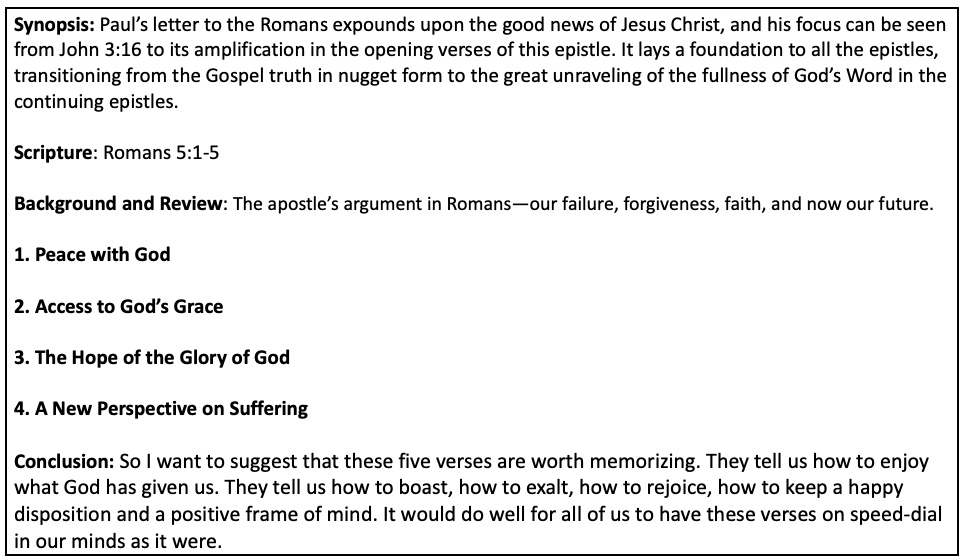
Scripture
5 Therefore, since we have been justified through faith, we have peace with God through our Lord Jesus Christ, 2 through whom we have gained access by faith into this grace in which we now stand. And we boast in the hope of the glory of God. 3 Not only so, but we also glory in our sufferings, because we know that suffering produces perseverance; 4 perseverance, character; and character, hope. 5 And hope does not put us to shame, because God’s love has been poured out into our hearts through the Holy Spirit, who has been given to us.
Background and Review
This passage begins a new section of Romans, and at this point I want to suggest an outline to you. We’ve already learned that the first seventeen verses of Romans are prologue. The corpus or body of the book begins in chapter 1, verse 18 and the first 64 verses describe our failure. In this section, from Romans 1:17 to Romans 3:20, the apostle Paul shows us from one angle after another that we have all suffered a major moral and spiritual collapse that renders us worthy of nothing but the wrath of God.
Then in Romans 3:21-31, he breaks forth with the good news of our forgiveness and freedom: But now apart from the law the righteousness of God has been made known, to which the Law and the Prophets testify. This righteousness is given through faith in Jesus Christ to all who believe….
Paul then devotes chapter 4 to a description of this kind of saving faith, using Abraham as the great illustration and example.
Now, in chapters 5 through 8, Paul wants to tell us about our future—both our short-term future on earth where God will be working in us through sanctification, but especially our long-term and eternal future, where God will give us the gift of glorification.
So this is the progress of the apostle’s argument in Romans—our failure, our forgiveness, our faith, and now our future.
Therefore…
Let’s start with the first word, “therefore.” Therefore, since we have been justified through faith….
Those eight words serve as a summary of everything we have just covered. The word, therefore, means that Paul is about to draw some conclusions from what he has been saying in chapters 1 – 4. Dr. John Murray wrote, “The ‘therefore’ indicates that an inference is being drawn from the doctrine that has been unfolded and demonstrated in the preceding chapters.”
The use of the word “therefore” is one of the reasons we believe this verse marks a major shift of content. But there are a couple of other indications too. Up until now in the body of this book, Paul had been using the first person plural to address his audience. He kept saying, “You…. You…. You…” Now he starts saying, “we.” Therefore, since we have been justified through faith…. There is a distinct change in tone. It is warmer, and Paul includes himself in the discussion.
These eight words—Therefore, since we have been justified through faith—serve as a summary of everything we have just covered and transition us to a wonderful summary of why we should be such happy and joyful people.
1. Peace With God
First, we now have peace with God. Therefore, Paul says, there are some defining things true for us, and the first is this—we are no longer enemies of God and subject to His wrath. We have a relationship with Him. We have peace with Him. We are friends with Him rather than enemies. Therefore, since we have been justified through faith, we have peace with God through our Lord Jesus Christ.
The Greek word for “peace” is Eirene, which means a state of tranquility. It’s equivalent to the Hebrew word shalom. Put simply, we have a positive relationship with God now. We are no longer banished from Him. We are no longer the enemies of His holiness. We are no longer objects of His wrath. By our justification, all our sin has been placed on Christ, and all His righteousness has been placed on us. And so there are no barriers to coming into the very presence of the holy and omnipotent God. We have a relationship with Him.
There is a similar but different phrase in Philippians 4:7, which says, “The peace of God, which transcends all understanding, will guard your hearts and your minds in Christ Jesus.”
Peace with God and the peace of God are two different but related concepts. Peace with God is an objective reality based on our justification. The peace of God is a subjective reality that follows. Because we have peace with God, we can experience the peace of God. And all this comes through our Lord Jesus Christ.
2. Access to God’s Grace
Second, having been justified by faith, we have total access to God’s treasure trove of grace: Therefore, since we have been justified through faith, we have peace with God through our Lord Jesus Christ, through whom we have gained access by faith into this grace in which we now stand.
When Jesus Christ died, a strange thing happened less than a mile from the location of Calvary. At the very moment of His death, an unexplained episode occurred at the Jewish Temple. Inside the temple were two rooms—the Holy Place and the Most Holy Place. No one could go into the Most Holy Place because it represented the very presence of God. A thick curtain barred the way and no one could go behind the curtain. The only exception was the High Priest of Israel on the Day of Atonement when he went behind the veil to offer the blood of the sacrifice for the sins of the nation.
In the book of Exodus, this curtain was made from blue, purple, and scarlet yarn with images of cherubim skillfully worked into it. Some Jewish sources say the curtain in the first-century temple was sixty feet tall—the size of a six-story building; and it was thirty feet wide.
But according to the Jewish historian Josephus, the veil of the temple was 55 cubits tall, which would have been over 80 feet tall—as tall as an eight-story building. Josephus says it was about four inches thick.
This wasn’t a shower curtain or a bedsheet. This is one of the largest, thickest, tallest, heaviest curtain tapestries ever known to history.
But at the very moment Christ died, a set of invisible hands reached down from heaven and ripped the curtain in two from top to bottom as if it was tissue. I suppose it was an angel who did this. It could have simply been the invisible influence of the power of God. The curtain was torn in two. This was not a postscript in the story. It wasn’t a footnote, but a headline.
If you had been a reporter on the scene, watching Jesus Christ die, what would you have written?
“The man’s suffering came to an end as he heaved a final breath and screamed one last time, then his head fell onto his shoulders, and they took notice and inspected him to make sure he was dead. A woman in the crowd wailed, and at that moment the tremors of an earthquake rumbled from within the earth, and people began running from the scene.”
But no, here is what Matthew said: “And when Jesus had cried out again in a loud voice, he gave up his spirit. At that moment the curtain of the temple was torn in two from top to bottom” (Matthew 27:50-51).
Matthew doesn’t even pause in his narrative. He hardly even puts a period there. He instantly and immediately links up the two events, even though he gives no explanation, no theological connection. He just states the matter in terms of what happened at that moment.
Mark does exactly the same thing in his account. He wrote, “With a loud cry, Jesus breathed his last. The curtain of the temple was torn in two from top to bottom” (Mark 15:37-38). This is not a detail. The Gospel writers are taking two different events that occurred at the exact same time and placing them side by side. On one side of town, a man dies. On the other side of town at the same instant, the greatest curtain ever known to humanity seemingly rips itself apart. Mark is implying a tremendous significance between the two events, though he offers no reason, no explanation. He just states the facts.
We have something a bit different with Luke. In Luke 23:44-46, we read: “It was now about noon, and darkness came over the whole land until three in the afternoon, for the sun stopped shining. And the curtain of the temple was torn in two. Jesus called out with a loud voice, ‘Father, into your hands I commit my spirit.’ When he had said this, he breathed his last.”
Luke says, “The curtain in the temple was torn in two and Jesus died at that moment.” This isn’t a contradiction. Luke is simply highlighting the importance of the tearing of the temple by placing it first. Luke puts the curtain incident ahead of the Lord’s death. Matthew and Mark said, “Jesus died, and the temple curtain was torn in two.” Luke said, “The temple curtain was torn in two and Jesus died.”
But in all three synoptic Gospels, the death of Christ and the ripping apart of the temple curtain are mentioned almost as if they were one and the same event. Yet none of the Gospel writers explain the significance. They give us the history but not the theology. They give us the news of the day but not the relevance.
Here in Romans 5, Paul gives us the meaning, the significance, and the theology of it. He says: Therefore, since we have been justified through faith, we have peace with God through our Lord Jesus Christ, 2 through whom we have gained access by faith into this grace in which we now stand.
The word “access” has the idea of coming into God’s presence with no hindrance. Paul uses this word two other times in his writings, both in Ephesians. But it’s not just access to God; it’s access to all of God’s grace—all His blessings and benefits and bounty. We have gained access by faith into this grace in which we now stand.
All we need for life and eternity is now available to us. Grace unlocks all His promises. Grace opens all His treasuries. Grace supplies all our needs. Grace wraps itself around us with strength and song. All of His all-sufficient grace is available to us all the time, at every moment in time and eternity. We have gained access by faith into this grace in which we now stand.
3. The Hope of the Glory of God
But that’s not all. We when are justified, we not only have peace with God and access to all His grace. Look at the remaining sentence in verse 2: And we boast in the hope of the glory of God.
The word “boast” means that we take sanctified pride, we are excited, we are thankful, we are eager to tell others about our good fortune. And what do we boast about? We boast about our hope.
The word “hope” always has to do with the future; and, as Paul uses the word here, it means we have a confident, absolute, unfailing, guaranteed excitement and expectation about the future. For now, we have forgiveness and faith, but we also have a remarkable future that is connected with the glory of God.
The word “glory” is a term that is spotlighted in the Old Testament to describe the presence of God in the Holy of Holies. The curtain is torn and we have access, not just to the grace of God, but to the glory of God.
In Exodus 40, when Moses dedicated the Tabernacle, we read, “Then the cloud covered the tent of meeting, and the glory of the Lord filled the tabernacle. Moses could not enter the tent of meeting because the cloud had settled on it, and the glory of the Lord filled the tabernacle.”
In 2 Chronicles 7, King Solomon turned the Tabernacle into a beautiful building called the Jewish Temple, and we read, “When Solomon finished praying, fire came down from heaven and consumed the burnt offering and the sacrifices, and the glory of the Lord filled the temple. The priests could not enter the temple of the Lord because the glory of the Lord filled it. When all the Israelites saw the fire coming down and the glory of the Lord above the temple, they knelt on the pavement with their faces to the ground, and they worshiped and gave thanks to the Lord, saying, ‘He is good; his love endures forever’” (2 Chronicles 7:1-3).
Later when Ezekiel described the temple that will exist on earth during the Millennial Reign of Jesus, he said, “Then the man brought me to the gate facing east, and I saw the glory of the God of Israel coming from the east. His voice was like the roar of rushing waters, and the land was radiant with his glory…. The glory of the Lord entered the temple through the gate facing east. Then the Spirit lifted me up and brought me into the inner court, and the glory of the Lord filled the temple” (Ezekiel 43:1-5).
When Jesus Christ came to earth, He temporarily lay aside some of the visible components of His glory. But three of His disciples got a glimpse of His glory on the Mount of Transfiguration, when “His face shone like the sun, and His clothes became as white as the light” (Matthew 17:2).
Stephen also got a glimpse of His glory in Acts 7, when he was under deadly assault by the Jewish leaders in Jerusalem who were stoning him to death. He said, “Look, I see heaven open and the Son of Man standing at the right hand of God” (Acts 7:56).
Saul of Tarsus saw the glorified Jesus, who appeared above him, shining brighter than the sun in its noonday splendor. Saul was instantly blinded by the brilliance of the face of Jesus.
John the Apostle saw the Lord Jesus in His glory, and he recorded it for us in Revelation. He said that the Lord’s face “was like the sun shining it all its brilliance” (Revelation 1:16).
Here in Romans 4, Paul tells us that we have access to God and we boast—we are excited, we are boasting about, the moment we shall see Him for ourselves in all His glory. We boast in the hope of the glory of God.
Matthew 5:8 says, “Blessed are the pure in heart, for they will see God.”
First Corinthians 13 says, “For now we see only a reflection as in a mirror; then we shall see face to face.”
Revelation 22:4 says, “[His servants] will see His face.” This is the hope of the glory of God—to see Jesus Christ, God Himself in the Second Person, face to face in all His glory.
First John 3:3 says, “…we shall see Him as He is.” So that is what we should be boasting about, telling people about, excited about. But that isn’t the entire meaning of the phrase. There is something else.
Dr. Martyn Lloyd-Jones wrote, “…it also means something further, and that is, that we ourselves shall be glorified. This is essential because without it we should never be fit or able to stand the glory of God which shall be revealed to us. This, again, is part of the ultimate of salvation. For some remarkable reason it is something that is tragically neglected by us all, and by the Church in general. We talk much about sanctification, but how little do we talk about glorification.”
This issue of glorification—of our being resurrected and glorified and fitted for eternal life—is much of what Paul wants to say in this section of Romans, in chapters 5 through 8. For example, Paul is going to resume this theme in verses 9 and 10.
Then in chapter 6, he says in verse 4, “…just as Christ was raised from the dead through the glory of the Father, we too may live a new life.”
Romans 6, verse 5, he says: “…we will certainly also be united with Him in a resurrection like His.”
He continues in Romans 8:11: “And if the Spirit of Him who raised Jesus from the dead is living in you, he who raised Christ from the dead will also give life to your mortal bodies….”
He continues in verses 18-21: “I consider that our present sufferings are not worth comparing with the glory that will be revealed in us.” That is the hope of the glory of God in which we boast. It involves that future moment when, not only will we see the glorified Son of God, but His glory will be revealed in us.
And verse 30: “And those He predestined, He also called; those He called, He also justified; those He justified, He also glorified.”
Dr. Lloyd-Jones said, “All the beauty of man, the most handsome man or woman, is only relative beauty, and there are seeds of decay in it. But when we are glorified, every vestige of sin will be taken out of [our bodies], and all the results and consequences of sin will be entirely removed. There will be no trace of sin left, and every one of us will be glorious in beauty.”
John said, “We shall be like Him, for we shall see Him as He is” (1 John 3:3).
4. A New Perspective on Suffering
But, you say, that sounds very wonderful and perhaps the future will be glorious, but right now I’m battling a terminal disease. Right now, I’ve found I owe fifty thousand dollars to the IRS. Right now, my child is estranged from me. Right now, I’m weighed down with burdens and cares and worries and anxieties and problems and pressure. What about right now?
I’m glad you spoke so honestly, says Paul. Look at verse 3 and following: Not only so, but we also glory in our sufferings, because we know that suffering produces perseverance; 4 perseverance, character; and character, hope.
This is an unexpected point, but as we think it through we realize it is a vital point. Being justified gives us a wonderful relationship with God, access to His grace, and the certain hope of glorification in the future. But it also enables us to meet the trials and troubles and tribulations we encounter on earth. It’s no easy thing to get through this life, and in some ways being a follower of Jesus Christ adds to the troubles we face, especially during times of persecution or satanic attack. Paul knew all about this. But he gives us a chain reaction of responses that we should have in difficult times. He is telling us that we have to trust God with the same kind of faith that brought us to Him to begin with.
Look at this passage again: Not only so, but we also glory in our sufferings, because we know….
We know something. We have some information and insight that is lost to most people. We have some knowledge about the ways and workings of God that will help us in the middle of the pressures we feel.
We know that suffering produces perseverance…. When I’m hit by a problem, I am in anguish. My whole physical body and emotional personality respond in fear and anxiety and agony. I cannot deal with this. At least, I cannot deal with it on my own. So I am driven to the Lord, to the Scripture, to the promises of God. As I come to the Lord, I feel a bit of hope and peace and strength enter me, and I’m able to get myself up, rededicate myself to the need, and do the next thing that needs to be done, to take the next step that needs to be taken. That is perseverance.
And perseverance is the kind of substance in my personality that gives me character. We know that suffering produces perseverance; perseverance, character…. I’m able to face my suffering like someone who knows that God will turn things for good in His timing and who knows, in any case, that the pain is temporary. As Paul says later in Romans 8: I consider that our present sufferings are not worth comparing to the glory that will be revealed in us.
Our minds are buttressed by the promises of God that apply both to this life and also to the life to come. Notice how this entire chain reaction is really a circle that begins and ends with hope.
And we boast in the hope of the glory of God. 3 Not only so, but we also glory in our sufferings, because we know that suffering produces perseverance; 4 perseverance, character; and character, hope. And hope does not put us to shame, because God’s love has been poured out into our hearts through the Holy Spirit, who has been given to us.
Conclusion
So I want to suggest that these five verses are worth memorizing. They tell us how to enjoy what God has given us. They tell us how to boast, how to exalt, how to rejoice, how to keep a happy disposition and a positive frame of mind. It would do well for all of us to have these verses on speed-dial in our minds as it were. So let’s review them as our conclusion:
Therefore, since we have been justified through faith, we have peace with God through our Lord Jesus Christ, 2 through whom we have gained access by faith into this grace in which we now stand. And we boast in the hope of the glory of God. 3 Not only so, but we also glory in our sufferings, because we know that suffering produces perseverance; 4 perseverance, character; and character, hope. 5 And hope does not put us to shame, because God’s love has been poured out into our hearts through the Holy Spirit, who has been given to us.