
A Study of Romans 5:12-21
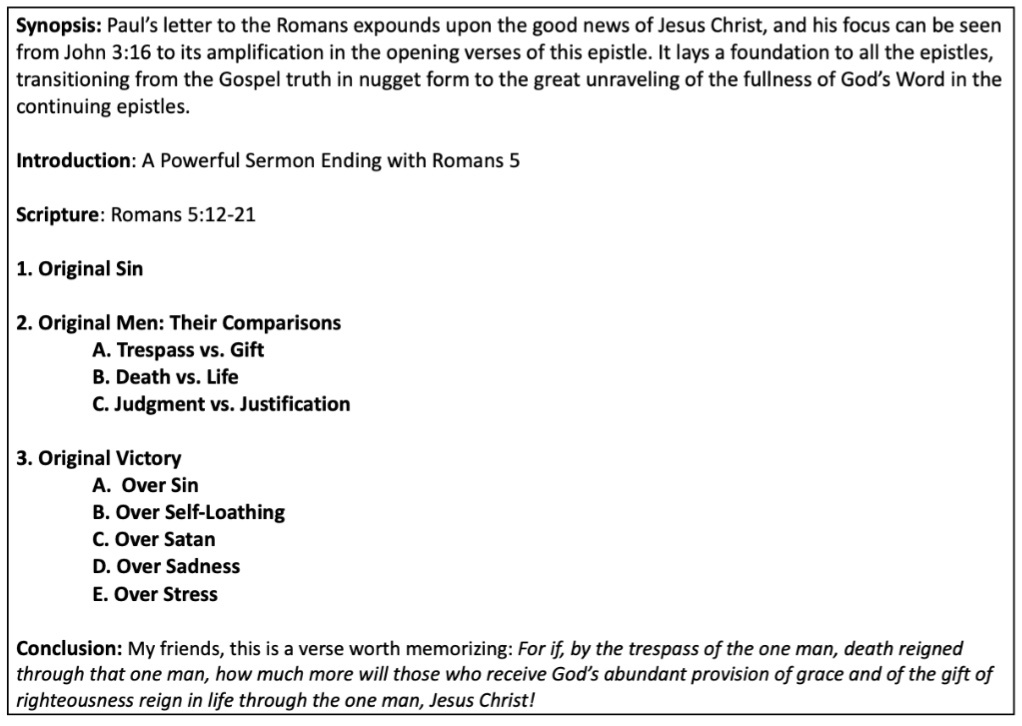
Introduction: Hello everyone! Years ago I sat in a chapel service where a wonderful and powerful preacher was holding forth with an authoritative message. I don’t remember his text. I don’t remember his topic. I don’t remember anything he said except his last words. In a voice that was quiet but strangely intense, he ended the message by quoting a verse of Scripture. He said: For if, by the trespass of the one man, death reigned through that one man, how much more will those who receive God’s abundant provision of grace and of the gift of righteousness reign in life through the one man, Jesus Christ!
I still remember the cadence of his voice as he spoke the words: …reign in life through one, Christ Jesus. During the decades since, I’ve intended to memorize that verse. Now, after all these years, I am memorizing it. Even today, I paced back and forth in my bedroom, reading and repeating this verse as if I were preaching in a vaulted European cathedral. And this verse is at the heart of the passage we’re coming to today—Romans 5:12-21.
Scripture
12 Therefore, just as sin entered the world through one man, and death through sin, and in this way death came to all people, because all sinned—
13 To be sure, sin was in the world before the law was given, but sin is not charged against anyone’s account where there is no law. 14 Nevertheless, death reigned from the time of Adam to the time of Moses, even over those who did not sin by breaking a command, as did Adam, who is a pattern of the one to come.
15 But the gift is not like the trespass. For if the many died by the trespass of the one man, how much more did God’s grace and the gift that came by the grace of the one man, Jesus Christ, overflow to the many! 16 Nor can the gift of God be compared with the result of one man’s sin: The judgment followed one sin and brought condemnation, but the gift followed many trespasses and brought justification. 17 For if, by the trespass of the one man, death reigned through that one man, how much more will those who receive God’s abundant provision of grace and of the gift of righteousness reign in life through the one man, Jesus Christ!
18 Consequently, just as one trespass resulted in condemnation for all people, so also one righteous act resulted in justification and life for all people. 19 For just as through the disobedience of the one man the many were made sinners, so also through the obedience of the one man the many will be made righteous.
20 The law was brought in so that the trespass might increase. But where sin increased, grace increased all the more, 21 so that, just as sin reigned in death, so also grace might reign through righteousness to bring eternal life through Jesus Christ our Lord.
Review and Overview
Let me propose a new outline for the material we’ve covered so far in Romans.
First, we have the Prologue, in Romans 1:1-17
Then we have sixty-four verses from Romans 1:18 to Romans 3:20 that can be summed up with the words: All Have Sinned.
The linchpin verses of Romans 3:21-31 say: But Now! And they take us to the heart of the Gospel: But now apart from the law the righteousness of God has been made known, to which the Law and the Prophets testify. This righteousness is given through faith in Jesus Christ to all who believe…
Chapter 4 can be summed up with two words: Abraham Believed. Paul takes us back to the Old Testament and shows us that justification by grace through faith has always been God’s operational plan for salvation—both in the Old Testament and in the New. Abraham believed God and it was credited to him as righteousness.
The next section is Romans 5:1-11: Peace with God! The great apostle tells us of the sure and certain and undeniable blessings that come into our lives as those who have been justified by faith and have peace with God.
1. Original Sin
Now today we are coming to the next section of God’s unfolding logical explanation of the Gospel. We can call it: Adam and Christ. In the last half of Romans 5, Paul rolls out an incredible historical parallel. Notice verse 14: Nevertheless, death reigned from the time of Adam to the time of Moses, even over those who did not sin by breaking a command, as did Adam, who is a pattern of the one to come.
Adam was a pattern. The Greek word is typos, or type, or prototype. When I say that the Old Testament is filled with information about Jesus, I don’t just mean verbal prophecies. There are many people, events, or objects in the Old Testament that prefigured Jesus. I like to say that Messianic Old Testament prophecy is made up of verbal predictions and visual representations. Here Paul says that Adam was a pattern or type of the coming Messiah. And in this passage, he shows us some points of comparison and some points of contrast.
In the final analysis, he is going to tell us that everyone in the world, everyone who has ever lived or will ever live, belongs to one of only two families—we either belong to the Adam Family or we belong to the Christ Family.
Paul begins by making a fantastic theological statement in verse 12: Therefore, just as sin entered the world through one man, and death through sin, and in this way death came to all people, because all sinned—
This is one of the greatest theological statements in all the Bible. Sin entered the world through one man, and when that one man sinned we all sinned. The entire human race fell into a state of sin and condemnation when Adam sinned. Look at the way it is phrased: sin entered the world through one man, and…. all sinned.
Sin was not in the world originally. It entered the world. How did it enter the world? Through one man–Adam
When Adam sinned, I sinned. I am a condemned sinner dating from the day Adam disobeyed God. That is what theologians call original sin. When you hear theologians use the phrase “original sin,” they aren’t talking just about the fact that Adam committed the original sin. They are talking about the fact that we all sinned when Adam committed that sin. They are talking about the fallen condition and guilt we inherit from him. The whole human race was infected with sin. The whole human race was condemned to death.
How could you or I have been involved in Adam’s sin when we had not yet been born? Well, there are two ways.
First, we were in Adam’s loins, to use a biblical phrase. We have a parallel passage in Hebrews 7 that helps us make sense of this. I’m going to read it in the New King James Version—Hebrews 7:1-10. This is a different subject but a similar principle that explains the biblical idea of corporate participation through ancestry. In this passage, the writer of Hebrews is talking about the story in Genesis 14, when Abraham met King Melchizedek and offered to him his tithes—a tenth of all his plunder. The passage says:
For this Melchizedek, king of Salem, priest of the Most High God, who met Abraham returning from the slaughter of the kings and blessed him, to whom also Abraham gave a tenth part of all, first being translated “king of righteousness,” and then also king of Salem, meaning “king of peace,” without father, without mother, without genealogy, having neither beginning of days nor end of life, but made like the Son of God, remains a priest continually.
4 Now consider how great this man was, to whom even the patriarch Abraham gave a tenth of the spoils. 5 And indeed those who are of the sons of Levi, who receive the priesthood, have a commandment to receive tithes from the people according to the law, that is, from their brethren, though they have come from the loins of Abraham; 6 but he whose genealogy is not derived from them received tithes from Abraham and blessed him who had the promises. 7 Now beyond all contradiction the lesser is blessed by the better. 8 Here mortal men receive tithes, but there he receives them, of whom it is witnessed that he lives. 9 Even Levi, who receives tithes, paid tithes through Abraham, so to speak, 10 for he was still in the loins of his father when Melchizedek met him.
Here is the argument the writer of Hebrews is making. Abraham met this powerful and mysterious man, Melchizedek, who was a special type of Christ. Abraham paid his tithes to him. He was a priest, and his priesthood was extraordinary. In fact, only Melchizedek and Jesus Christ would belong to this order of priesthood.
The writer says that even the priestly tribe of Levi was inferior to the priestly order of Melchizedek, and that Levi himself paid tithes to Melchizedek even though Levi would not be born for another 150 years or so. How could Levi pay tithes to Melchizedek when he wasn’t yet alive? He was in the loins of his great grandfather Abraham.
In the same way, the entire human race was in the loins of Adam when Adam sinned, and so we all sinned. This is a case of corporate participation through ancestry. The early theologian Augustine helped us understand this, and it is sometimes called the Augustinian or Realistic view of original sin.
There is another way theologians think about this. Now only were we in the loins of Adam, but we stood under his legal headship. He acted as our legal representative. What he did counted for us. Theologians call this the federal view of original sin. Think of it like this. When a head of state—let’s say a president or prime minister or king—signs a treaty with another nation, he is signing for us. He is representing us. He is committing every person in his realm to that treaty. In the same way, Adam is the federal head of the human race. He represented all of us, and legally his guilt was counted to us. In Adam’s act, we were counted as having sinned.
Third, not only were we in the loins of Adam, and not only are we in Him legally, but we all are in his legacy. The moment Adam sinned, he took upon himself a sinful nature, which every one of us has inherited. So Paul tells us here: Therefore, just as sin entered the world through one man, and death through sin, and in this way death came to all people, because all sinned.
Original Men: Their Comparisons
Interestingly, Paul stops himself here and interrupts himself—the NIV shows this by using a dash. And Paul wants to explain something in parenthesis. Some expositors believe the parenthetical portion goes all the way through verse 17, and that Paul doesn’t pick up his thought again until verse 18.
But even if that is true, the entire paragraph is contrasting Adam with Christ, and the material is very rich.
What Paul is telling us here is this: There are two men who head up the two families of humanity upon the earth. The great difference between human beings is not racial. It is not geographical. It is not political. It is not economic. It’s not by age grouping or by passports. It is not educational. We exploit all these differences, and we go to war over them. Our nation is divided right now because of some of these things.
But none of those things represent the great divide that slices through the population of earth. The major division in the human race is whether you still belong to the family of Adam or whether you now belong to the family of Jesus Christ. That’s what Paul is saying. That’s what Romans 5 is driving home.
This paragraph puts these two men side by side. In some ways they are alike. There are remarkable comparisons between them.
- They are the only two men in the history of the world who came into the world in a supernatural way—one was created full born and the other was virgin-born. Paul doesn’t mention this in Romans 5, but it is an understood set of facts.
- Adam and Jesus are the only two men who came into the world sinless and with an unbroken relationship with God already in place.
- Each is the head of a humanity. These are the only two men who serve as federal heads or representatives of humanity.
- Both committed a decisive act that changed history.
- Both of them introduce a reign. In one case, death reigns; in the other grace reigns.
- Both of these men shape the condition of those who are “in” them.
- Both are covenant heads in redemptive history.
So these men have remarkable points of comparison, but the primary point of the passage involves the contrasts between them. Christ is not merely like Adam; the good news is that he is unlike Him.
Original Men: Their Contrasts
Trespass vs. Gift
The first contrast is found in verse 15: But the gift is not like the trespass. The word “trespass” simply means to go where you should not go. If you are hiking through the woods and to your right is a fence and a sign that says, “No Trespassing,” it means you should not climb over the fence and enter that part of the woods. The Greek word literally means “false step.”
But like an old hymn says, we are “prone to wander.” And we feel it. We’re prone to go where we should not go:
- Morally, crossing lines of right and wrong.
- Sexually, ignoring God’s designs and boundaries.
- Financially, coveting and spending for things we don’t need or shouldn’t have.
- Legally, by disregarding laws.
- Mentally, by dwelling on thoughts we shouldn’t entertain.
- Emotionally, by allowing bitterness or anger or discouragement to fester within us.
But the contrasting word is somewhat surprising. What is the opposite of trespassing? It is a gift. Paul wrote, “But the gift is not like the trespass.” In return for our trespassing His laws, God has responded by giving us a gift. And that brings up the next contrast.
Death vs. Life
Verse 15 goes on to say: But the gift is not like the trespass. For if the many died by the trespass of the one man, how much more did God’s grace and the gift that came by the grace of the one man, Jesus Christ, overflow to the many!
Adam’s trespass brought death. Death spread through the human race. But God’s gift brought grace, and God’s grace was much greater than Adam’s trespass. Notice the words “how much more.” What God did for our benefit is much greater than what Adam did for our destruction.
Judgment vs. Justification
That brings us to the next contrast. Verse 16 says, Nor can the gift of God be compared with the result of one man’s sin: The judgment followed one sin and brought condemnation, but the gift followed many trespasses and brought justification.
Adam’s trespass brought judgment and condemnation to the human race, but God’s gift brought justification, which Paul has been describing in the previous sections of Romans. Paul repeats this in verses 18-19: Consequently, just as one trespass resulted in condemnation for all people, so also one righteous act resulted in justification and life for all people. For just as through the disobedience of the one man the many were made sinners, so also through the obedience of the one man the many will be made righteous.
And then Paul goes on to tell us he is talking about whether we are going to die or whether we are going to live forever. It depends on whether we are still in Adam or if we are now in Christ. The paragraph ends with verses 20-21: The law was brought in so that the trespass might increase. But where sin increased, grace increased all the more, so that, just as sin reigned in death, so also grace might reign through righteousness to bring eternal life through Jesus Christ our Lord.
Notice his last words: …eternal life through Jesus Christ our Lord. The next chapter, Romans 6, ends with the exact same words: For the wages of sin is death, but the gift of God is eternal life through Jesus Christ our Lord.
So the most important question we will ever answer is—am I still in the dying family of Adam, or am I now in the living family of Jesus Christ my Lord. This isn’t the only time Paul puts these two men side by side. This is what he wrote in 1 Corinthians 15:
Just as death came into the world through a man, now the resurrection from the dead has begun through another man.…. The Scriptures tell us, “The first man, Adam, became a living person.” But the last Adam—that is, Christ—is a life-giving Spirit…. Adam, the first man, was made from the dust of the earth, while Christ, the second man, came from heaven. Earthly people are like the earthly man, and heavenly people are like the heavenly man (verses 21 and 45-48 NLT).
Original Victory
Now all of that provides the context for our study of our key text of Romans 5:17: For if, by the trespass of the one man, death reigned through that one man, how much more will those who receive God’s abundant provision of grace and of the gift of righteousness reign in life through the one man, Jesus Christ!
What have we received? We have received God’s abundant provision of grace. The biblical writers used the word “abundant” to describe the quality and quantity of a heavenly gift that defied measurement.
- Numbers 14 says God is longsuffering and abundant in mercy.
- Nehemiah 9 says He is abundant in kindness.
- Psalm 37 says His people shall delight themselves in the abundance of peace.
- Psalm 130 says with Him is abundant redemption.
- Isaiah 55 says He abundantly pardons us.
- Titus 3 says He has poured out His Spirit on us abundantly.
- Ephesians 3 says He is able to do exceedingly, abundantly more than all we can ask or think.
- And Jesus said, “I have come that they may have life and may have it more abundantly.”
Here in Romans 5:17, we read that God has given us an abundant, measureless, boundless, over-the-top abundance of grace along with the gift of righteousness we have gained through our justification. And as a result of that we should be reigning in life. But what does that mean in practical terms? Let me suggest four things. We have royal authority:
Over Sin
First, we have the capability, through God’s abundant provision of grace, to reign over sin. This will be the subject of the next paragraph in Romans. Look at Romans 6:12, where Paul uses this same word: “Therefore do not let sin reign in your mortal body so that you obey its evil desires.”
You may think you aren’t doing very good at that, which is also the way I often think of myself. We are not yet perfect; we have not been glorified. And yet, a plain reading of the Bible tells us that when we are living a Christ-centered, Spirit-filled life it is possible and even normal for us to be able to live in consistent victory over known sin.
This is a phrase I learned from one of my mentors, Robertson McQuilkin. He talked about the possibility of living a life filled with the Spirit and having consistent victory over known sin.
In his sermon on this topic, Ray Stedman said, “Here is God’s provision that every believer in Jesus Christ, without exception, may live in continual, unbroken victory over every evil habit, every impatient spirit, every lustful thought, every discouraging circumstance, and every crushing disappointment in his life. He may enjoy, all the while, the smile of the Lord Jesus and the fellowship of an ungrieved Spirit.”
That doesn’t mean we don’t mess up and sin. It simply means that we really don’t have to. We may not have perfect victory, but we can have consistent victory. Paul is going to go into this in great detail in chapters 6, 7, and 8.
This is not a teaching of sinless perfection, but of Spirit-enabled progress.
Over Self-Loathing
Second, because of God’s abundant provision of grace and of the gift of righteousness we can have victory over this common affliction in our times called self-loathing. We look at ourselves with disgust because we do in fact mess up, and we are weighed down by a sense of failure. But the apostle Paul is going to give us a word about this too—in Romans 8:1: “Therefore, there is now no condemnation for those who are in Christ Jesus….”When I feel a sense of frustration and failure toward myself, that’s the verse I quote.
Over Satan
Third, because of God’s abundant provision of grace and of the gift of righteousness, we can reign in life over Satan. The last section of the book of Romans contains an interesting word about this—Romans 16:20: “The God of peace will soon crush Satan under your feet.” We’ll deal with that when we come to Romans 16, but for now let me point out that this verse comes just after Paul has warned the Romans of false teachers who cause divisions. The Christians in Rome were being buffeted by opposition from the Roman government and the infringement of divisive teachers. Paul indicated that Satan was behind these forces, but that the God of Peace was about to do what He had promised in Genesis 3:15 and crush Satan under the feet of His servants. We need to be aware of Satan’s devices, but we also need to treat him as a defeated enemy.
Over Sadness
Fourth, because of God’s abundant provision of grace and of the gift of righteousness, we can reign over sadness. The Lord does not want us to go around irritable and downcast. I have to remind myself of that sometimes, but the book of Romans helps me. Later in this letter, Paul is going to tell us, “Never be lacking in zeal, but keep your spiritual fervor, serving the Lord. Be joyful in hope…” (Romans 12:11-12). In Romans 15:13, he says, “May the God of hope fill you with all joy and peace as your trust in Him, so that you may overflow with hope by the power of the Holy Spirit.”
Over Stress
Finally, because of God’s abundant provision of grace and of the gift of righteousness, we can reign in life over stress. Romans 14:17-18 says, “For the kingdom of God is not a matter of eating and drinking, but of righteousness, peace and joy in the Holy Spirit, because anyone who serves Christ in this way is pleasing to God and receives human approval.” God wants to increase by degrees our righteousness, peace, and joy. Romans 15:4 adds that as we absorb the truth of the Scriptures, we will also grow in encouragement and hope.
So when Paul talks about reigning in life through the one man, Christ Jesus, he is really setting up the content of the rest of his letter. That’s why Romans is so wonderful. In a logical and theological way, we have the plan of God unfolded for us, including all the blessings and benefits found in His Gospel. Christianity is not about trying harder in Adam’s strength, but reigning in Christ’s grace.
Conclusion
Earlier I quoted Ray Stedman. Let me end with something else he wrote in his same message. He said, “When I was a student in Dallas Theological Seminary, I remember Dr. Lewis Sperry Chafer, president of the seminary, saying to us in a theology class that he considered the last half of Romans 5 the supreme test of a [person’s] theology, and, also, that this was the most concentrated summary of the basic truths of Christianity in all the Scriptures. He said that when he was visiting in churches around the country, especially churches of Dallas graduates, he always took occasion, when he was in the pastor’s study, to see if the fifth chapter of Romans was well worn in his Bible. While Dr. Chafer was alive, I always kept an index at that place in my Bible — in case he should come to visit me!”
My friends, this is a verse worth memorizing: For if, by the trespass of the one man, death reigned through that one man, how much more will those who receive God’s abundant provision of grace and of the gift of righteousness reign in life through the one man, Jesus Christ!