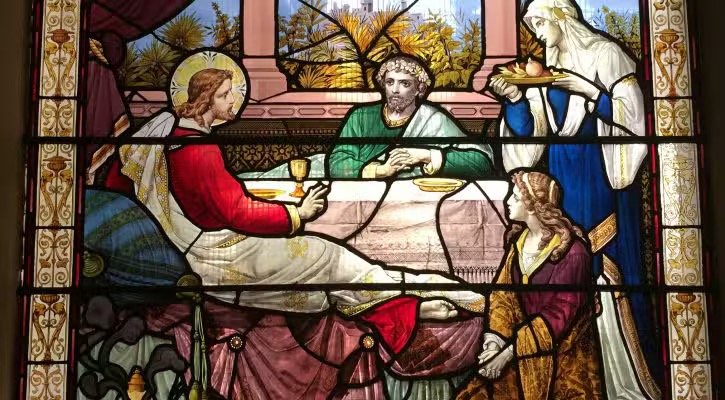
When you mess up but refuse to give up, Jesus will help you grow up. That’s the theme of our study today as we join Jesus in a home in Jerusalem where He hosted the Passover meal for His disciples.
A newspaper in 1909, The Birmingham (Alabama) Age-Herald, included a game for kids. Inside a box, a group of dots were arranged, without numbers, and children had to use their pencil to connect the dots and find a picture of a large boy. Six years later, The Newark Evening Star, published a cartoon with a child wondering what his birthday present would be. The cartoon title was “The Great Dot Mystery.” By connecting numbered dots, children could solve the puzzle.
By the time I was a child in the 1950s, connect the dot puzzles were in every newspaper, some comic books, and always included in children’s puzzle books and periodicals. Today children still play connect the dots digital games.
In the process, the phrase “connect the dots” became part of our common language. Intelligence agencies failed on 9/11 because they didn’t connect the dots. Detectives connect the dots by arranging evidence and discovering a pattern to the crime. In academic circles, scholars connect the dots by discerning facts and synthesizing them into a coherent theory.
Sometimes we even connect the dots when we study the Bible.
When it comes to one of the most sacred moments of the Gospel—the Lord’s final dinner with His disciples—I don’t want to presume to understand all the background. But I want to connect some dots and present a hypothesis for you to consider. It concerns a young man with whom you and I can easily identify—John Mark. He kept messing up. But he teaches us that when you persevere through one failure after another, you’ll arrive, by grace, at victory. Even if you keep messing up, if you don’t give up, the Lord Jesus will help you.
As a Rich Young Man
Let’s begin with the tenth chapter of Mark. Jesus was nearing Jerusalem on His way to be slain for the world, and a wealthy young man ran up to Him and knelt before Him, asking, “Good Teacher, what shall I do that I may inherit eternal life?”
All three Synoptic Gospels (Matthew, Mark, and Luke) record the story, but only Mark adds this poignant detail: “Then Jesus, looking at him, loved him” (Mark 10:21). Jesus told the young man to jettison his wealth, take up his cross, and follow Him. The man went away sorrowfully, and Jesus told the disciples how hard it is for rich people to follow Him. “It is easier for a camel to go through the eye of a needle than for someone who is rich to enter the kingdom of God.”
The disciples said in amazement, “Who then can be saved?”
Jesus replied, “With man this it is impossible, but not with God; all things are possible with God” (Mark 10:25-27). In other words, there was hope, even for this wealthy young man from an aristocratic Jewish family. Notice that Jesus didn’t give the man much time to think it over. When I gave my life to the Lord in full surrender, I took time to think it over. To make so momentous a decision on the spur of the moment was more than the young man—or perhaps you or I—could do.
But what if Jesus was simply planting the seed? What if this wasn’t the young man’s one and only opportunity? And what if this young man was John Mark, who would later write the second Gospel and recall how Jesus, looking at him, loved him?
In the early 1900s, a British pastor named Rev. J. Barton Turner wrote an article entitled “Who Was the ‘Rich Young Ruler? A Suggestion.’” He built a plausible case that the rich young man was Mark himself, who never forgot how Jesus conveyed his love for him by the emotional contact of their eyes during that moment of decision. Others have brought up the same possibility. When I was in graduate studies at Wheaton College, I had a professor who first alerted me to this line of thinking.
We can’t be certain, but sometimes it’s a matter of connecting the dots.
As a Levite from Africa
Now let’s delve into John Mark’s background. According to Acts 12, he was fairly well known; and he and his mother had a large home in Jerusalem. His uncle or cousin was named Barnabas, who was from the tribe of Levi and who grew up in Cyprus.
According to very strong and old African traditions, John Mark grew up in Cyrene in Libya. I’ll tell you more about this next week. His father and uncle were wealthy farmers, Levites, who studied and memorized Scripture in Hebrew. Because of unrest in Cyrene, the family fled to Israel. This family obviously brought their wealth to Jerusalem with them, because John Mark and his mother had a large house with at least one servant and probably more.
As a Host
Just a few days after meeting the rich young ruler, Jesus and His disciples had arrived in Jerusalem for the Passover, and Jesus needed someone to let Him use a spacious dining room for what we call the Last Supper. Look at Mark 14:12-16: On the first day of the Festival of Unleavened Bread, when it was customary to sacrifice the Passover lamb, Jesus’ disciples asked him, “Where do you want us to go and make preparations for you to eat the Passover?”
So he sent two of his disciples, telling them, “Go into the city, and a man carrying a jar of water will meet you. Follow him. Say to the owner of the house he enters, ‘The Teacher asks: Where is my guest room, where I may eat the Passover with my disciples?’ 15 He will show you a large room upstairs, furnished and ready. Make preparations for us there.”
Tell him the Teacher needs a room to host the Passover meal. There could be another clue there. What did the rich young ruler call Jesus? He said, “Good Teacher….” And now Jesus said, “Tell him the Teacher needs to borrow his dining room.”
And so we have the Last Supper in a room offered by a wealthy man in Jerusalem. This is the most famous supper in human history and we know what happened that night. The disciples come in irritated with each other and jockeying for position, so Jesus strips off His garment, dons a towel, and washes their feet.
He has supper with them and institutes the Lord’s Supper with the breaking of the bread and the sharing of the cup. He also tells them that one among them will betray Him, and Judas gets up and storms out of the room. He’s going for the authorities. He’s going to give up the location of the Last Supper so the Romans can arrest Jesus under cloak of darkness away from the eyes of the crowd.
Then Jesus begins to teach the remaining eleven. He says, “Let not your heart be troubled; you believe in God, believe also in Me. In My Father’s house are many mansions; if it were not so, I would have told you. I go to prepare a place for you. And if I go and prepare a place for you, I will come again and receive you to Myself; that where I am, there you may be also” (John 14:1-3 NKJV).
He says some more wonderful things in John 14, and then Jesus abruptly says, “Come now; let us leave” (John 14:31). This was unexpected, but Jesus did not want to be captured in that room or at that very moment. He was a step ahead of Judas. And so the twelve men suddenly got up, perhaps muttering and asking one another questions, and they filed down the staircase and began walking through the deserted and darkened streets of Jerusalem.
Meanwhile Jesus continued teaching them: “I am the vine, you are the branches. He who abides in Me, and I in him, bears much fruit; for without Me you can do nothing…. These things I have spoken to you, that My joy may remain in you, and that your joy may be full. This is My commandment, that you love one another as I have loved you…. In the world you will have tribulation; but be of good cheer, I have overcome the world” (John 15:5. 11-12; 16:33 NKJV).
At that point, Jesus paused. He was just below the towering Temple Mount, still on the western slopes of the Kidron Valley, and He began to pray. His prayer is recorded in John 17: Jesus looked toward heaven and prayed: “Father, the house has come. Glorify your Son, that your Son may glorify you…. I have brought you glory on earth by finishing the work you gave me to do…” (John 17:1-4).
John 18 continues: When he had finished praying, Jesus left with his disciples and crossed the Kidron Valley. Here they entered the Garden of Gethsemane, which was an olive orchard. Our Lord had only one hour of freedom left, and He knelt and prayed, “Nevertheless, not my will, but thine be done” (Luke 22:42 KJV).
Meanwhile Judas led the soldiers to the Upper Room, but imagine his shock and consternation when they found it empty. “Not to worry,” said Judas. “I think I know where they have gone. Follow me.” And he led them from the Upper Room to the Gethsemane.
As a Naked Runner
All four of the Gospels tell us about the arrest of Jesus, but Mark adds a very unexpected and curious detail. Look at Mark 14:51-52: A young man, wearing nothing but a linen garment, was following Jesus. When they seized him, he fled naked, leaving his garment behind. Many translations say he was wearing nothing but a linen sheet.
This is the mysterious naked runner in the Bible, and only Mark mentions him. Who could he be? Let’s connect the dots. Jesus held His Last Supper in Mark’s house—or the house he and his mother shared—and it got late. Jesus was still talking, and Mark undressed and went to bed. He was sleeping in a nearby room. Perhaps he could overhear voices from the nearby room. But when the party suspended their supper and left so abruptly, he grew curious. Looking out his window, he felt in his heart something wasn’t right. He jumped out of bed and wrapped the sheet around him and followed the men through the dark Jerusalem streets.
Mark is the only Gospel writer who adds this strange detail. It’s almost like his way of letting us know he was an eyewitness to this scene.
If I’m connecting the dots correctly, this is the second time the young man has failed. Jesus had told him, “Come, follow me” in Mark 10:21. But he didn’t do it. Now he had another chance, this time to join the Lord Jesus and stand by Him as He was arrested. Perhaps he and Jesus would have stood trial together. But the young man fled. And there’s one other corresponding fact. A Roman soldier managed to grab the linen sheet covering the man’s body, and the young fellow fled naked into the night. The next day, a Roman soldier also stripped Jesus of His clothing, and He was executed on the cross.
As a Converted Man
Are you ready to connect some more dots? On the first day of the week, the astonishing news flew from disciple to disciple that the tomb of Jesus was empty and that people had witnessed Him alive and breathing and talking and teaching. Ten of the disciples met together that evening. Judas had committed suicide and Thomas was too depressed to join them. Where did they meet? We don’t know, but the logical place would be in the Upper Room.
The apostle John wrote, On the evening of that first day of the week, when the disciples were together, with the doors locked for fear of the Jewish leaders, Jesus came and stood among them and said, “Peace be with you!” After he said this, he showed them his hands and side. The disciples were overjoyed when they saw the Lord (John 20:19-20).
A week later, Jesus appeared to His disciples again, and this time Thomas was among them. Our Lord lingered for nearly six weeks, and then He ascended into Heaven.
That brings us to the book of Acts, which continues the story: Then the apostles returned to Jerusalem from the hill called the Mount of Olives, a Sabbath day’s walk from the city. When they arrived, they went upstairs to the room where they were staying. Those present were Peter, John, James and Andrew; Philip and Thomas, Bartholomew and Matthew; James son of Alphaeus and Simon the Zealot, and Judas son of James. They all joined together constantly in prayer, along with the women and Mary the mother of Jesus, and with his brothers (Acts 1:12-14).
This large upper room became the headquarters for the followers of Jesus. John Mark isn’t mentioned, but if our conjectures are correct, he was certainly absorbed by what was happening and undoubtedly talking to Simon Peter about everything. And ten days later, what happened? Acts 2:1-2 says, When the day of Pentecost came, they were all together in one place. Suddenly a sound like the blowing of a violent wind came from heaven and filled the whole house where they were sitting.
Could the birth of the church have actually happened in the house of the rich young ruler and his mother? We can’t say for certain. But I can imagine it, and it is plausible. According to our traditions, this is also when John Mark finally made his commitment to Christ under the preaching of Peter, and he was among those baptized on the Day of Pentecost. More about that next week.
And I have one other piece of evidence to give you.
In Acts 12, Peter is arrested and condemned to be executed. But during the night, an angel comes and opens the prison doors so Peter can escape. Verses 12-13 says Peter went to the house of Mary the mother of John, also called Mark, where many people had gathered and were praying. Peter knocked at the outer entrance, and a servant named Rhoda came to answer the door.
Notice how this is worded: “Mary the mother of John Mark.” It was the young man who was known and his mother was defined by her relationship with him. He was the most prominent. It didn’t say “John Mark, whose mother is Mary whom we all know.” It said, “Mary, whose son, John Mark, we all know.
The home of John Mark and his mother was the meeting place for the Christians. It was large enough for many people. It had an outer entrance. The family was wealthy enough to have servants. And Mary was known as the mother of John Mark. I would suggest to you that John Mark was a wealthy young aristocrat who shared a home with his mother that was large and affluent enough to serve as the birthplace for the church in Jerusalem. I would also suggest that both John Mark and his mother had become followers of the risen Christ. I believe they were led to Christ by Peter.
As a Missionary Intern
But that doesn’t mean John Mark wasn’t going to mess up again. Let’s read Acts 13.
1 Now in the church at Antioch there were prophets and teachers: Barnabas, Simeon called Niger, Lucius of Cyrene, Manaen (who had been brought up with Herod the tetrarch) and Saul. 2 While they were worshiping the Lord and fasting, the Holy Spirit said, “Set apart for me Barnabas and Saul for the work to which I have called them.” 3 So after they had fasted and prayed, they placed their hands on them and sent them off.
This is a very important moment in Christian history. This is the beginning of church-sponsored church-planting operations. Until then, Christians had been scattered and wherever they went they preached the Gospel. But now we have a local church making a strategic decision to send missionaries out in order to establish churches in a way that is financed and backed by that local church.
This first team was made up of Barnabas, Saul of Tarsus; and a young man named John Mark who went along as their assistant. They left Antioch and their first day’s travel took them down to the harbor on the Mediterranean coast, which was the port of Seleucia. The Roman fleet for the region was stationed there, and there were undoubtedly many cargo ships. So Saul and Barnabas and John Mark bought tickets for the island of Cyprus, which was only about 60 miles offshore. Cyprus was the place where Barnabas had grown up.
Cyprus had two main cities—Salamis on the East and Paphos on the West. The ship docked in Salamis and that’s where we pick up the story in Acts 13:5: When they arrived at Salamis, they proclaimed the word of God in the Jewish synagogues. John [Mark] was with them as their helper.
Luke doesn’t tell us anything more about the ministry that occurred there. After preaching in various Jewish synagogues, the three missionaries made their way along the southern coastal route to the other major city, New Paphos. This was the Roman capital of the island. It was a journey of about 100 miles. There they met Sergius Paulus. In the last 150 years, archaeologists have found multiple ancient inscriptions about a man by this name who was a Roman official in the very period of time we’re reading about in Acts. Verse 7 says: The proconsul, an intelligent man, sent for Barnabas and Saul because he wanted to hear the word of God. Sergius Paulus became Paul’s first recorded convert on his first missionary journey. This is the first known convert of church-sponsored international missions. He was an intelligent man. He heard and considered the Gospel. He saw the rebuke given to his aide. And he believed. He was amazed and astounded at the teachings about the Lord.
Now look again at verse 13: From Paphos, Paul and his companions sailed to Perga in Pamphylia, where John left them to return to Jerusalem.
Something happened that upset John Mark and caused him to leave the team and to go back to Jerusalem. Later Paul accused Mark of deserting them and he refused to take him on any more tours with him. Barnabas might have been disappointed in his nephew but he was understanding. Paul, on the other hand, felt betrayed by the young man. This broke up the first missionary team in history.
We don’t know why John Mark deserted them. Was he worried about his mother? Was he uncomfortable with Paul’s gravitation toward the evangelization of Gentiles? Perhaps he was upset because Paul was insisting on lengthening their mission, leaving Cyprus, and going on to Turkey. When the team had left Antioch, Barnabas had been in charge. But Paul was becoming the dominant figure. If you read Acts 13 and 14 carefully, when the journey began, it was Barnabas and Paul, but midway through it became Paul and Barnabas—and that is just at the point when John Mark left them and returned to Jerusalem. It’s very possible that he grew angry and frustrated over Paul’s dominant personality and the psychological shift of leadership in the team.
At any rate, John Mark deserted them and returned to Jerusalem, and I imagine Barnabas was left with a sense of desolation over it. Paul was simply frustrated and angry. Look at Acts 15:36ff: Sometime later Paul said to Barnabas, “Let us go back and visit the believers in all the towns where we preached the word of the Lord and see how they are doing.” Barnabas wanted to take John, also called Mark, with them, but Paul did not think it wise to take him, because he had deserted them in Pamphylia and had not continued with them in the work. They had such a sharp disagreement that they parted company. Barnabas took Mark and sailed for Cyprus, but Paul chose Silas and left, commanded by the believers to the grace of the Lord.
As an Interpreter for Peter
Mark kept messing up, but he didn’t give up. According to very strong early documentary evidence, John Mark became Peter’s companion and interpreter. He traveled with Peter everywhere and listened as Peter told the stories about Jesus over and over. He wrote down the accounts, and that became the Gospel of Mark, most likely the first of the four Gospels to be written. Meanwhile, Paul finally came around and realized he had underestimated the young man. During his first Roman imprisonment, Paul wrote to the Colossian church and said, “My fellow prisoner Aristarchus sends you his greetings, as does Mark, the cousin of Barnabas. (You have received instructions about him; if he comes to you, welcome him” (Colossians 4:10).
During his second Roman imprisonment and shortly before his execution, Paul wrote to Timothy, saying, “Only Luke is with me. Get Mark and bring him with you, because he is helpful to me in my ministry” (2 Timothy 4:11).
As the Ambassador of Christ to Africa
After Peter and Paul were executed in Rome, Mark traveled to Alexandria, Egypt, and began the evangelization of the African continent. Dr. Thomas Oden wrote, “[John Mark] became known as the apostle to everywhere…. Geographically he covered more of the earth than Paul, witnessing on all three known continents.”
Conclusion
Dr. J. Barton Turner wrote, “The failing of one’s nature is not conquered in a moment. Even after one has left all and followed Jesus, there come times when the old weakness is felt intensely and its voice is obeyed. But the child becomes a man, and years bring strength, and so, in after days, Mark has grown out of his weakness and is ready for service and suffering.”
So many of us—and I certainly include myself—carry around a sense of failure or shame or guilt. We’re more aware of our defeats than our victories, and we wish we were better people than we are. But the one who has begun a good work in us will carry it on to completion (Philippians 1:6). Even when we mess up, if we don’t give up, the Lord Jesus will help us grow up, mature in the faith and useful for the Gospel. He will perfect that which concerns us (Psalm 128:8).