A Study of Romans 9
Hello everyone. Israel has been in the news recently. Israel is always in the news. This tiny nation on a narrow sliver of land seems to dominate the headlines around the world. Why is that—and what is God’s role for Israel in the future?
Today we’re resuming our study of the book of Romans and coming to one of the most difficult and complex chapters in Paul’s library of works, but I think we can read through it—Romans 9—and grasp his main points. Chapters 9 through 11 of Romans is all about the role of Israel in God’s plan for human history.
We’re coming to a new section of Romans. Everyone who studies this letter sees there are three clear sections to the book. Chapters 1 through 8 explain the Gospel—that we are justified by grace through faith in the redemptive work of Christ on the cross. Chapters 12 through 16, the last part of the book, tell us how we should then live. But in between we have chapters 9, 10, and 11. Paul wants to explain how Israel and the church are both channels of God’s redemption—and the role each one plays in God’s plan.
For the previous 2000 years, God’s program of redemption had focused on the Jewish people. God had chosen one man—Abraham—and given him a set of promises. God made a covenant with Abraham, and from his seed had come the redemption of the world. It had unfolded amid the turmoil of Old Testament history. But amazingly, when the Messiah was born of Abraham’s seed, the Jewish people rejected Him. And then something remarkable happened. The church, which began among Jewish believers, spread rapidly into the Gentile world. Gentiles were coming to Christ without first becoming Jewish or placing themselves under the Law of Moses. Had the church replaced Israel? What was going on?
That’s the issue Paul tackles in this section. Chapter 9 is such a hard passage to handle that this is my second attempt to explain it.
Background
Some historical background may be helpful. When I first began teaching Romans one-on-one to Taylor Melton, one of my young adults, he had been reading the book and couldn’t understand why Paul had so much to say about Jews and Gentiles. “What’s all this about the Jews and the Gentiles?” he asked. That was a great observation and question.
We believe it’s possible the church in Rome was started about A.D. 33 by Jews who had been to Jerusalem on the Day of Pentecost and were among those saved on that occasion. So the origins of the church in Rome were Jewish, but as the Gospel spread through the sprawling streets and allies of the world’s largest city, non-Jews began to embrace the message. Gentiles were saved.
Then in the year 49, Emperor Claudius expelled the Jews from Rome. We read about this in Acts 18, because Aquila and Priscilla had to leave Italy at that time. We don’t know if every single Jew left the city, but many of them were probably driven out. In any case, the expulsion evidently disrupted the Jewish community. The church, which was begun by Jews, now consisted primarily of Gentiles.
When Claudius died in 54, the Jews were able to return, and many of them did. We don’t know how this affected the relationships within the church. What we’re talking about are house churches—not one big, massive congregation. There wasn’t one large congregation meeting in a single building. Christians gathered in various homes around Rome. Some of these groups may have been predominantly Jewish, others predominantly Gentile, and still others a mixture of both.
Three years later, in A.D. 57, Paul wrote his letter, and one of his purposes was to help the Jewish and Gentile elements in the church to get on the same page, as it were. He wanted to help clarify the relationship between the two groups and help foster unity. So all the way through his letter, he says things like, “This applies to the Jews; this is true also of the Gentiles.” He wants us to know that both Jews and Gentiles are facing the wrath of God without Christ, and that we are all saved by grace through faith in the finished work of Jesus Christ.
But these two groups had a vastly different heritage. The Gentile Christians may have been tempted to dismiss the heritage of the Jews and downplay their importance. In fact, Paul specifically warns them against boasting over the Jewish people in Romans 11. The Jewish Christians, meanwhile, may have felt that their heritage was being disregarded. What did it mean to be Jewish now that Gentiles were coming to Christ on equal terms?
Did it no longer mean anything to be a Jew? Had God’s promises to Israel failed? Or had they all been fulfilled with Christ, so that being a Jew meant nothing? And why, if God had chosen the Jewish people as His channel of redemption, had He now laid them aside and formed a new entity—the church. Had He replaced Israel with the church?
There is another issue too. In Romans 8, Paul made a series of tremendous declarations about God’s power to keep us. He said that nothing could separate us from the love of God. But if that is true, then what about Israel? God made promises to Abraham and his descendants centuries earlier. Yet now many of the Jewish people had rejected their Messiah. Had God’s promises failed? And if God’s promises to Israel could fail, how could we be certain that His promises to us would stand? That’s why Paul includes this discussion of Israel and the church in chapters 9, 10, and 11.
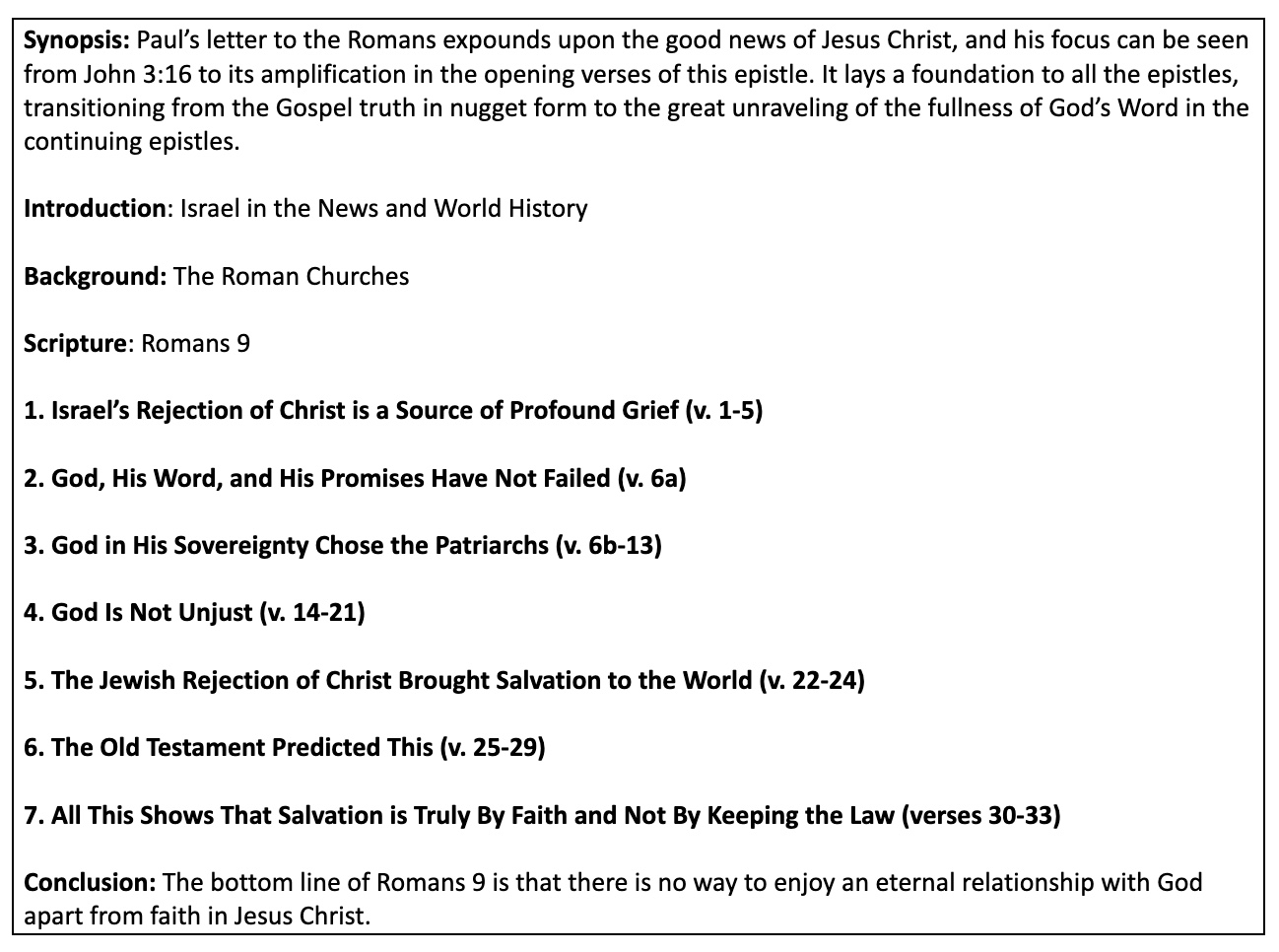
1. Israel’s Rejection of Christ is a Source of Profound Grief (v. 1-5)
As we work our way through Romans 9, paragraph by paragraph, let’s begin with verses 1-5. The theme of this opening paragraph is that Israel’s rejection of Christ is a source of profound grief to the apostle Paul, as it should be to us.
Let’s begin reading at verse 1!
I speak the truth in Christ—I am not lying, my conscience confirms it through the Holy Spirit—I have great sorrow and unceasing anguish in my heart. For I could wish that I myself were cursed and cut off from Christ for the sake of my people, those of my own race, the people of Israel.
In other words, Paul said that his burden for Israel was so great he would almost be willing to give up his own salvation and spend eternity in hell if it would bring the Jewish people to their Messiah. This may sound extreme, but almost every Christian parent of a prodigal child could come near to saying the same thing. The burden we bear for an unsaved loved one can be very great, and that makes Paul’s statement understandable to us. Now, he is going to list the advantages their historic faith gave them.
Theirs is the adoption to sonship; theirs the divine glory, the covenants, the receiving of the law, the temple worship and the promises. Theirs are the patriarchs, and from them is traced the human ancestry of the Messiah, who is God over all, forever praised! Amen.
Israel had to trample over all this, as it were, to reject their Messiah. The apostle Paul was a man with a burden. We see that in the book of Acts. Whenever I read the book of Acts, chapter 17, for example, I feel a pang of personal guilt. After a brutal series of months, Paul finally arrived in Athens, one of the most storied cities on earth with a rich history that perhaps exceeded any other metropolis of antiquity. When I find myself in a place like that for a few days, I want to explore and rest and see the sites. In fact, I was in Athens for several days earlier this year, and my main concern was to rest, to explore, and to find some good restaurants. But Acts 17:16 and 17 says, “While Paul was waiting for them in Athens, he was greatly distressed to see that the city was full of idols. So. He reasoned in the synagogue with both Jews and God-fearing Greeks, as well as in the marketplace day by day.”
He couldn’t turn off his burden for the lost. He told the Corinthians, “For Christ’s love compels us, because we are convinced that one died for all…. We are therefore God’s ambassadors, as though God were making his appeal through us. We implore you on Christ’s behalf: Be reconciled to God” (2 Corinthians 5:14; 20).
It is reminiscent of the words of Isaiah after he saw the glory of the Lord: “Here am I. Send me!” (Isaiah 6:8). Nineteenth-century missionary Robert Moffat is quoted as having said about his time in Africa, “In the vast plain of the north I have sometimes seen, in the morning sun, the smoke of a thousand villages where no missionary has ever been.” I want to see that smoke too, and to carry a burden for the unsaved—including the unsaved peoples among the Jews. May the Lord renew our burden, whether it’s for the neighbor across the street or the unreached tribe across the seas. This is the weight carried by the apostle Paul for his own people.
2. God, His Word, and His Promises Have Not Failed (v. 6a)
The apostle’s second point is that God, His Word, and His promises have not failed. It may appear that God’s plan for Israel collapsed, but the Lord has not broken any of the promises He made. Look at verse 6: It is not as though God’s word had failed.
We have to remember that the Jewish mindset was that if a person was a descendent of Abraham and had been circumcised and was living under the Law, they were saved. The Jewish critics said to Jesus in John 8, “We are Abraham’s descendants and have never been slaves to anyone. How can you say that we shall be set free?” They were God’s chosen people, which they thought gave them a kind of automatic salvation.
But in Romans, Paul had already said in chapters 2 and 3 that the Jews were as lost as anyone else, and so it sounded as though the covenants of God had failed. No, said Paul, God and His Word and His promises have not failed.
Israel’s rejection of their Messiah does not represent the failure of God’s promises or the collapse of God’s purposes. Paul said: It is not as though God’s word had failed. All God’s promises to Israel and all of the covenants He established are still operative.
3. God in His Sovereignty Chose the Patriarchs (v. 6b-13)
Paul’s third stage of discussion is to point out in verses 6 through 13 that God, in His sovereignty, chose the patriarchs—Abraham, Isaac, and Jacob. God sovereignly chose the individuals who comprised the line of descent for the Messiah, and sidelined many others. Look at verses 6 and following.
For not all who are descended from Israel are Israel. Nor because they are his descendants are they all Abraham’s children. On the contrary, “It is through Isaac that your offspring will be reckoned.”
You may not realize that Abraham had eight sons we know of. First, he had Ishmael with Hagar (Genesis 16). Then he had Isaac with Sarah (Genesis 21). After Sarah died, Abraham married Keturah and we have the names of six additional sons given in Genesis 25. But only Isaac was selected to be the heir of promise in the line of Messianic ancestry. Verses 8 and 9 continue:
In other words, it is not the children by physical descent who are God’s children, but it is the children of the promise who are regarded as Abraham’s offspring. For this was how the promise was stated: “At the appointed time I will return, and Sarah will have a son.”
Paul goes on to the next generation and says the same is true about Isaac’s children. He and Rebekah had two sons—twins—Esau, who was born first, and Jacob, who was born a moment later. But God passed over Esau and chose the younger son Jacob to be heir of the promise and in line of promise. Verses 10-13 continue:
Not only that, but Rebekah’s children were conceived at the same time by our father Isaac. Yet, before the twins were born or had done anything good or bad—in order that God’s purpose in election might stand: not by works but by him who calls—she was told, “The older will serve the younger.” Just as it is written: “Jacob I loved, but Esau I hated.”
That word “hated” puts us off, but it is a Jewish idiom meaning “bypassed” or “rejected.” Jacob was chosen in the sovereign will of God to be in the line of the ancestry of the Messiah. Paul ends his point there, but he could have gone on and talked about Jacob’s twelve sons, and how only Judah was chosen. And so forth for the next 2,000 years until Christ was born of the very lineage we read about in His genealogies in Matthew 1 and Luke 4.
This is a complicated passage, but I believe Paul is simply saying God is sovereign and He chooses who He wants to, and He chose Abraham, Isaac, and Jacob to inherit the promises and start the channel of redemption that led to the Messiah.
4. God Is Not Unjust (v. 14-21)
Now in verse 14, Paul anticipates someone objecting to his argument and accusing God of being unjust. If He arbitrarily chose Jacob and rejected Esau, even before the boys were old enough to make any decisions of their own, is God not unjust and unfair. How is it fair that He rejected the older and chose the younger? How can God be so arbitrary?
But the problem is the word “arbitrary.” God is not random, haphazard, capricious, or irrational. His decisions are not based on arbitrariness. We don’t have all the facts, and we don’t have the capacity to probe the limitless depths of the understanding of God. But we can say one thing for certain—God is not unjust, and He is not unfair.
Look at verses 14 and following: What then shall we say? Is God unjust? Not at all! For he says to Moses [and now Paul is going to quote from Exodus 33:9]: “I will have mercy on whom I have mercy, and I will have compassion on whom I have compassion.”
Verse 16 goes on: It does not, therefore, depend on human desire or effort, but on God’s mercy. For Scripture says to Pharaoh [and now Paul is going to quote from Exodus 9:16]: “I raised you up for this very purpose, that I might display my power in you and that my name may be proclaimed in all the earth.” Therefore God has mercy on whom he wants to have mercy, and he hardens whom he wants to harden.
This is a reference to the passages in Exodus that say that God hardened Pharaoh’s heart. Now, when I am teaching from Exodus and I explain this, I point out that Pharaoh himself had something to do with the hardness of his heart. But Paul doesn’t make that point here. Paul is simply telling us that God is sovereign and He has mercy on whom He wants to have mercy, and He hardens whom he wants to harden.
Again, I will point out that God is not arbitrary. He doesn’t just randomly roll the dice. There is some basis to His choices. We can speculate about what it is, and we may find some hints in Scripture. Some theologians point out that two different passages of the Scripture talk about God’s making decisions based on His foreknowledge. For example, 1 Peter 1:2 says we “have been chosen according to the foreknowledge of God the Father….” Arminians and Calvinists debate the meaning of that, too. But my main point is that God’s choices are never random or irrational. They arise from His perfect wisdom, His holy character, and His eternal purposes. But He has not revealed all the reasons for His decisions, nor has He given us the capacity to comprehend fully the depths of His reasoning. We might as well try to contain the Pacific Ocean in a teaspoon as try to understand the vastness of God’s thinking in our finite brains.
But Paul doesn’t mention that here in Romans 9. He simply says that God is sovereign, yet He is also fair and just. He chooses one and not another, He shows mercy to one and not another, but Paul does not give us the basis or an explanation for why this is so. He simply leaves us with the understanding that if we knew everything and had all the facts and truly had all wisdom, we would instantly understand that God is fair and just and merciful and good.
He doubles down on this in verses 19-21 by anticipating another objection: One of you will say to me, “Then why does God still blame us? For who is able to resist his will?” But who are you, a human being, to talk back to God? [And now he’s going to quote from Isaiah]: Shall what is formed say to the one who formed it, “Why did you make me like this?” Does not the potter have the right to make out of the same lump of clay some pottery for special purposes and some for common use?
Paul keeps going back to the fact that we—mere human beings—cannot fully understand the depths of God’s sovereign wisdom. Paul is telling us that God does not treat every single person the same way. We are all different. There is so much about our lives we cannot control. We have no say in who our parents were or when or how or where we were born. God treats each person uniquely and makes one in this way and another in that way. He doesn’t explain His reasons or the logical and reasonable depths of His sovereign will. But He is all powerful and all-knowing, and that is a very good thing for us. If God wasn’t sovereign, we’d be in a lot of trouble.
So let’s recapitulate. Israel’s rejection of Christ is a source of profound grief, but it is not God who failed. Indeed, God is the one who sovereignly chose the individuals over a 2,000 year period who would bring the Messiah into the world. When we discuss God’s authority to do this, it does raise questions. We don’t understand it all. How does God’s sovereignty interact with our personal responsibility to make moral choices and to choose to follow Jesus? Paul doesn’t deal with that. He simply tells us that our questions are answered by recognizing that the Lord is God, He is the Potter and we are the clay, and we can trust Him to be fair and wise and good. He does what He wants and fulfills what He purposes. But what He wants and what He purposes to do is always right and righteous.
5. The Jewish Rejection of Christ Brought Salvation to the World (v. 22-24)
Now, Paul gets to his main point about Israel. Remember, his whole discussion here involves the fact that God chose Israel to be the people through whom the Messiah would come, but when He came He was rejected by that very nation. How do you explain this?
Paul’s explanation is that it was all part of God’s plan. Paul introduces this with two sentences that begin with the words, What if….
We use those words when we want to introduce an idea people have perhaps never before considered. What if we decided to take a trip and visit Ouagadougou? What if we moved to Florida to be near our kids? What if the reason I got sick was so I could witness to the patient down the hall. We use those words to introduce new possibilities. So now Paul wants us to consider the fact that the Jewish people rejected their Messiah so that the Gospel could ricochet off them, as it were, and strike the whole world. Look at verse 22 and Paul’s first “what if” question: What if God, although choosing to show his wrath and make his power known, bore with great patience the objects of his wrath—prepared for destruction?
What if God put up with Israel’s rebellion over and over and over again, showing His great patience for Israel, although they would face His wrath?
And the second “what if”: What if he did this to make the riches of his glory known to the objects of his mercy, whom he prepared in advance for glory—even us, whom he also called, not only from the Jews but also from the Gentiles?
What if God, in His sovereign wisdom, has patiently endured human rebellion and unbelief, even while preparing to display the riches of His mercy? And what if the recipients of that mercy include not only believing Jews but also believing Gentiles? What if God’s sovereign purposes are much larger than anyone had imagined?
Somehow in the plan of God, the Jewish rejection of Christ led to the creation of the church and accelerated the spread of the Gospel of grace to the whole world.
6. The Old Testament Predicted This (v. 25-29)
Paul’s next point is that the Old Testament predicted this. We can see how God told us all this in advance. Paul quotes from the prophet Hosea in verse 25: As he says in Hosea: “I will call them ‘my people’ who are not my people; and I will call her ‘my loved one’ who is not my loved one.”
The Gentiles—the non-Jews—were not My chosen people. But I will call them to be My people and My loved ones.
And in verse 26, Paul quotes another passage from Hosea: In the very place where it was said to them, “You are not my people,” there they will be called “children of the living God.’”
And now Paul is going to quote Isaiah 10: Isaiah cries out concerning Israel: “Though the number of the Israelites be like the sand by the sea, only the remnant will be saved. For the Lord will carry out his sentence on earth with speed and finality.”
In other words, a small portion of the Jewish people will embrace the Messiah during this age. Then Paul goes on to quote from the first chapter of Isaiah: It is just as Isaiah said previously: “Unless the Lord Almighty had left us descendants, we would have become like Sodom, we would have been like Gomorrah.”
In other words, Isaiah predicted that a remnant of Jews would embrace the Savior and will join the Gentiles in following Jesus.
7. All This Shows That Salvation is Truly By Faith and Not By Keeping the Law (verses 30-33)
And now we come to the seventh paragraph in Romans 9. All of this is the ultimate demonstration that salvation is truly by faith and not by keeping the law. Look at verses 30-33:
What then shall we say? That the Gentiles, who did not pursue righteousness, have obtained it, a righteousness that is by faith; but the people of Israel, who pursued the law as the way of righteousness, have not attained their goal. Why not? Because they pursued it not by faith but as if it were by works. They stumbled over the stumbling stone. As it is written: “See, I lay in Zion a stone that causes people to stumble and a rock that makes them fall, and the one who believes in him will never be put to shame.”
Here, interestingly, Paul now points out that Israel had a role in her own destiny in this. He said that Israel did not understand the nature of the Law, which is something he explained in great detail earlier in Romans. The Law was never given to be a ladder to Heaven, but to be a yardstick showing us our shortcomings and causing us to trust God’s mercy. The Jews pursued righteousness by work, by trying to keep the Law. But those who make up the church—both Jews and Gentiles—come by faith in the cornerstone of Jesus Christ.
So let me review: Paul said that he carries in his heart a deep and painful burden for the salvation of his Jewish brothers. But their rejection of their Messiah did not indicate the failure of God’s promises and plans. God is sovereign and can do whatever He wants, but He is not unjust. We cannot understand all His ways. He is the Potter and we are the clay. All we know is that He has a sovereign plan; and in His sovereign plan the Jewish rejection of Christ brought salvation to the world, as the Old Testament predicted—salvation that is by faith alone and grace alone through Christ alone.
Conclusion
As Douglas Moo puts it, the main point of this paragraph is to show that “God’s Word never offered salvation to all of the biological descendants of Abraham. Salvation was never a birthright, even for Jews, but always a gift of God’s electing love, a gift He is free to bestow on Gentiles as well as Jews.”
Now, let me address one other issue. If you’re familiar with theological systems, Romans 9 for the most part sounds very Calvinistic. This is a foundational passage for Calvinism, which teaches that God is sovereign and chooses who will be saved. I will point out the obvious. Paul’s primary subject in Romans 9–11 is God’s sovereign dealings with Israel and the Gentiles in redemptive history, not primarily a systematic explanation of how God chooses individuals for salvation. Nevertheless, some of his statements bear directly on that question and are very strong.
On the other hand, Romans 10 places emphasis on human responsibility, which is something our Arminian friends particularly emphasize. At the heart of the next chapter is verse 13:
For it is with your heart that you believe and are justified, and it is with your mouth that you profess your faith and are saved. As Scripture says, “Anyone who believes in him will never be put to shame.” For there is no difference between Jew and Gentile—the same Lord is Lord of all and richly blesses all who call on him, for, “Everyone who calls on the name of the Lord will be saved.” How, then, can they call on the one they have not believed in? And how can they believe in the one of whom they have not heard? And how can they hear without someone preaching to them? And how can anyone preach unless they are sent? As it is written: “How beautiful are the feet of those who bring good news!
Romans 9 places tremendous emphasis on God’s sovereignty—His calling, choosing, mercy, and purposes. Romans 10 places tremendous emphasis on human responsibility—we must hear, believe, confess, and call upon the Lord. Christian theologians have debated for centuries exactly how those two truths fit together.
I happen to believe both can be true at the same time, but I do not have the totality of knowledge to explain the mystery. All of us have heard how Artificial Intelligence is solving mathematical problems that have puzzled scholars for years. Well, there are some theological issues that have puzzled scholars for years. AI isn’t going to solve them, but the omniscient mind of God understands all the issues and to Him they present no logical contradictions. We’ll understand more by and by, and so I’m content to accept the mystery of things I don’t fully understand—the mystery of the Trinity; the dual nature of Jesus Christ; the problem of evil; and the balance between the sovereignty of God and the free will of humanity.
I love the way John Stott addresses this issue by appealing to a preacher of yesteryear. Let me quote Stott:
Few preachers can have maintained this balance better than Charles Simeon of Cambridge in the first half of the nineteenth century. He lived and ministered at a time when the Arminian–Calvinist controversy was bitter, and he warned his congregation of the danger of forsaking Scripture in favor of a theological system. “When I come to a text which speaks of election,” he said in 1831, “I delight myself in the doctrine of election. When the apostles exhort me to repentance and obedience, and indicate my freedom of choice and action, I give myself up to that side of the question.”
[Stott continued]: In defense of his commitment to both extremes, Simeon would sometimes borrow an illustration from the Industrial Revolution: As wheels in a complicated machine may move in opposite directions and yet subserve a common end, so may truths apparently opposite be perfectly reconcilable with each other, and equally subserve the purposes of God in the accomplishment of man’s salvation.
Invitation
The bottom line of Romans 9 is that there is no way to enjoy an eternal relationship with God apart from faith in Jesus Christ. This week I read about a girl in India named Satabdi [sha-tob’-di] Banerjee, who grew up in a home that worshipped many gods and goddesses. While in the tenth grade, she took a Bible offered her by a Gideon worker, and she began reading the book of Romans. In chapter 1, she read about how humans reject the one true God and begin worshipping idols. In chapter 3, she read, “For all have sinned and fall short of the glory of God.” She kept reading and came to chapter 5—God demonstrates His own love for us in this, that while we were still sinners Christ died for us.
Not wanting anyone to see her, she went to the bathroom and began to cry. “The Lord opened my heart. I knew that I believed through reading the Scriptures,” she said. Her parents and family thought someone had brainwashed her, yet Satabdi continued studying God’s Word. It took her almost a year and a half to find another believer, and she eventually joined a church in Calcutta. “I prayed, ‘God, what do you want from me?’ and He answered, ‘Go, spread the Word.’”
Today, God continues opening doors all over the world for Satabdi to share her story. All over the globe, people are responding to the only true message of hope the world has ever known. I hope you do the same.