A Study of Romans 8:15-17
Everybody dreams at one point or another about receiving a visit from an attorney telling us that a long-lost unknown relative has died and has left us a fortune. Such a thing does occasionally happen, and there was even a television show some years ago on the BBC entitled Heir Hunters. It was about professional probate researchers who track down people who are legally entitled to inherit estates but often had no idea that an inheritance was waiting for them. Some episodes involved wonderful moments when an investigator actually knocked on someone’s door and told an unsuspecting person that he or she had just inherited a windfall. The program ran for twelve series.
Well I feel like one of those investigators right now, knocking on your door to let you know that as a child of God you are legally entitled to inherit a vast estate, and we’ll look at this not only in the book of Romans but in some other New Testament letters. But let’s begin here with Romans chapter 8, beginning with verse 15:
15 The Spirit you received does not make you slaves, so that you live in fear again; rather, the Spirit you received brought about your adoption to sonship. And by him we cry, “Abba, Father.” 16 The Spirit himself testifies with our spirit that we are God’s children. 17 Now if we are children, then we are heirs—heirs of God and co-heirs with Christ, if indeed we share in his sufferings in order that we may also share in his glory.
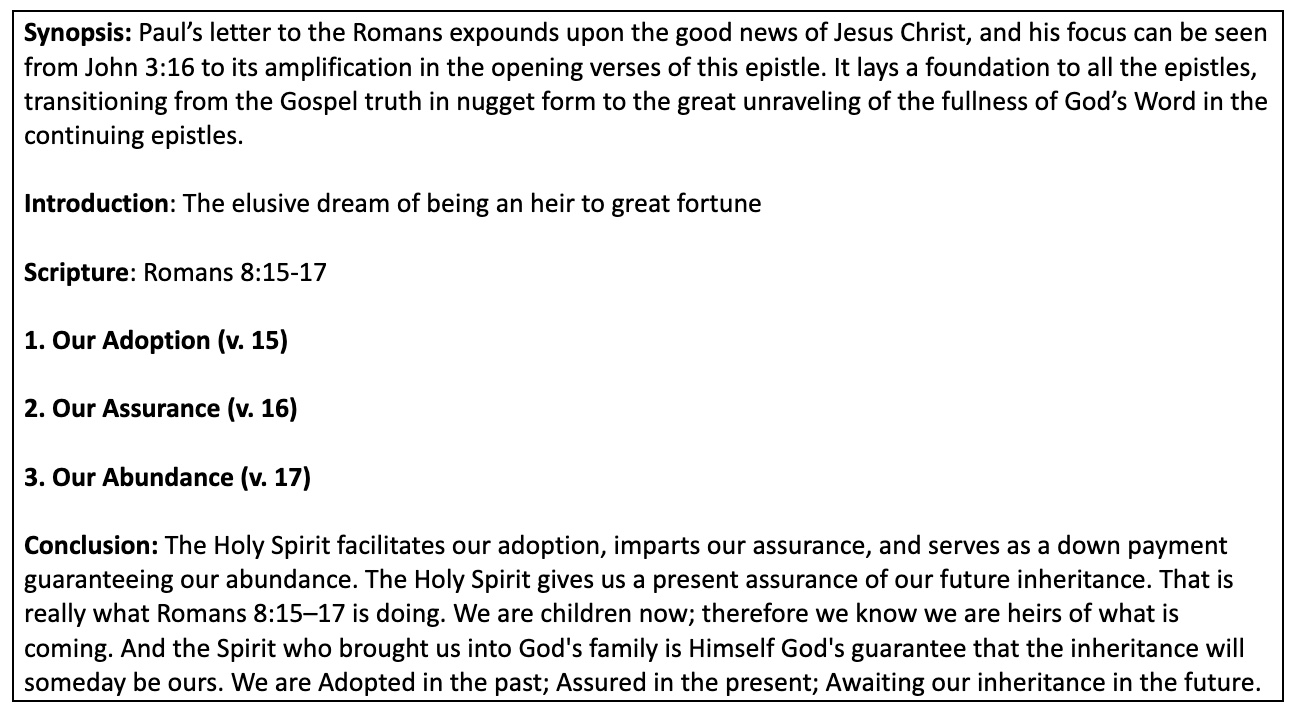
It is very easy to follow the progression of Paul’s thinking here. Verse 15 has to do with our adoption; verse 16 has to do with our assurance; and verse 17 has to do with our abundance.
Our Adoption (Verse 15)
We have already looked in the last episode at our adoption into God’s family. I just finished reading Anne of Green Gables. I had never read it before nor had I seen any of the movies or television shows. I went into the novel not knowing what to expect, but the whole story was a pleasure to read.
Anne Shirley was an eleven-year-old orphan who had spent much of her childhood being passed from household to household and then living in an orphanage. Matthew and Marilla Cuthbert, an unmarried brother and sister living at Green Gables on Prince Edward Island, decided to adopt a boy to help Matthew on the farm. But when Matthew went to the train station to collect the boy, he realized there had been a misunderstanding. It was a girl who was waiting for him there. Marilla was very upset and intended to send Anne back. Matthew was immediately taken with Anne, and before long even Marilla’s resistance began to melt. When they told her that she could live with them on and on, Anne said, “I’m so happy. It’s the first time I’ve ever been happy.”
Pastor Aaron Menikoff wrote, “Adoption is rooted in God’s eternal plan and inexhaustible love. Before mountains rose, rivers ran, or birds flew, God “predestined us for adoption to himself as sons through Jesus Christ.” His desire to place sinners in His family through the work of His Son precedes even the work of creation. We can only marvel at the kindness of God who would not call us merely His friends, but also His own sons and daughters. [As the Bible says, ‘See what kind of love the Father has given to us, that we should be called children of God; and so we are.’”
Our Assurance (Verse 16)
Pastor Menikoff also wrote, “Most adopted children, after the gavel has been struck, are tempted to question if their new home will last. They wonder if they really belong to their family and if this new home really belongs to them. But when it comes to God’s adoption of His people, there can be no doubt or uncertainty. He is forever their Father. It is, after all, the will of God that makes justified sinners His children.”
And that brings us to verse 16, which speaks of our assurance. The Spirit himself testifies with our spirit that we are God’s children. I wish I could explain this to Vice President J.D. Vance. He recently gave an interview to evangelist Bryce Crawford, who asked him how confident he was that he would go to Heaven, telling him to rate his answer on a scale from 1 to 10. Vance replied, “Oh man, that is a tough question. It’s high, but it’s not a 10. I mean, it’s a seven or it’s an eight.” He added, “If you’d asked me that question a year ago, it probably was like a five or a six.”
Crawford told Vance that at one time he, too, would have answered with a six. But a pastor challenged that way of thinking by asking him whether Jesus had died for only 60 percent of his sins. That answer changed Crawford’s perspective. He now answers ten, not because of confidence in his own goodness, but because of his confidence in what Jesus has done.
I have no idea about where the vice president stands in relationship with the Lord Jesus Christ, but I believe that if you and I know Him as Savior, we can go to bed tonight with 100% confidence in our salvation and that we are going to heaven. And it’s the Holy Spirit who gives us the inner reassurance.
The question isn’t whether I have complete confidence in myself; it is whether I have complete confidence in Christ.
Now, we certainly need to have an intellectual grasp on the truthfulness and reliability of the Bible and the Christian message. And we need to trust Him. But when those things are in place, the Holy Spirit confirms it all in the inner recesses of our minds. He whispers to us, in the words of Romans 8: “Therefore there is now no condemnation to those who are in Christ Jesus.
We looked at all that in the last installment as well, so let’s go on now and spend the remainder of our time on verse 17, which speaks of our abundance.
Our Abundance (Verse 17)
Now if we are children, then we are heirs—heirs of God and co-heirs with Christ, if indeed we share in his sufferings in order that we may also share in his glory.
I turned to my commentary by Dr. Douglas Moo, and this is what I read: “Paul uses the word ‘inheritance’ to introduce his qualification of our adoption in terms of its future aspects.”
In other words, our privileges as God’s children are wonderful right now, but incomplete. Moo suggests that Paul is talking here about “eschatological life”—or the abundant blessings yet to come.
Indeed, Paul goes on to say, as we’ll see next week—and this is the next verse, Romans 8:18: For I consider that the sufferings of this present time are not worthy to be compared with the glory which shall be revealed in us.
Right now we are living in this present time, and we are in a world of which suffering is an inevitable aspect. Some of that suffering may be due to our commitment to Christ, but some of it is common to all of humanity. We live in a disturbing world, and there are fears and alarms on every side.
The other day I met with the young couple who are contemplating going into vocational ministry. I told them that when the Lord calls someone to be a pastor of a church, it is the highest calling on earth and we are sustained by the strength of the Lord. But along the way we will become engulfed with the tragedies that afflict our congregations.
I related some of the situations I had faced, such as sitting with a mother as her five-year-old son died in her arms from a liver disease; ministering to a family who had suffered from mass murder; and staying up through the night with the family whose teenage daughter had been killed in an automobile accident.
I suddenly realized I may have been doing more harm than good as I talked to them. I didn’t want to frighten them away from pastoring, and I went on to reassure them of God’s sustaining grace in every circumstance. But life is full of distress. Dealing with suffering and tragedy is not just the plight of people who are in pastoral ministry. The amount of evil, heartache, violence, misfortune, and frustration in life, well, it seems never ending.
But Paul is going to say that the sufferings of this present life are not worthy to be compared with the glory that is going to be revealed to us when Jesus comes again, and we are glorified, and we fully come into the inheritance that is ours in the new heavens, the new earth, and the city of new Jerusalem, where we will enjoy the glorified life and all of its abundant splendor. Paul is speaking especially of the sufferings that come with belonging to Christ, but as the chapter unfolds he will widen the lens to encompass the groaning and suffering of the entire creation.
He goes on to say in verse 24: For we were saved in this hope, but hope that is seen is not hope…. In other words, our inheritance, and our glory and abundant splendor is the substance of our hope, our sure and certain expectation of what’s ahead. If we were already living in glory, we wouldn’t have to still hope for it. The fact that we look forward in hope means that it is not here yet; it is ahead of us.
Colossians 1:12 says to give “joyful thanks to the Father, who has qualified you to share in the inheritance of his holy people in the kingdom of light.”
The book of Hebrews takes this concept back to Old Testament days, saying,
By faith Abraham, when called to go to a place he would later receive as his inheritance, obeyed and went, even though he did not know where he was going. 9 By faith he made his home in the promised land like a stranger in a foreign country; he lived in tents, as did Isaac and Jacob, who were heirs with him of the same promise. 10 For he was looking forward to the city with foundations, whose architect and builder is God…. All these people were still living by faith when they died. They did not receive the things promised; they only saw them and welcomed them from a distance, admitting that they were foreigners and strangers on earth. 14 People who say such things show that they are looking for a country of their own. 15 If they had been thinking of the country they had left, they would have had opportunity to return. 16 Instead, they were longing for a better country—a heavenly one. Therefore God is not ashamed to be called their God, for he has prepared a city for them. (Hebrews 11:8-16).
Our coming inheritance involves:
- Sharing in the glory of God
- Sharing Christ’s glory
- Living with a perfected, permanent, personal body—your own body, resurrected and glorified—with imperishable qualities.
- Having a life that never ends.
- Living in the palatial settings of New Jerusalem and the gorgeous expansions of the New Earth.
- Fellowshiping and enjoying the pleasure of the company of all the redeemed of all the ages including our loved ones.
- Serving the Lord in meaningful ways and being productive and involved in projects without fatigue or frustration.
- Enjoying sounds we’ve never heard, colors we’ve never seen, fragrances we’ve never smelled, flavors we’ve never tasted, and experiences we’ve never felt.
- Mingling with angels and with the host of the now-unseen world and having them as our neighbors and fellow servants.
- Worshiping with full awareness in the very presence of the Lord’s glory.
- Gone will be all sickness, worry, anxiety, regret, and frustration.
- And having face-to-face conversations with the Lord Jesus Christ.
All of that is ahead of us, but for now we have the Holy Spirit as a down payment or deposit.
The apostle Paul wrote, “For no matter how many promises God has made, they are “Yes” in Christ. And so through him the “Amen” is spoken by us to the glory of God. 21 Now it is God who makes both us and you stand firm in Christ. He anointed us, set his seal of ownership on us, and put his Spirit in our hearts as a deposit, guaranteeing what is to come” (2 Corinthians 1:20-22).
Again he wrote, For while we are in this tent [our present body], we groan and are burdened, because we do not wish to be unclothed but to be clothed instead with our heavenly dwelling [our glorified body], so that what is mortal may be swallowed up by life. 5 Now the one who has fashioned us for this very purpose is God, who has given us the Spirit as a deposit, guaranteeing what is to come” (2 Corinthians 5:4-5).
In Ephesians 1, he wrote, “And you also were included in Christ when you heard the message of truth, the gospel of your salvation. When you believed, you were marked in him with a seal, the promised Holy Spirit, who is a deposit guaranteeing our inheritance until the redemption of those who are God’s possession—to the praise of his glory” (verses 13-14).
There it is in one sentence: The Holy Spirit is God’s deposit in our hearts, guaranteeing our inheritance.
He told the Colossians, “Whatever you do, work at it with all your heart, as working for the Lord, not for human masters, since you know that you will receive an inheritance from the Lord as a reward. It is the Lord Christ you are serving” (Colossians 3:23-24).
And let me show you one other related passage. The book of Galatians is, in some ways, a miniature version of the book of Romans. Paul touches on many of the same themes. Here is the way this truth is stated in Galatians 4:1-7:
4 What I am saying is that as long as an heir is underage, he is no different from a slave, although he owns the whole estate. 2 The heir is subject to guardians and trustees until the time set by his father. 3 So also, when we were underage, we were in slavery under the elemental spiritual forces of the world. 4 But when the set time had fully come, God sent his Son, born of a woman, born under the law, 5 to redeem those under the law, that we might receive adoption to sonship. 6 Because you are his sons, God sent the Spirit of his Son into our hearts, the Spirit who calls out, “Abba, Father.” 7 So you are no longer a slave, but God’s child; and since you are his child, God has made you also an heir.
Did you notice the sequence? Slaves become sons; sons receive the Spirit; the Spirit cries, ‘Abba, Father’; and because we are God’s children, we become His heirs. That’s almost exactly the progression Paul gives us here in Romans 8.
Conclusion
Ladies and gentlemen, we are living in a broken world. It is torn by war, fractured by fighting, tortured with tragedy, and filled with sickness and suffering. We have wars on the outside and anxieties on the inside. The Lord Jesus Christ gives us strength for each day and the grace to endure. We do not despair, but we realize we are strangers and pilgrims, living in tents, heirs of the promise, and eagerly looking forward to a city with foundations whose builder and maker is God.
I think we need to train our minds to think and ponder and anticipate our future. Colossians
3 tells us to set our hearts and minds on things above, where Christ is seated at the right hand of God.
Jesus said, “Let not your hearts be troubled. You believe in God; believe also in Me. In My Father’s house are many mansions. If it were not so, I would have told you. I go to prepare a place for you, that where I am there you may be also” (John 14:1-3).
I memorized those verses in elementary school through a scripture memory program we had in my classroom. They have stayed with me all these years. So I want to challenge you to memorize John 14:1-3. And if you already know them, find a way to display them on your wall or mirror or dashboard. For a few days quote them each morning when you wake up and again in the evening before you fall asleep.
Every once in a while, read Revelation 21 and 22, the Bible’s most effusive treatment of our heavenly home.
One of the most repeated quotes by CS Lewis is this one:
Christians who did most for the present world were just those who thought most of the next. The Apostles themselves, who set on foot the conversion of the Roman Empire, the great men who built up the Middle Ages, the English Evangelicals who abolished the Slave Trade, all left their mark on Earth, precisely because their minds were occupied with Heaven. It is since Christians have largely ceased to think of the other world that they have become so ineffective in this. Aim at Heaven and you will get earth ‘thrown in’: aim at earth and you will get neither.
The Holy Spirit facilitates our adoption, imparts our assurance, and serves as a down payment guaranteeing our abundance.
The Holy Spirit gives us a present assurance of our future inheritance. That is really what Romans 8:15–17 is doing. We are children now; therefore we know we are heirs of what is coming. And the Spirit who brought us into God’s family is Himself God’s guarantee that the inheritance will someday be ours.
We are
- Adopted in the past.
- Assured in the present.
- Awaiting our inheritance in the future.
And next week we’ll go on to study Romans 8:18-25, our present suffering and future glory.