
A Study of Romans 10
The Lord alone can change hearts. He can do remarkable things, even in the lives of sixteen-year-olds.
Hello everyone and welcome to today’s episode from the book of Romans, chapter 10.
The other day at church, I sat with a couple of young 84-year-olds. The gentleman, whose name was Dean, told me his story. When he was a teenager in 1960, his family was fractured, and his father was a raging alcoholic, gambler, and womanizer. Dean’s grandmother cared for him. “I was staying with my grandparents in Minneapolis. One day, my grandmother told me Billy Graham was coming to town and asked if I would like to go hear him. I decided to go. I remember how deeply Billy Graham’s message touched my heart. At the time, I wasn’t attending church or serving the Lord. But when the invitation was given, I got up, walked down to the altar, and accepted Jesus Christ as my personal Savior.”
“A few months later—perhaps five or six months—my grandmother and I were watching television together. A Billy Graham crusade was about to be televised, and my grandmother suggested we watch it.
“As the program began, I said, ‘Grandma, I think this is the very crusade I attended! It’s at the State Fairgrounds in Minneapolis.’
“Then, as Billy Graham gave the invitation, something amazing happened. The television cameras zoomed in on a young man walking down to the altar. It was me! My grandmother and I sat there watching the very moment when I had walked forward to accept Jesus Christ as my Savior. I could hardly believe it!”
In the years that followed, Dean led every member of his family to the Lord, including a never-to-be-forgotten moment when his father, who had been particularly resistant to the Gospel, was dramatically saved. And from that day when he was sixteen years old, Dean has continued serving the Lord faithfully.
That’s the power of the Gospel. That’s why Paul wrote his book to the Romans, to help us understand the Gospel and the incredible power it possesses to transform lives. In chapters one through eight, Paul explains the theology, the doctrine, and the rationale of the Gospel message. But how does one actually receive this message? How is one actually and literally saved? How does that catalytic moment happen? Paul answers that question in Romans 10 as he continues to deal with the issue of the dynamic between Israel and the church in God’s plan for the ages. Let’s read this chapter together.
Scripture
1Brothers and sisters, my heart’s desire and prayer to God for the Israelites is that they may be saved. For I can testify about them that they are zealous for God, but their zeal is not based on knowledge. Since they did not know the righteousness of God and sought to establish their own, they did not submit to God’s righteousness. 4Christ is the culmination of the law so that there may be righteousness for everyone who believes.
5Moses writes this about the righteousness that is by the law: “The person who does these things will live by them.”
6But the righteousness that is by faith says: “Do not say in your heart, ‘Who will ascend into heaven?’ ” (that is, to bring Christ down) “or ‘Who will descend into the deep?’ ” (that is, to bring Christ up from the dead). But what does it say? “The word is near you; it is in your mouth and in your heart,” that is, the message concerning faith that we proclaim:
9If you declare with your mouth, “Jesus is Lord,” and believe in your heart that God raised him from the dead, you will be saved. For it is with your heart that you believe and are justified, and it is with your mouth that you profess your faith and are saved. 11As Scripture says, “Anyone who believes in him will never be put to shame.” 12For there is no difference between Jew and Gentile—the same Lord is Lord of all and richly blesses all who call on him, 13for, “Everyone who calls on the name of the Lord will be saved.”
14How, then, can they call on the one they have not believed in? And how can they believe in the one of whom they have not heard? And how can they hear without someone preaching to them? And how can anyone preach unless they are sent? As it is written: “How beautiful are the feet of those who bring good news!”
16But not all the Israelites accepted the good news. For Isaiah says, “Lord, who has believed our message?” Consequently, faith comes from hearing the message, and the message is heard through the word about Christ. But I ask: Did they not hear? Of course they did: “Their voice has gone out into all the earth, their words to the ends of the world.”
19Again I ask: Did Israel not understand? First, Moses says, “I will make you envious by those who are not a nation; I will make you angry by a nation that has no understanding.”
20And Isaiah boldly says, “I was found by those who did not seek me; I revealed myself to those who did not ask for me.”
21But concerning Israel he says, “All day long I have held out my hands to a disobedient and obstinate people.”
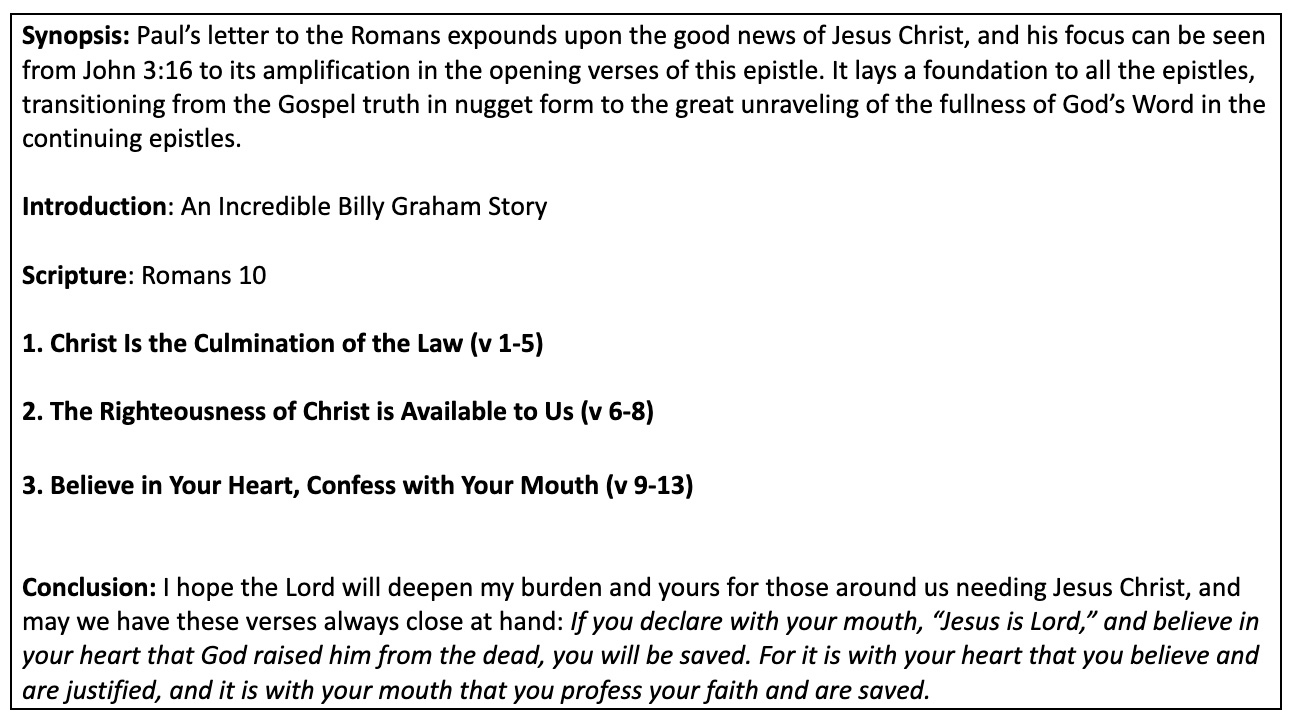
1. Christ Is the Culmination of the Law (v 1-5)
As I analyze it, Paul is making several points here, and in doing so he is providing a recapitulation of his explanation of the Gospel, which occupies chapters 1 through 8. His first point is that Christ is the culmination of the law. Look at verses 1-4 again.
Brothers and sisters, my heart’s desire and prayer to God for the Israelites is that they may be saved. For I can testify about them that they are zealous for God, but their zeal is not based on knowledge. Since they did not know the righteousness of God and sought to establish their own, they did not submit to God’s righteousness. 4Christ is the culmination of the law so that there may be righteousness for everyone who believes.
Paul recognized that the Jewish people, many of them, were very religious. People all over the world are religious. There is something within the human heart that longs for a relationship with God. The Bible says we have eternity in our hearts. Augustine is quoted as saying we all have a God-shaped vacuum inside of us. People have developed many different religious traditions trying to fill that vacuum, and many of them are very zealous. But zeal without the genuine knowledge of the truth is a very dangerous thing. Look at Islamic fanaticism and all of the tragedy and geopolitical catastrophes that have come from that one slice of religious zeal.
The apostle Paul was saying that the Jewish people, many of them, were very zealous in trying to keep the law. They thought if they could call Abraham their father and if they could reasonably live in accordance with the law, that they were saved. They thought that was the key to a relationship with God. They thought they could live a good enough life to earn heaven. Look at verse 5, which is a quote from Leviticus 18: “The person who does these things will live by them.” In other words the person who totally obeys the law will have life through the perfection of their law keeping.
What they didn’t take into account is that almighty God is infinitely perfect and infinitely holy, and not even one tiny shred of a little shadow of any sin can exist in His presence. Every human being has fallen short of the perfect keeping of the law.
Every human being except one! Jesus Christ is the culmination of the law. He observed it completely. He lived without any sin. In the exterior of His life He lived an absolute obedience to every one of the Ten Commandments and to every one of the 613 Jewish laws of the Torah. But in an even greater way in the interior of His life He never violated the love or the character or the holiness of God. He never harbored resentment or allowed a lustful fantasy to dominate His brain. His motivations were always and only for the glory of the Heavenly Father and not for His own well-being. He never overreacted, was never rude, never lost His patience or His temper, and His love for everyone was always perfect and pure and unceasing. Both inwardly and outwardly He was the only righteous man, the only righteous person, who has ever lived.
We cannot be saved by depending on our own righteousness but by placing our full faith and trust in His. Commentators tell us this discussion really begins at the end of chapter 9 and runs through this paragraph of chapter 10. The primary point is that Israel sought a righteousness that came from keeping the law and they failed to receive the righteousness that comes from Christ, who is the fulfillment and the culmination of the law.
2. The Righteousness of Christ is Available to Us (v 6-8)
Now in verses 6, 7, and 8, the great apostle is going to show us how accessible and available salvation really is when we come to Jesus Christ in simple faith. Before we read these verses, I want to read you this beautiful passage in Deuteronomy, which Paul is going to adopt for his own purposes.. In Deuteronomy 30, Moses told the Israelites:
Now what I am commanding you today is not too difficult for you or beyond your reach. It is not up in heaven, so that you have to ask, “Who will ascend into heaven to get it and proclaim it to us so we may obey it?” Nor is it beyond the sea, so that you have to ask, “Who will cross the sea to get it and proclaim it to us so we may obey it?” No, the word is very near you; it is in your mouth and in your heart so you may obey it.
Now Paul is going to quote this passage and apply it to Jesus. I’ll paraphrase for you. What Paul says is this: The relationship with God you need through Jesus Christ, who is our righteousness, is available to you. You don’t have to climb up to heaven to find Jesus. You don’t need to dive into the depths of hell to find Jesus. He and his salvation are very accessible and very available and very close. You simply have to come to Him by faith.
3. Believe in Your Heart, Confess with Your Mouth (v 9-13)
In the next paragraph, Paul tells us exactly how to do that. Look at verses 9 through 13:
If you declare with your mouth, “Jesus is Lord,” and believe in your heart that God raised him from the dead, you will be saved. For it is with your heart that you believe and are justified, and it is with your mouth that you profess your faith and are saved. 11As Scripture says, “Anyone who believes in him will never be put to shame.” 12For there is no difference between Jew and Gentile—the same Lord is Lord of all and richly blesses all who call on him, 13for, “Everyone who calls on the name of the Lord will be saved.”
That little phrase, “Jesus is Lord,” is the simplest creed in all of Christendom. This was no small confession for Christians living in the Roman world, where the emperor was acclaimed as kurios, or lord, and where imperial loyalty could carry religious obligations. To say “Jesus is Lord” is to acknowledge that He alone is the supreme authority over everything in the cosmos—over the visible and invisible realms, over all creation, over the entire universe, now and forevermore, from eternity to eternity. No one is higher or greater in power, authority, dominion, or sovereignty. He is fully God, coequal and coeternal with God the Father and God the Holy Spirit.
But there is something else. When we say, “Jesus is Lord,” the implication is that we are saying. “Jesus is my Lord.” I am here and now turning my entire life over to Him, to live a life pleasing to Him, and to rearrange my life so that everything circulates around His will.
I read about an evangelist who said, “A young man came to visit me with a question on his mind. He asked, ‘I prayed to receive Jesus as my Savior, but why has nothing really changed in my life?’ I asked him, ‘Who is running your life?’ He replied, ‘I am!’”
The evangelist inquired further, “Has anyone informed you that Jesus wants to be your Lord and run your life?”
“No one has,” he answered. The evangelist then asked him, “Would you be willing to pray right now and give Jesus complete charge over your whole life?” He said, “Yes, I will.” He was very willing. After he accepted Jesus as his Lord and gave Him full authority and control, the young man’s life changed. He reported having a new desire to be with Christians, to pray, to read his Bible and also to share about his new life with others.
When you say that Jesus is Lord you are giving him the permission to run your life. And why would you do that? Because there is a very tightly related truth–that Jesus Christ, the righteous perfect Savior of the world, gave His life for you and died and rose on the third day. Paul said, “If you declare with your mouth, ‘Jesus is Lord,’ and believe in your heart that God raised him from the dead, you will be saved.”
All the way through the book of Romans, Paul emphasizes the theological necessity and the historical reality of the resurrection of Jesus Christ:
- In the very prologue of the book, and Romans 1, verses 3 and 4, Paul said that the Gospel was a message from God “…regarding his Son, who as to his earthly life was a descendant of David, and who through the Spirit of holiness was appointed the Son of God in power by his resurrection from the dead: Jesus Christ our Lord.”
- In Romans 4: 24 and 25, Paul wrote, “God will credit righteousness—for us who believe in him who raised Jesus our Lord from the dead. He was delivered over to death for our sins and was raised to life for our justification.”
- Romans 5:10 says, “For if, while we were God’s enemies, we were reconciled to him through the death of his Son, how much more, having been reconciled, shall we be saved through his life!”
- Romans 6:4 says, “We were therefore buried with him through baptism into death in order that, just as Christ was raised from the dead through the glory of the Father, we too may live a new life.”
- Romans 6:8, 9, and 10 say, “Now if we died with Christ, we believe that we will also live with him. For we know that since Christ was raised from the dead, he cannot die again; death no longer has mastery over him. The death he died, he died to sin once for all; but the life he lives, he lives to God.
- And look at Romans 7:4: “So, my brothers and sisters, you also died to the law through the body of Christ, that you might belong to another, to him who was raised from the dead.”
- We have this superb promise in Romans 8:11: “And if the Spirit of him who raised Jesus from the dead is living in you, he who raised Christ from the dead will also give life to your mortal bodies because of his Spirit who lives in you.”
- Romans 8:34 says, “Who then is the one who condemns? No one. Christ Jesus who died—more than that, who was raised to life—is at the right hand of God and is also interceding for us.”
- And finally, Romans 14:8-9 says, “If we live, we live for the Lord; and if we die, we die for the Lord. So, whether we live or die, we belong to the Lord. For this very reason, Christ died and returned to life so that he might be the Lord of both the dead and the living.”
There is substantial historical evidence for the resurrection of Jesus Christ from the tomb of Joseph of Arimathea in the first century. To believe in the resurrection is not a blind leap. It is a reasonable conclusion based on compelling evidence. But to me, some of the strongest confirmations for the veracity of the resurrection involves the logic that provides the unbroken basis of God’s brilliant, long-term, extended operation in human history for the redemption and salvation of people like you and me.
From the very first messianic prophecy in Genesis 3:15, and all the way through the 2000 years between Abraham and Jesus, the message of all of the prophets involved God’s plan for saving the world from death, the death that resulted from Adam’s disobedience. It should not surprise us, then, if at the heart of human history there would be an unspeakable sacrifice and a glorious resurrection. The resurrection is not merely supported by historical evidence; it also makes profound sense within the entire unfolding story of Scripture. And that is why Paul said:
9If you declare with your mouth, “Jesus is Lord,” and believe in your heart that God raised him from the dead, you will be saved. For it is with your heart that you believe and are justified, and it is with your mouth that you profess your faith and are saved. 11As Scripture says, “Anyone who believes in him will never be put to shame.” 12For there is no difference between Jew and Gentile—the same Lord is Lord of all and richly blesses all who call on him, 13for, “Everyone who calls on the name of the Lord will be saved.”
The remainder of chapter 10 is Paul’s exhortation for us to take this message to the world. He said, “How, then, can they call on the one they have not believed in? And how can they believe in the one of whom they have not heard? And how can they hear without someone preaching to them? And how can anyone preach unless they are sent? As it is written: “How beautiful are the feet of those who bring good news!”
And he ends chapter 10 by lamenting Israel’s failure to do that. But now, and in the light of that, the Gospel has gone out to all of the world.
Conclusion
I found an amazing story related to this passage on the website for the Australian Bible Society. It was one of the stories collected by missionary Naomi Reed and it involved a woman who was concerned about her mother, who was named Margaret. The woman said:
My mother (Margaret) was born in 1920 and died in 2020, six weeks off turning 100. She had a Christian upbringing, but she was in her twenties in World War 2, and all her friends went off to war. Not many of them came back. She decided God wasn’t worth knowing. She became a secular humanist – she believed in the goodness of man, and she saw science as having the answers.
It continued her whole life, until she was 98. I became a Christian at age 17 and I talked to her about Jesus but after a while, she told me to back off, and I did. I said I wouldn’t mention my faith again until she had questions. Life went on for us both….
My father died, aged 92. Mum was 86 by then and she found it very hard. She moved into a retirement village in Sydney which wasn’t too bad at first. She still had her poetry groups and her Shakespeare groups…. But then one day, aged 95, she had a breakdown. She suddenly came to the end of herself. She wanted to die. She became aggressive to the staff, and they had to give her tranquilizers.
Afterwards, I told my siblings I wanted to bring her out to [the town] where my husband and I lived. She thrived there, in a retirement village and I would visit her every day. On the weekends, we’d take her to family events, including church.
It was the first time she’d been to church as an adult. She knew some of the old hymns and she seemed to be enjoying it. One day, two years later, at 98, she said to me, “How do I become a member?”
I explained to her that we don’t do membership at our church. We just attend and we belong. But then my husband said, “I don’t think she’s talking about membership. She’s looking for a relationship with Christ.”
For the next few weeks, I read Romans 10:9 with her, “If you declare with your mouth, ‘Jesus is Lord,’ and believe in your heart that God raised him from the dead, you will be saved.”
By then, mum could only concentrate for 5 minutes at a time, so it took us weeks to read that verse and understand it. We read a few words each day and she had questions…. Finally, I said that Jesus asks us to come to him like little children….”
She said, “Oh, yes!” And she did. She believed in Jesus for the first time. She was 98. Soon after that, she asked me if she could do a public declaration of her faith at church. She did. She went up to the front of the church, in her wheelchair and shared. Everybody sang, “Blessed Assurance, Jesus is mine.” Then a group of people gathered around her and laid hands on her to pray for her.
She died just under two years later. But she was different in that time. She sang hymns and prayed. She enjoyed being a child of God. The staff loved her. On the day she died, she seemed distressed, so my husband recited Psalm 121 to her, and she calmed down. I held her hand and I said Jesus will take you home. She died at peace.
In looking back, it amazes me. We never pushed her to faith. In 50 years, we always respected each other’s beliefs. But in the end, she came to Jesus herself. God answered my prayers. I was so excited! I started praying for her when I was 17. It took all that time (49 years) till she was ready. It’s amazing!”
I hope the Lord will deepen my burden and yours for those around us needing Jesus Christ, and may we have these verses always close at hand: If you declare with your mouth, “Jesus is Lord,” and believe in your heart that God raised him from the dead, you will be saved. For it is with your heart that you believe and are justified, and it is with your mouth that you profess your faith and are saved.