A Study of Romans 8:12-13
Hello everyone. The Bible tells us to do something I hardly know how to do. How do we slay stubborn sins? How do we eradicate bad habits? How do we overcome addictive patterns? The answer is summed up in two remarkable verses in Romans 8, which we’ll look at in this episode.
The subject of Romans 8 has to do with the Spirit-enabled life. So if you have a Bible nearby and can follow along, you might open it to that passage.
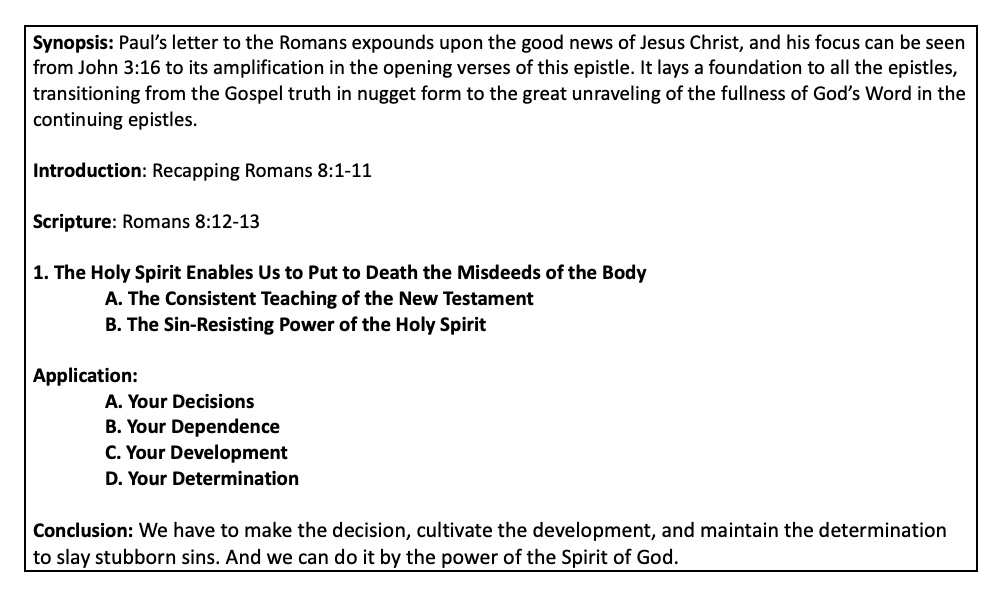
So far in the first 11 verses of Romans 8, we’ve discovered seven supernatural operations of the Holy Spirit in our lives.
1. The Holy Spirit Awakens Your Dead Soul
2. The Holy Spirit Unshackles You from Sin and Death
3. The Holy Spirit Changes Your Lifestyle
4. The Holy Spirit Infuses a New Set of Desires into Your Personality
5. The Holy Spirit Is Able to Govern Your Mind
6. The Holy Spirit Represents the Presence of Christ Within Your Life.
7. The Holy Spirit Will Raise Your Body Imperishable in the Last Day
Now, let’s go to these next two verses that, well, they boggle my mind—verses 12 and 13, which tell us how to slay stubborn sins: Therefore, brothers and sisters, we have an obligation—but it is not to the flesh, to live according to it. 13 For if you live according to the flesh, you will die; but if by the Spirit you put to death the misdeeds of the body, you will live.
8. The Holy Spirit Enables Us To Put to Death the Misdeeds of the Body
And this brings us to the eighth operation of the Holy Spirit in our lives. He enables us to put to death the misdeeds of the body. It’s very interesting how the great apostle frames this. He tells us that one day we will have pure and perfect, permanent and perpetual bodies, equipped for eternity. But while we are earthbound, we cannot escape the struggle we have to keep our bodies from veering into sinful patches.
This happens to be the passage in Romans 8 that I’m currently committing to memory, and my motivation was boosted by the remarkable comments of Dr. Martyn Lloyd-Jones on these verses. In his studies through Romans, he said:
In many ways these two verses are perhaps the most important statement with regard to the practical aspect of the New Testament doctrine of sanctification in the whole of Scripture…. Here we are told exactly how, in practice, the Christian becomes sanctified.
The whole process of sanctification involves growing in holiness, maturity, and personal victory over stubborn sins. The book of Hebrews tells us to throw off the sins that so easily entangle us. We are all unique individuals, created differently, and susceptible to different weaknesses. It is true that our temptations are “common to mankind” (1 Corinthians 10:13), but they are not identical in the way they afflict us. As we read the Bible, we find that God’s people struggled with different besetting sins.
Moses struggled with anger and a quick temper (Numbers 20:10-12). David was distracted by sexual temptation (2 Samuel 11). Jonah wrestled with resentment and rebellion against God’s compassion (Jonah 1; 4). Thomas battled doubt (John 20:24-29). Martha was overwhelmed by worry and anxiety (Luke 10:38-42). The prodigal son pursued reckless pleasure and addictive self-indulgence (Luke 15:11-32). James and John were overly ambitious, seeking positions of honor and power (Mark 10:35-45). King Saul was consumed by jealousy (1 Samuel 18-26). Ananias and Sapphira tried to deceive the apostles so they could pad their pockets (Acts 5:1-11). Paul told Timothy that some of the people in Ephesus had been seduced by the doctrines of demons (1 Timothy 4:1). James warned that some people can’t control their tongue (James 3:8).
What is your besetting sin? Is there a habit in your life that you cannot seem to overcome?
The Bible tells us here in Romans 8: But if by the Spirit you put to death the misdeeds of the body, you will live.
Notice carefully what Paul is saying, but also notice what he is not saying. He does not tell us to put our bodies to death; he tells us to put to death the sinful deeds our bodies are tempted to do. Throughout the history of Christianity, some characters have misunderstood this distinction. They practiced severe asceticism, believing they could conquer sin by punishing the body through prolonged fasting, self-flagellation, exposure to harsh climates, or solitary exile. But the problem is never merely the body. Our bodies are good. They are fearfully and wonderfully made. They are the homes of the Holy Spirit who lives within us, and God has given us bodies so we can enjoy the many pleasures He has created for us here on this earth. It is the sinful heart that misuses the body. As one old monastic saying puts it, “I fled into the desert to escape the dancing girls, only to discover they were still dancing in my head.”
The problem lies with the misdeeds of the body. We want to eat too much or drink too much or engage in sexual activities beyond what the Lord has designed for us. We feel lazy. We become addicted to entertainment or games. We let our eyes look at the wrong things. We let our ears hear the wrong dialogue. We let our mouths say the wrong words. We can’t seem to control our emotional reactions.
The apostle Paul is telling us there are two ways to correct this and to bring our bodies under sanctified control.
First, we are to put to death the misdeeds of the body. We are to discard these bad habits like a gardener pulling up weeds from his flowerbed.
Second, we are to realize we cannot do this in our own strength or by our own ability. So we must go about this process in the power of the Holy Spirit. The Holy Spirit, who lives within us, can enable and empower us to live a better, holier, and more sanctified life from day to day. Our ability to slay stubborn sins is directly related to how we relate to the Holy Spirit.
The verse, again, says: But if by the Spirit you put to death the misdeeds of the body, you will live.
This is the Consistent Teaching of the New Testament
I want you to see, first of all, that this verse is not an outlier. When you begin to look for it, you find this teaching throughout the New Testament. The most obvious cross reference is in Galatians 5. In fact, Galatians 5 takes this idea and expounds on it perfectly, saying:
16 So I say, walk by the Spirit, and you will not gratify the desires of the flesh.
17 For the flesh desires what is contrary to the Spirit, and the Spirit what is contrary to the flesh. They are in conflict with each other, so that you are not to do whatever you want. 18 But if you are led by the Spirit, you are not under the law.
19 The acts of the flesh are obvious: sexual immorality, impurity and debauchery; 20 idolatry and witchcraft; hatred, discord, jealousy, fits of rage, selfish ambition, dissensions, factions 21 and envy; drunkenness, orgies, and the like. I warn you, as I did before, that those who live like this will not inherit the kingdom of God.
22 But the fruit of the Spirit is love, joy, peace, forbearance, kindness, goodness, faithfulness, 23 gentleness and self-control. Against such things there is no law. 24 Those who belong to Christ Jesus have crucified the flesh with its passions and desires. 25 Since we live by the Spirit, let us keep in step with the Spirit.
We are to walk in the Spirit, keep in step with the Spirit, cultivate the fruit of the Spirit, and be led by the Spirit. This is what gives us the power to resist the sins of the flesh and slay the stubborn sins that so easily besets us.
We see the same thing in 1 Thessalonians 4, beginning with verse 3:
It is God’s will that you should be sanctified: that you should avoid sexual immorality; 4 that each of you should learn to control your own body in a way that is holy and honorable, 5 not in passionate lust like the pagans, who do not know God…. 7 For God did not call us to be impure, but to live a holy life. 8 Therefore, anyone who rejects this instruction does not reject a human being but God, the very God who gives you his Holy Spirit.
Do you see the same connection? It is God’s will for us to be sanctified and avoid sexual immorality and other lusts. We must learn to control our bodies in a way that is holy and honorable; and we can do that because of the very God who has given us His Holy Spirit.
One more passage—Ephesians 5:15-18:
15 Be very careful, then, how you live—not as unwise but as wise, 16 making the most of every opportunity, because the days are evil. 17 Therefore do not be foolish, but understand what the Lord’s will is. 18 Do not get drunk on wine, which leads to debauchery. Instead, be filled with the Spirit….
How do we live as people who are wise, redeeming the time in an evil age, avoiding debauchery and drunkenness and the fatal flaws of the flesh? We must continually be filled with the Holy Spirit.
The Sin-Resisting Power of the Holy Spirit
Dr. Gorden Fee, in his massive thousand-page book on the subject of the Holy Spirit in the writings of Paul, said:
Here one sees at least in part the significance of the early church’s referring to the Spirit as the Holy Spirit…. For Paul, “holiness,” I.e., waking by means of the Holy Spirit, was two-dimensional. On the one hand, it meant abstaining from certain sins–absolutely. Since in Christ they had died to both sin (the flesh) and the law, believers are to serve God “in the newness of the Holy Spirit” (Romans 7:6). They must put to death their former way of life, portrayed as the “works of the flesh…” [which refers] to live before and outside of Christ. Such a life is no longer an option for the new people of God, who are so by the indwelling of the Spirit of God. Paul, therefore, understands such “putting to death” of the works of the flesh as the empowering work of the Spirit.
On the other hand, “holiness” also (especially) means the Holy Spirit living in believers, reproducing the life of Christ within and among them…. To do otherwise is to “grieve the Holy Spirit….”
Let me summarize. The apostle Paul is telling us two things at once. First, he tells us to put to death the misdeeds of the body. Second, he tells us that we can only do that as the Holy Spirit is working His presence in and through us.
Suppose I told a garden glove to pull up a weed and to plant a pack of seeds. That glove was made for that very purpose. Someone designed it specifically for that. But the glove needs the empowering presence of a human hand inside of it to accomplish its task.
You and I have some weeds to pull up in our lives, and some seeds to plant. We have been made for that very purpose. God designed us to live a certain kind of life. But we need the empowering presence of the Holy Spirit within us to accomplish the task. This isn’t a perfect analogy, because a mere glove isn’t able to think—and we can. But the point is that we need the inner strengthening of the Holy Spirit to live in an increasingly holy way, and there is absolutely no other way of doing it.
2 Corinthians 3:17-18 says in the New Living Translation: “For the Lord is the Spirit, and wherever the Spirit of the Lord is, there is freedom. So all of us who have had that veil removed can see and reflect the glory of the Lord. And the Lord—who is the Spirit—makes us more and more like him as we are changed into his glorious image.”
I don’t know how to reduce this down to a series of 1-2-3, A-B-C steps. It’s simply the gradual process of spiritual growth. But I do know three things that are necessary.
First, it’s a matter of your decisions. We have to make up our minds to turn away from that besetting sin. If my besetting sin is an irritable personality and an unpredictable temper, I have to acknowledge that, I have to recognize it as sin, and I have to make a decision to change.
Ephesians 4 says:
17 So I tell you this, and insist on it in the Lord, that you must no longer live as the Gentiles do, in the futility of their thinking…. Having lost all sensitivity, they have given themselves over to sensuality so as to indulge in every kind of impurity, and they are full of greed. That, however, is not the way of life you learned… You were taught, with regard to your former way of life, to put off your old self, which is being corrupted by its deceitful desires; 23 to be made new in the attitude of your minds; 24 and to put on the new self, created to be like God in true righteousness and holiness.
25 Therefore each of you must put off falsehood and speak truthfully to your neighbor, for we are all members of one body. 26 In your anger do not sin: Do not let the sun go down while you are still angry, 27 and do not give the devil a foothold.
Second, it’s a matter of your dependence. We have to depend on the Lord to do what we don’t have the strength to do within ourselves. We have to lean on the Holy Spirit. In the history of Christian hymns, a few have been addressed as a prayer to the Holy Spirit. Fanny Crosby, the blind hymnist wrote one that is no longer sung. But it should be—and I want to suggest a stanza or two you can jot into your prayer journal.
The Holy Spirit, Lord, alone
Can turn our hearts from sin;
His power alone can sanctify
And keep us pure within.
Third, it’s a matter of your development. We do not become mature overnight. It’s a process, but if we are growing day by day in the grace and knowledge of Jesus Christ, we will have increasing victory. A small dog can jump on a toddler and knock him over, but a grown man can kick the little pest out of the way. I’m not recommending kicking dogs, but I am suggesting we need to grow strong enough and mature enough to swat away those besetting sins. As we spend time every day reading and pondering God’s Word, as we grow in our life of prayer, as we become increasingly committed to Christ, and as the fruit of the Spirit develops within us, we are fashioned into the likeness of Christ from day to day, from one degree of glory to another, by the indwelling Spirit.
That’s why we shouldn’t stay discouraged with ourselves. As we walk in the Spirit, we increasingly grow into the victory God has for us. Seldom is the day when I forget to ask the Lord to take my life and fill me with His Holy Spirit.
Fourth, it’s a matter of your determination. We are all going to mess up. But we cannot give up. We have to get back up, dust ourselves off, confess our sin and repent of it, and rededicate ourselves to victory. We have to make the decision, cultivate the development, and maintain the determination to slay stubborn sins. And we can do it by the power of the Spirit of God.
Leroy Forlines wrote, “The Christian has declared war on sin. It is his aim to put to death the sinful practices of the body; he may not win every battle, but his declaration of war stands. When he fails, he will get up, dust himself off, and go for another battle.”