A Study of Romans 8:26-30
Hello everybody, and welcome back to our series of studies from the book of Romans, chapter 8. Today we’re coming to that marvelous, matchless, magnificent promise, which serves as the climactic gemstone of all of the arguments and discussions Paul has been making thus far in the book of Romans, that all things work together for good for those who love the Lord and who are called according to his purpose.
I preached a series of sermons on this passage in 2005, which later became a book entitled The Promise. When the book was finally taken out of print we had the rights reverted back to us. And I went back and revised the manuscript and we published it ourselves under the title, God Works All Things Together for Your Good. This book is available now along with the study guide at our website, robertjmorgan.com.
Today’s installment is adapted from this book.
But first let’s review. Romans 8 focuses on the role and the operations and the interactions of the Holy Spirit within the heart and mind and life of the child of God. It is the Holy Spirit who brings life to our souls and sets us free from the law of sin and death. The Holy Spirit establishes our walk, infuses us with new desires, and governs our minds. He brings us life and peace as He lives within us, representing Christ to us. He keeps giving life to us, and He will be the powerful operating agent who will give glorified eternal life to our mortal bodies on the day of resurrection.
Until then, the Holy Spirit enables us to put to death the misdeeds of the body. He leads us, brings about our adoption to sonship, testifies with our spirits that we are God’s children, and encourages us with the knowledge that we are heirs of God and co-heirs of Christ. He is a deposit or downpayment from Heaven, guaranteeing the glories to come and enabling us to wait for them patiently.
All of that is in the first 25 verses of Romans 8. And now in verse 26, Paul is going to say here is something else the Holy Spirit does for us. He’s going to help us in our weakness. And with that let’s jump into our text as we read together this golden and glorious passage, Romans 8:26-30:
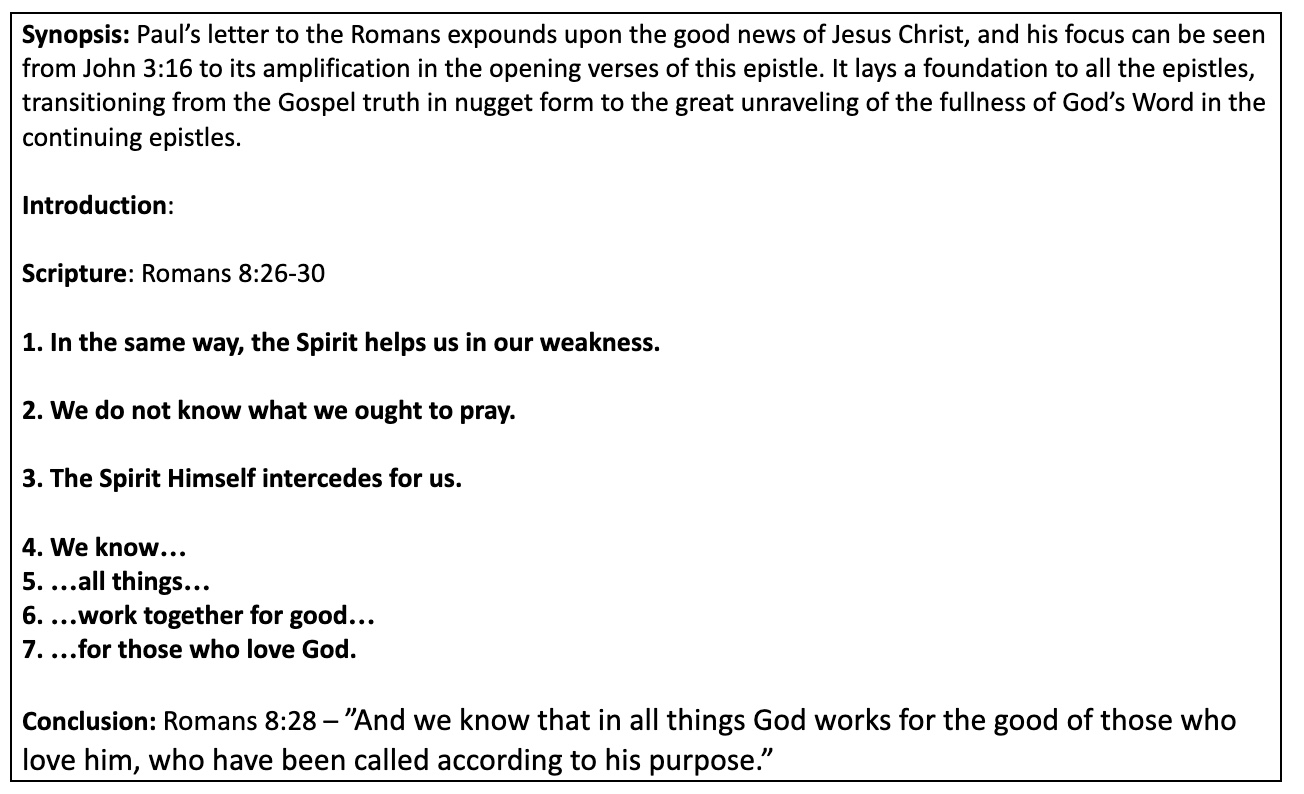
26 In the same way, the Spirit helps us in our weakness. We do not know what we ought to pray for, but the Spirit himself intercedes for us through wordless groans. 27 And he who searches our hearts knows the mind of the Spirit, because the Spirit intercedes for God’s people in accordance with the will of God.
28 And we know that in all things God works for the good of those who love him, who have been called according to his purpose. 29 For those God foreknew he also predestined to be conformed to the image of his Son, that he might be the firstborn among many brothers and sisters. 30 And those he predestined, he also called; those he called, he also justified; those he justified, he also glorified.
My book on this passage begins with a rich quotation from the British preacher, Charles Spurgeon, who said:
Everything that happens to you is for your own good. If the waves roll against you, it only speeds your ship toward the port. If lightning and thunder comes, it clears the atmosphere and promotes your soul’s health. You gain by loss, you grow healthy in sickness, you live by dying, and you are made rich in losses.
Could you ask for a better promise? It is better that all things should work for my good than all things should be as I would wish to have them. All things might work for my pleasure and yet might all work my ruin. If all things do not always please me, they will always benefit me.
This is the best promise of this life.
So said Spurgeon. We live in a world of catastrophes and calamities, and none of us knows what we’ll face next. Without God’s oversight, our futures are like scraps of paper scattering in the wind. But under His oversight, they’re like pages of hope indelibly written by grace.
The Scripture teaches we have a God who turns problems inside out—all our perils and perplexities. None is excluded for God-lovers, those who are called according to His purpose. He engineers blessings out of burdens, and He knows how to wrangle gladness out of sadness. God’s guarantee in Romans 8:28 can alter your mood, dissipate your discouragement, lessen the pangs of your grief, and usher confidence back into your heart.
It isn’t that Bible-believers are unaffected by life’s blows; it’s simply that because of Romans 8:28, we have a different way of processing them. It isn’t a simple or sudden route. Some problems are so tangled, only God can resolve them; and He detangles them at His own speed. But we must train ourselves to put on the God-given glasses of this verse as we view all that happens around us.
God’s promises are not magic wands that instantly make problems disappear like rabbits down a hole. But we do have a God-given assurance that God will sooner or later work every single circumstance for the ultimate good of those who love Him and for those fully committed to Jesus Christ. That changes our attitudes about every event in life, or it should.
Romans 8:28 morphs us into resilient, cheerful people, whatever our temperament. It’s God’s darkroom in which negatives become positives. It’s His situation-reversal machine in which heartaches are changed into hallelujahs. It is the foundation of hope and a fountainhead of confidence. Even our failures can become enriching and our sins can be redeemed. Even death itself becomes a blessing for the child of God.
In the Same Way, the Spirit Helps Us in Our Weakness
Romans 8:26 begins by saying, “In the same way, the Spirit helps us in our weakness.” In some ways, this has been the theme thus far of the entire chapter. For example, we have a lot of weakness in our thinking, and we’re tremendously helped when we allow the Holy Spirit to govern our minds. We have a lot of weaknesses in our ability to resist temptation, but the Holy Spirit enables us to put to death the misdeeds of the body. But here Paul is talking about a new weakness that he wants to discuss, and it involves the subject of prayer.
This verse implies we have many weaknesses when we try to pray. What weakness exists in your life of prayer? Maybe you’re weak in your ability to concentrate, in the time you spend on your knees, or in your zeal and fervor. Does your mind drift? Is your heart lax and listless? Do you feel ineffective in your praying? Is your faith weak and spotty?
All those things are frequently true for me, and sometimes I pray for only a few moments when I should pray for an hour. I have many weaknesses in my prayer habits, and I suppose you do, too.
But Paul was not talking about any of those weaknesses in verse 26. He was thinking of another weakness, a specific problem that perhaps you’ve never considered.
We Do Not Know What We Ought to Pray
We often do not know what to pray for. We offer our prayer requests with limited knowledge. Of course, when we pray for things like a stronger faith, a more loving attitude, or for the Lord to quickly come, we can present those requests with total confidence that we’re praying according to God’s will, for His Word endorses those things.
But when we pray about specific circumstances in our lives, it’s different. How do we know what’s best when we can’t predict the future? Perhaps the job we want so badly would be a disaster for us, if we could see only five years into the future. Since we can’t predict how events will unfold, we can’t be sure how things will turn out or which things are really for our benefit.
We can’t see into tomorrow, so we don’t know how things will turn out. How do you know if it’s best to buy the house you’re considering? How do you know if your child should be accepted into a particular college? How do you know if you should make this investment or that one? What about that big trip you’re planning? The healing you desire? The relationship you crave? The academic program you’re considering?
Since we don’t know which things will turn out advantageously, we should do as James 4:15 advises and pray, “If the Lord wills.” When I pray for specific things, I try to say, “Lord, if it is Your will, please do this or that,” or, “If it seems good to You, grant this or that.”
The Holy Spirit, however, being God, is omniscient, so He knows the future as well as the past. He sees every cause and effect, every chain reaction and ripple effect, every domino from now to eternity. He’s an infinite chess player who perceives every sequential consequence of every move from now into the boundless future. As a result, He knows exactly how to pray for us, what to request on our behalf, and what dangers to pray against. Being God, He also fully knows God’s ultimate and infinite will for our lives.
Hence, knowing the future perfectly and knowing God’s will totally, He can pray specifically for every detail of our lives.
The Spirit Himself Intercedes for Us
Here’s something else. According to this verse, He does so with great fervor, with deepest feelings of love on our behalf, with groanings that go beyond words: “The Spirit also joins to help in our weakness, because we do not know what to pray for as we should, but the Spirit Himself intercedes for us with unspoken groanings.”
That’s Romans 8:26.
The result, declared in Romans 8:27, is that the Heavenly Father answers these earnest prayers offered by the Spirit on our behalf. “He who searches the hearts knows the Spirit’s mind-set, because He intercedes for the saints according to the will of God.”
And the result of that is Romans 8:28. All things work out for good in the lives of those for whom the Spirit is praying, for those who love God and are called according to His purpose.
Romans 8:28, then, isn’t a miscellaneous motto, an isolated promise, or a random verse. It is embedded into the book of Romans like a tree whose roots are coiled around underground boulders. It flows out of the justification that Christ purchased on the cross, and it occurs because of the powerful and omniscient intercession of the Holy Spirit.
When you look behind the curtain of Romans 8:28, you see the machinery of Trinitarian involvement. The whole Godhead is involved in this—Father, Son, and Holy Ghost. It is a promise signed and sealed by each member of the Trinity.
- God the Son guarantees Romans 8:28 by His blood purchase of justification. It’s part of His glorious redemption. Precisely as He redeems our souls from death, He redeems our sins, mistakes, situations, and sufferings for our good.
- God the Spirit guarantees Romans 8:28 by His earnest prayers on our behalf as He fervently intercedes for us with omniscient wisdom and according to the Father’s will.
- God the Father guarantees Romans 8:28 by His omnipotent providence that rules and overrules every situation in our lives. Responding to the blood of Christ and the prayers of the Spirit, He providentially works all things for our benefit and His glory.
We Know
And that brings us right into verse 28. Notice the first two words of this verse: “We know that all things work together for good to those who love God. . . .”
The words we know are not necessary to the promise, and the verse makes perfect sense without them. If it simply read “All things work together for good to those who love God,” we would never have been the wiser, and it still would have been a great truth. In fact, if the verse were worded like that, the primary subject and verb would be the promise itself: (All) Things / Work!
But the Holy Spirit, who doesn’t waste words in the Bible, began the sentence, not with an emphasis on what God is going to do, but with an emphasis on what our attitude should be about it. The primary subject is the pronoun we, and the primary verb is know. Romans 8:28 thus begins with a statement of certitude, underscoring how important it is to God that we claim His promise with total confidence.
We don’t hope, hypothesize, or hallucinate. We don’t postulate, speculate, or fabricate. We don’t toss and turn in anxiety. We simply know. We know God, therefore we know His power, understand something of His providence, and can trust His provision. It’s certain. For sure. Positive. Fail-safe. Inevitable. It’s God’s guarantee, and it can never be otherwise.
Faith is the ability to tackle life with confidence, come what may, knowing that the trustworthy promises of God are precisely as real as the transient circumstances around us. Faith is believing that God will do exactly as He has said. Those who live by faith don’t have a “hope so” optimism. They live in the society of the certain.
All Things
Verse 28 continues, “We know that all things….” Not some things, a few things, a lot of things, select things, good things, bad things, sad things, or funny things—but all things. There are no exceptions or exemptions. It’s neither hyperbole nor exaggeration. If it were not all-encompassing, it wouldn’t be worth the paper it’s printed on. All means all.
This even includes our missteps and mistakes, even our faults and failures. When we bring our sordid messes to Him in humble repentance and place them under the redeeming blood of Jesus, the Lord can turn poison into porridge, mistakes into masterpieces, and errors into alleluias.
Work Together for Good
Romans 8:28 was originally written in Greek, and its verb for ‘work together’—synergeō—lies behind our English word synergy. Paul is telling us that under God’s providence, all the disparate elements of our lives are being worked together toward His good purpose. There is an irresistible law of divine synergy operational in the God-lover’s life, working together all things to produce effects greater than and often completely different from the sum of the various elements. This synergy works under the authority of God’s undeniable providence.
Dr. Handley Moule was a brilliant British Bible teacher and author who died in 1920. On one occasion, he was called to the scene of a terrible accident at a British coal mine. Many friends and relatives of the victims of the cave-in gathered, and it was Dr. Moule’s responsibility to address them.
“It is very difficult,” he said, “for us to understand why God should let an awful disaster happen, but we know Him and trust Him, and all will be right. I have at home an old bookmarker given me by my mother. It is worked in silk, and when I examine the wrong side of it, I see nothing but a tangle of threads. It looks like a big mistake. One would think that someone had done it who did not know what she was doing. But when I turn it over and look at the right side, I see there, beautifully embroidered, the letters, ‘God is love!’ We are looking at all this today from the wrong side. Some day we shall see it from another standpoint and we shall understand.”2
Sometimes in the face of tragedy and disappointment, we can only hide ourselves in the promises of God until the storm passes by. We have to reassure our heart with the facts of God when we can’t calculate the sums of life. We have to tell ourselves the truth, regardless of appearances to the contrary: Not some things, but all things work together.
For Those Who Love God
Romans 8:28 isn’t a platitude to be slapped on our backs like a bumper sticker. It’s not for universal distribution without conditions, and it’s not for wholesale dissemination. It is precisely and only for those who meet the requirement of loving God.
Loving God is the ultimate purpose of the soul. We’re made to love, and a life without love is a worthless life. Loving God is the highest duty and the greatest joy of our lives, either in time or eternity. Loving God is the key that opens the sluices and releases the blessings.
That’s the constant drumbeat of Scripture. I want you to read the following verses. Notice how God attaches His greatest promises to the nonnegotiable condition of loving Him:
- “Know that Yahweh your God is God, the faithful God who keeps His gracious covenant loyalty for a thousand generations with those who love Him and keep His commands” (Deut. 7:9).
- “Turn to me and be gracious to me, as is Your practice toward those who love Your name” (Ps. 119:132).
- “The Lord guards all those who love Him” (Ps. 145:20a).
- Jesus answered, “If anyone loves Me . . . My Father will love him, and We will come to him and make Our home with him” (John 14:23).
- It is written: “What no eye has seen and no ear has heard, and what has never come into a man’s heart, is what God has prepared for those who love Him” (1 Cor. 2:9).
- “If anyone loves God, he is known by Him” (1 Cor. 8:3).
- “Grace be with all who have undying love for our Lord Jesus Christ” (Eph. 6:24).
- “Blessed is a man who endures trials, because when he passes the test he will receive the crown of life that He has promised to those who love Him” (James 1:12)
- “Listen, my dear brothers: Didn’t God choose the poor in this world to be rich in faith and heirs of the kingdom that He has promised to those who love Him?” (James 2:5).
God’s promises are not distributed wholesale to every inhabitant on earth; they are the exclusive domain of those who love Him.
So for review, let me read this paragraph one final time.
26 In the same way, the Spirit helps us in our weakness. We do not know what we ought to pray for, but the Spirit himself intercedes for us through wordless groans. 27 And he who searches our hearts knows the mind of the Spirit, because the Spirit intercedes for God’s people in accordance with the will of God. 28 And we know that in all things God works for the good of those who love him, who have been called according to his purpose.
Next time we will continue right on with this paragraph and with the conclusion of Romans chapter 8. In the meantime, if you would like to explore this theme more, then look for my book and study guide, God Works All Things Together for Your Good. You can find it at Robertjmorgan.com.