A Study of Romans 8:31-37
Hello everyone, and welcome to installment number 32 in our series of studies, Grace Unleashed, as we walk through every verse of the book of Romans. We’re going to finish our study of Romans chapter 8 today by looking at Paul’s grand finale of assurance and security. It’s some of his most elevated and exalted words, so if you have your Bible turn with me to Romans 8.
Last month the New York Times carried an article by Bill McKibben entitled, “I’m Exhausted. You’re Demoralized. We Weren’t Built for a World Like This.” I found myself agreeing with the title and wanting to read the article. McKibben detailed the acceleration of life and the growing depth of the dangers confronting us. He said, “We definitely weren’t designed to cope with all this — our bodies, our nervous systems, our brains. Among all the other dangers these developments represent, they’re simply wearing us out.” He said that fatigue has become one of the most frequently reported health concerns in primary care visits.
McKibben continued, “A kind of overwhelming weariness and even sadness is increasingly the default state of what, in living memory, were optimistic, get-up-and-go-ish fellow Americans…. The level of pressure that an even somewhat engaged American feels at the moment is very nearly debilitating.”
I kept reading for his answers, but he only suggested a handful of very questionable political changes. His diagnosis was better than his remedy. I frequently battle fatigue and weariness too. But I find daily replenishment in the Scripture, and especially in Romans 8. This is one of the most energizing passages in the Bible. The apostle Paul has been making a list of some of the ways in which the Holy Spirit powers up our lives. Let me review the bullet points.
- The Holy Spirit gives us life.
- He sets us free from the law of sin and death.
- He helps us establish new habit patterns in our lives and daily routines.
- He gives us a new set of desires.
- He governs our minds and gives us life and peace.
- He lives within us.
- He keeps giving us life.
- He will raise our mortal bodies at the return of Christ.
- He enables us to put to death the misdeeds of the body.
- He leads us.
- He reassures us that we have been adopted into God’s family.
- He enables us to pray.
- He testifies with our spirits that we are children of God.
- He brings heaven to our hearts as we are traveling there.
- He helps us in our weakness and He prays for us in accordance with God’s will.
And that is why all things work together for the good of those who love God and who are called according to His purpose. And with that Paul has completed his explanation and his treatise on justification and salvation and the Gospel. Now he is going to present a grand finale—a series of rhetorical questions to show us how blessed, how secure, how rich, and how anchored we are in the love of God the Father and God the Son. Let’s read this together, beginning in Romans 8:31 and reading to the end of the chapter.
31 What, then, shall we say in response to these things? If God is for us, who can be against us? 32 He who did not spare his own Son, but gave him up for us all—how will he not also, along with him, graciously give us all things? 33 Who will bring any charge against those whom God has chosen? It is God who justifies. 34 Who then is the one who condemns? No one. Christ Jesus who died—more than that, who was raised to life—is at the right hand of God and is also interceding for us. 35 Who shall separate us from the love of Christ? Shall trouble or hardship or persecution or famine or nakedness or danger or sword? 36 As it is written:
“For your sake we face death all day long;
we are considered as sheep to be slaughtered.”
37 No, in all these things we are more than conquerors through him who loved us. 38 For I am convinced that neither death nor life, neither angels nor demons, neither the present nor the future, nor any powers, 39 neither height nor depth, nor anything else in all creation, will be able to separate us from the love of God that is in Christ Jesus our Lord.
1. What Shall We Say in Response to These Things?
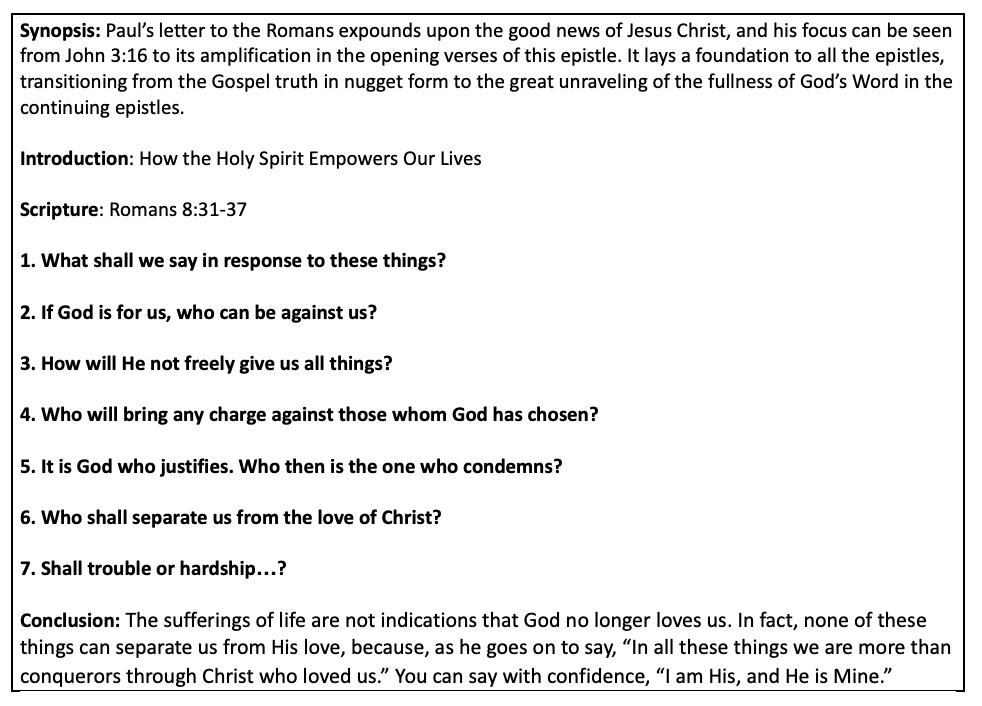
In this glorious passage, Paul is going to proclaim the reverberations of the Gospel—what it means to our security and our future and our everlasting safety. He just erupts in a series of glorious cascading questions. These are rhetorical questions meant to multiply, one after another, in a glorious climax of certainty and unquenchable hope. He poses seven questions for the steadfast soul.
He begins in verse 31: What then shall we say in response to these things? He has now explained the Gospel. He has told us we can never have an eternal hope on the basis of our own merits or efforts. But God has provided a way for us to be declared righteous in His sight, and it is by faith in Jesus Christ, who is the gift of His grace. He has justified us, and He is sanctifying us, and He will glorify us—and He has placed within us His Holy Spirit to guide us through the process.
So should we be insecure? Should we go through life afraid? Should we grumble like the Israelites in the desert? Should we worry about dying and about death and about what lies beyond? Should we feel threatened by the enemy? Should we wonder if we are truly saved and heaven-bound? What should we say to these things? What is the correct intellectual and emotional response to all this? How should this information change our lives?
Well, he answers that question by asking another.
2. If God is for Us, Who Can Be Against Us?
I want you to underline those four words: God is for us. In the margin of your Bible, you can write: God is for me. That is the Gospel. It’s previewed in the Old Testament.
- Nehemiah 4:20 says, “Our God will fight for us.”
- Psalm 40:5 says, “Many, Lord my God, are the wonders you have done, the things you planned for us.”
- Psalm 47:4 says, “He chose our inheritance for us.”
- Psalm 126:3 says, “The Lord has done great things for us, and we are filled with joy.”
- Isaiah 26:12 says, “Lord, you establish peace for us; all that we have accomplished you have done for us.”
- Isaiah 63:7 says, “I will tell of the kindnesses of the Lord, the deeds for which he is to be praised, according to all the Lord has done for us.”
Now, Paul is saying, “If all that is true, and if the Gospel is real, and if God is for us to such an unimaginable extent, who could be against us? Who could destroy us or divert us from God’s plan?
Paul answers that question with yet another question.
3. How Will He Not Freely Give Us All Things?
He who did not spare his own Son, but gave him up for us all—how will he not also, along with him, graciously give us all things?
God the Father did not spare His own Son. He sent Him to live a purely righteous life on this sinful planet, and then to be subjected to a death so painful we cannot grasp it. He did it in order to shed His blood for the forgiveness of our sins. He gave Him up for us all. And then Jesus rose from the dead. And how can we ever imagine that God the Father and God the Son would do all that for us only to drop us and forsake us and lose us in the end?
Perish the thought! How could God the Father now also, along with God the Son, not graciously give us all things? He will! He most certainly will. He is and He will! All the things we need. All the things that pertain to eternity. Paul would later write about this in Ephesians 1:3: “Praise be to the God and Father of our Lord Jesus Christ, who has blessed us in the heavenly realms with every spiritual blessing in Christ.”
Peter speaks to this also in 2 Peter 1:3: “His divine power has given us everything we need for life and godliness through the knowledge of Him who called us by His own glory and goodness.”
Now Paul asks a fourth question.
4. Who Will Bring Any Charge Against Those Whom God Has Chosen?
When you have been redeemed by the blood of Jesus Christ and have been declared righteous in God’s sight, who can bring up anything—any little detail—that can separate you from your position in Christ?
Some people may accuse you of being homophobic, Islamophobic, misogynistic, a Christian nationalist, puritanical, narrow, intolerant, and foolish. They may try to marginalize you. But which of them can shake you from your firm foundation? Which of them can pry you from the grace of Jesus? Which of them can separate you from the love of God?
And what about the devil? He is the “accuser of the brethren.” He brought accusations about Job, who was a good man in every way. He accused the high priest Joshua of filthiness in Zechariah 3. He will slander you.
And what about your own tendency to condemn yourself and tell yourself that you are unworthy, that you are no good, that you are a failure?
If God is for you, and if He did not spare His own Son, and if He has promised to graciously give us all things—who can oppose that? Now Paul answers with a statement that sets up another question.
5. It is God Who Justifies. Who Then Is the One Who Condemns?
Paul answers this question with two words—No One! He is saying,
- If God has pardoned your sins and cast them away from you as far as the east is from the west, as we read about in Psalm 103…
- If He has taken all your sins and cast them behind his back, as Isaiah 38:17 tells us…
- If He has hurled our sins into the depths of the sea, as Micah 7:19 says…
- If He has made you white as snow in His sight, as we read in Isaiah 1:18…
- If He has cancelled our debt, as we read in Matthew 6:12…
- If our sins have been swept away like clouds from the sky, according to Isaiah 44:22…
- If the handwriting against us has been erased, as Colossians 2:14 tells us…
- If He remembers our sins no more, as we read in Jeremiah 31:34…
- If we have been cleansed by the blood of Jesus Christ, as 1 John 1:7 promises…
Then who in this entire universe—in the seen or unseen realm—can ever prosecute us for anything large or small? No one! We can sing that old Sunday school song that says:
Gone, gone, gone, gone,
Yes, my sins are gone!
Now my soul is free
And in my heart’s a song.
Buried in the deepest sea.
Yes—that’s good enough for me—
I shall live eternally.
Praise God—my sins are G-O-N-E, gone!
I often think of the words of a British expositor who said that if we ever look back over our past with shame or regret or self-loathing, we have underestimated the power of the blood of Jesus Christ.
Now, Paul is going to make a great declaration before asking his next question. He goes on in verse 34: Christ Jesus who died—more than that, who was raised to life—is at the right hand of God and is also interceding for us.
In a fascinating way, this one single verse is a summary of the entire book of Hebrews, which is about the priestly ministry of Christ. When Jesus came to earth, He came to fulfill three roles—prophet, priest, and king. During His earthly ministry, He was a prophet, traveling through the land proclaiming the Gospel and the message of God. With His death, resurrection, and ascension back to heaven, His priestly role came into full view. And when He comes again, He will fully assume the role of King.
But for now, He is enthroned at the Father’s right hand, praying for us and being our advocate. I want to point out that little word, also. Christ Jesus who died—more than that, who was raised to life—is at the right hand of God and is also interceding for us.
Remember back in verse 26, Paul told us that the Holy Spirit was interceding for us. So we are like Moses who had two prayer partners on the mountaintop—Aaron and Hur. We have the Lord Jesus Christ on one side and the Holy Spirit on the other side, both pleading on our behalf and both making sure the blood never loses its power.
Hebrews 7:24 says, “Because Jesus lives forever, He has a permanent priesthood. Therefore He is able to save completely those who come to God through Him, because He always lives to intercede for them.”
Hebrews 9:24 adds, “For Christ did not enter a sanctuary made with human hands that was only a copy of the true one; He entered heaven itself, now to appear for us in God’s presence.”
Now to appear for us in God’s presence! Or, as Romans 8:34 says, Christ Jesus who died—more than that, who was raised to life—is at the right hand of God and is also interceding for us.
And that occasions Paul’s sixth and seventh questions.
6. Who Shall Separate Us from the Love of Christ?
He began the chapter by telling us there is no condemnation to those who are in Christ Jesus. Now He ends by telling us nothing or no one can separate us from the love of Christ. He could have said, “Who shall separate us from the grace of Christ?” Or “…the commitment of Christ.” Or “the power of Christ.” But He did all of this because of His love for us. In Bible College we used to sing this hymn:
Loved with everlasting love,
Led by grace that love to know;
Gracious Spirit from above,
Thou hast taught me it is so!
O this full and perfect peace!
O this transport all divine!
In a love which cannot cease,
I am His, and He is mine.
In a love which cannot cease,
I am His, and He is mine.
That really summarizes the point Paul is making here. And that leads to his final follow-up question.
7. Shall Trouble or Hardship or Persecution or Famine or Nakedness or Danger or Sword?
And he is going to quote Psalm 44:22. As it is written “For your sake we face death all day long; we are considered as sheep to be slaughtered.”
Paul was writing to Christians in the imperial city of Rome where within just a few years he himself would be slain. He was preaching to a persecuted church. Imagine being a Christian in Nigeria, where 3,400 Christians were killed last year for their faith? Imagine writing this letter to churches in China, who are being suppressed and oppressed by Communist authorities and constantly surveilled. One Chinese pastor, who has been able to flee to the United States, recently spoke at the Museum of the Bible.
He said, “Like every house church in China, we don’t have a church building. Some Sundays, we split into small groups and meet in some church members’ living room; other Sundays, we take [the] risk to rent a hotel room.” He added that police are empowered to arrive at any time, sometimes in tactical gear.
“They check our IDs illegally, interrupt our worship, traumatize our children and take our church leaders away,” he said.
He said, “Lots of Christian leaders wake up every morning, not knowing if today is the day the police will come for them.”
Paul was addressing people who would smell that kind of danger around them, and his point is the sufferings of life are not indications that God no longer loves us. In fact, none of these things can separate us from His love, because, as he goes on to say, “In all these things we are more than conquerors through Christ who loved us.”
And now he comes to his magnificent conclusion: For I am convinced that neither death nor life, neither angels nor demons, neither the present nor the future, nor any powers neither height nor depth, nor anything else in all creation, will be able to separate us from the love of God that is in Christ Jesus our Lord.
The Bible says that God loves us with an everlasting love. He loves us dearly and deeply during the few and fleeting years we spend on this troubled earth, and He went to enormous extents to make sure that His love sweeps us upward and onward, into heaven, and into eternity, and into a fellowship with one another and with Himself that will never end. You can say with confidence, “I am His, and He is Mine.”
Well, for the next two weeks I want to talk about a couple of subjects that have been on my mind recently, and then at the end of the month we’ll tackle Romans 9 as we continue our study, Grace Unleashed.