INTRODUCTION
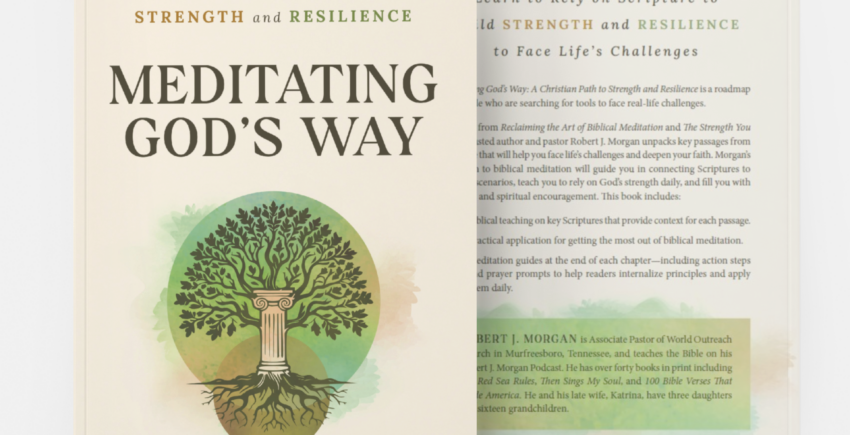
Today I want to talk with you about something the Bible presents as a sure pathway to success—not success as the world defines it, but success as God defines it. This also connects closely to my new book, Meditating God’s Way: A Christian Path to Strength and Resilience, because at the heart of that message is a simple but powerful habit: biblical meditation.
Years ago, when I was a college student, I read J. I. Packer’s classic book Knowing God. His words had a profound influence on me. They helped me understand that it’s not enough to simply learn truths about God in an academic way. We learn the truth of God so that we can know the God of truth personally. And one of the primary ways that happens is through meditation.
Packer wrote, “How can we turn our knowledge about God into knowledge of God? The rule for doing this is demanding, but simple. It is that we turn each truth that we learn about God into a matter for meditation before God, leading to prayer and praise.”
About that same time, I noticed something in my own Bible study that convinced me of this: my life would be successful—guaranteed successful—if I learned and practiced this habit of biblical meditation. That may sound like a bold statement, but I didn’t mean worldly success. Even then, I understood that God’s definition of success is very different from fame, fortune, or prestige.
PERSONAL BACKGROUND
At the time, I was a shy young man, struggling with low self-esteem and feeling ill-prepared for adulthood, marriage, or a meaningful career. But as I studied three passages in Scripture—one near the beginning of the Bible, one in the middle, and one near the end—I became convinced that success, as God defines it, is not only possible but inevitable if we embrace the practice of biblical meditation. Let me show you those passages.
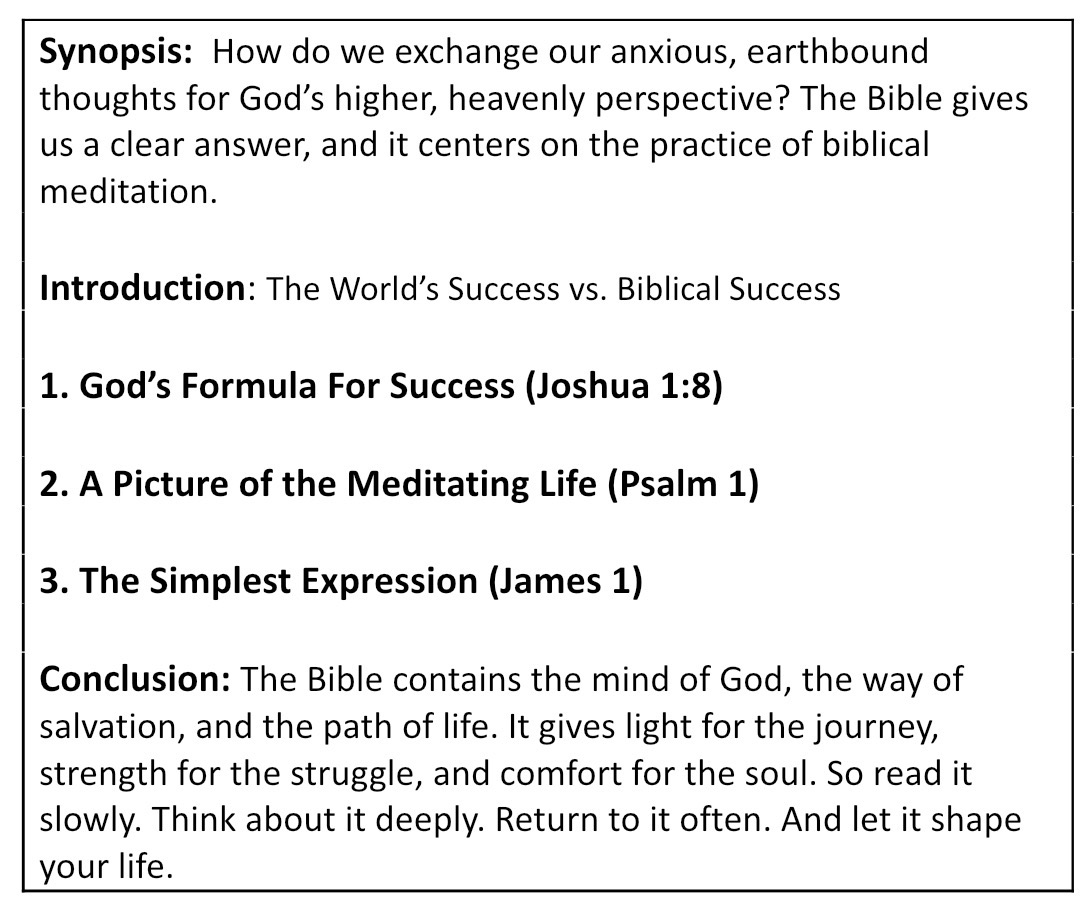
1. JOSHUA 1:8 — GOD’S FORMULA FOR SUCCESS
The first is Joshua 1:8: “Keep this Book of the Law always on your lips; meditate on it day and night, so that you may be careful to do everything written in it. Then you will be prosperous and successful.”
This verse contains three clear commands and two powerful promises. We are to keep Scripture on our lips—reading it, speaking it, quoting it. We are to meditate on it day and night. And we are to practice it, being careful to do what it says. Then come the promises: we will be prosperous, and we will be successful.
This instruction came at a critical moment. Moses had died, and Joshua was stepping into leadership. The Israelites were preparing to enter the Promised Land, facing battles and enormous challenges. What kind of preparation did God give Joshua at that moment?
He didn’t outline military strategies. He didn’t provide a battle plan.
Instead, He told Joshua to meditate on His Word.
And that makes perfect sense. Our fallen minds are limited and often misguided. Left to ourselves, our thinking never rises above the basement level of life. But when we meditate on Scripture day and night, God uses that process to lift our thinking. He reshapes our perspective. He fills our minds with His thoughts—and His thoughts always lead toward what He calls success.
That kind of success includes a life marked by purpose, perseverance, faithfulness, joy, and a deepening relationship with God.
2. PSALM 1 — A PICTURE OF THE MEDITATING LIFE
The second passage is Psalm 1, which beautifully illustrates Joshua 1:8: “Blessed is the one… whose delight is in the law of the Lord, and who meditates on His law day and night. That person is like a tree planted by streams of water… whatever they do prospers.”
Here again we see the same pattern: meditation leads to blessing and fruitfulness. But Psalm 1 adds imagery, and that’s important, because imagination plays a key role in meditation.
God has given us minds capable of forming pictures—images, scenes, and impressions. Left unchecked, our minds often fill themselves with anxious or unhelpful thoughts. But through meditation, we can begin to repaint those inner walls with the truth of Scripture.
Interestingly, even athletes understand something like this. The great soccer player Pelé used to visualize his games before stepping onto the field. He would picture himself playing, moving, and succeeding. By the time he began the game, he had already played it in his mind.
In a similar way, David may have taken Joshua 1:8 and pictured it. Perhaps as a shepherd, he looked out and saw a tree by a stream—roots deep in the water, leaves full and green, fruit appearing in season. And he realized: that’s what a life of meditation looks like.
So he gave us Psalm 1—a living picture of a life nourished by the Word of God.
3. JAMES 1 — THE SIMPLEST EXPRESSION
The third passage is James 1:25: “Whoever looks intently into the perfect law that gives freedom, and continues in it—not forgetting what they have heard, but doing it—they will be blessed in what they do.”
James says essentially the same thing as Joshua and David, but in a more direct, concise way. We are to look intently into God’s Word, continue in it, remember it, and practice it. And when we do, we will be blessed.
That phrase “look intently” suggests careful, sustained attention—like Peter bending down to examine the empty tomb. That’s a vivid picture of meditation. It’s not a passing glance; it’s a steady gaze.
So what does this look like in everyday life? Whenever you read a verse in the Bible, pause and think about it. Notice each word. Emphasize different parts of the sentence. Write it down. Carry it with you. Return to it throughout the day. Picture it in your mind as if you were painting it on a canvas.
That simple habit can change everything.
Those three passages—Joshua 1, Psalm 1, and James 1—became anchors in my life. I didn’t believe I could succeed on my own, but I believed I could follow this pattern. I could read the Word, think about it, and attempt to obey it. That was my part. The outcome—fruitfulness, blessing, and success—was God’s part.
There’s an interesting story about J. Paul Getty. He had a habit of sitting quietly for an hour each day doing nothing but thinking. After that hour, he would often make decisions that dramatically increased his success. Now, that’s an example of common grace. Thoughtfulness leads to better decisions. But the Bible takes it further. It doesn’t tell us to think and grow rich—it tells us to meditate and experience the riches of God’s grace.
I won’t claim to be a successful person in worldly terms. There are many times I feel my own limitations and failures. But I know this: my life has been far more fruitful and meaningful because of these passages and the habit of meditation.
And it can be true for you as well. God wants to guide your steps, provide for your needs, steady your heart, and bring purpose to your life. He wants you to trust Him in difficulty, rejoice in trials, and live each day with a sense of His presence. Ultimately, He wants to bring you safely home to Himself. That is success.
CONCLUSION — THE ROLE OF MEMORIZATION
Let me close with a very practical aspect of meditation: Scripture memorization.
Proverbs 10:14 says, “The wise store up knowledge.” Memorization gives us ready access to God’s Word at any moment. When we lie down, when we wake up, when we face anxiety or decision, those verses are already there.
There are certain passages I return to again and again—Psalm 1, Psalm 46, Proverbs 3:5–6, John 14, Romans 8, and many others. Over the years, they’ve become a reservoir of strength and peace.
Memorization may take effort, especially as we grow older, but it is always worth it. Even learning a phrase at a time—what one person called “slow memorization”—can anchor a verse deeply in your heart.
Every word of Scripture is powerful. It strengthens us, steadies us, and guides us. Like a transfusion of life, it brings clarity, courage, and hope.
The Bible contains the mind of God, the way of salvation, and the path of life. It gives light for the journey, strength for the struggle, and comfort for the soul. So read it slowly. Think about it deeply. Return to it often. And let it shape your life.
That’s why I’ve written Meditating God’s Way: A Christian Path to Strength and Resilience. I believe this is one of the most needed habits in the Christian life today. You can find it wherever books are sold, and I hope you’ll pick up a copy for yourself—and another for a friend.