INTRODUCTION
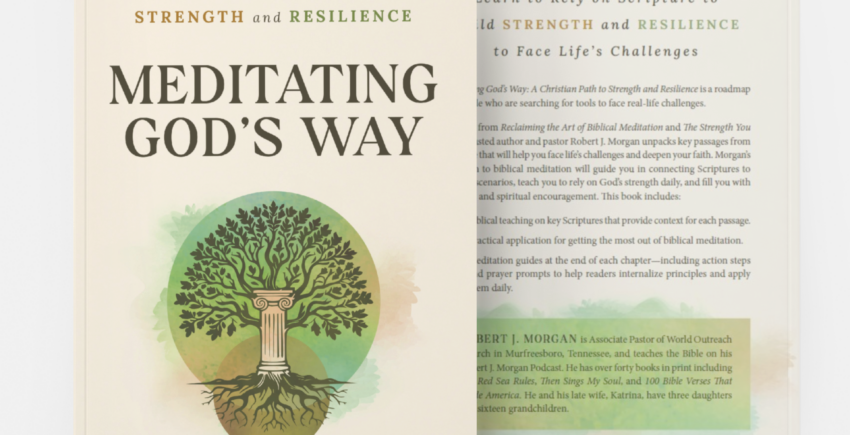
Today I want to talk about what may be the missing step in Bible study—the step that turns knowledge into understanding and transforms information into life. This episode also ties directly to my book Meditating God’s Way: A Christian Path to Strength and Resilience, because what we’re discussing today is the practical side of meditation—how it actually works in everyday life.
A Puritan writer once said, “Knowledge brings us to the door of truth, but meditation brings us into the house and into all the rooms thereof.” That’s a wonderful way of putting it. Bible study gets us to the door, but meditation ushers us inside.
When I was a boy, I had a little record player that spun 45 RPM singles. I kept my records stacked in a rack and spent hours listening to them—singing along, dancing around, enjoying the music. But every now and then the needle would slip out of its groove and scrape across the vinyl, making a terrible noise and scratching the record. Only when it found its groove again did the music return.
I don’t have that record player anymore, but I still remember that awful sound. And I’ve discovered something over the years—there’s a similar experience in the soul. When the “needle” of my mind slips out of its groove, my thoughts can begin to scrape across my nerves. I feel tension, frustration, even anger.
But biblical meditation helps the mind find its groove again. It restores the music. It provides the soundtrack for life—songs of praise and melodies of joy rooted in Christ.
Over time, I’ve learned to turn to specific passages of Scripture in specific moments.
- When I struggled with patience—perhaps helping my disabled wife with a task—I whispered to myself, “Love is patient, love is kind…” from 1 Corinthians 13.
- When I’m tempted to spend money unwisely, Hebrews 13:5 reminds me, “Be content with what you have.”
- When I’m anxious about loved ones, I recall Jesus’ words in John 14:1: “Do not let your hearts be troubled.”
- When I feel anger rising, Proverbs 29:11 steadies me: “A fool gives full vent to his anger, but a wise man keeps himself under control.”
- When I’m tempted to compare myself with others, I remember Jesus’ words to Peter: “What is that to you? You follow Me.”
- And when sleep is interrupted by worries about the future, I find myself returning to Revelation 21—the vision of the new heaven and the new earth.
Again and again, in moments of stress or struggle, the Word of God provides a steady anchor. Through meditation, it’s as if the Lord gently lifts the needle and sets it back into the groove of grace.
But for that to happen, we must be students of Scripture. Too many people try to live on devotional thoughts alone—what I sometimes call the leftovers of other people’s meditation. There’s nothing wrong with devotional books, but they are supplements, not the main course.
The same can be said of commentaries. We often rely too much on what others have said and not enough on personal reflection. In our fast-paced world, we want instant insight. We grab a verse quickly, like someone grabbing a snack on the run.
But biblical meditation requires something deeper. It requires time in the Word itself.
It is, in many ways, the missing link in Bible study. Let me suggest a simple, practical, four-fold approach.
1. READ THE BOOKS OF THE BIBLE
First, read the Bible in book-sized portions. The sixty-six books of Scripture are not random collections of verses; they are carefully structured messages, each unfolding logically and purposefully.
A friend of mine once told me about actor Anthony Hopkins, who reads a script over and over—sometimes a hundred times—until he fully internalizes it. My friend thought, “If an actor can do that with a script, why can’t I do that with a book of the Bible?”
So he chose the book of James and read it repeatedly. Over time, the themes became clear, the structure emerged, and the message began shaping his daily life.
Many books of the Bible can be read in just a few minutes. Even longer books can be read in a relatively short amount of time. And when we read them repeatedly, we begin to grasp the flow of God’s message.
2. STUDY THE PASSAGES OF THE BIBLE
Second, study smaller portions—paragraphs, sentences, even individual words. Take time to examine what the text is saying. Ask questions. Make notes. Underline, circle, and reflect. Break the passage apart and put it back together. Consider its context and its application.
The Bible is inexhaustible. No matter how many times we read it, there is always something new to discover. It is a book we can study for a lifetime and never fully exhaust.
3. DIGEST THE THOUGHTS OF THE BIBLE
Third, begin digesting what you’ve read. Meditation is like digestion. Reading and hearing Scripture is like eating, but meditation is the process of chewing, absorbing, and assimilating that truth into your life. The prophet Jeremiah said, “Your words were found, and I ate them.” Job said he treasured God’s words more than daily bread. The psalmist said God’s words were sweet to his taste.
That’s what meditation does—it allows the truth of Scripture to become part of us.
Even the disciples on the road to Emmaus experienced this. As Jesus explained the Scriptures to them, they later said, “Were not our hearts burning within us?” He opened the Scriptures to them, and in doing so, He opened their minds. That’s what the Holy Spirit does for us today.
4. SHARE THE MESSAGE OF THE BIBLE
Finally, meditation prepares us to share God’s Word with others. Too often we rush from reading to speaking, from study to teaching, without taking time to reflect. But Psalm 39 says, “While I meditated, the fire burned; then I spoke.”
In my own life, I’ve found that my best insights often come not at my desk, but while walking, thinking, and meditating on Scripture. That’s when ideas begin to form, and those thoughts later shape sermons, lessons, and writing.
Meditation doesn’t require a special place or time—it can happen throughout the day.
It can happen in the morning as you awaken, before your mind fills with distractions. It can happen during your daily time with the Lord, as you pause over a verse that speaks to you.
It can happen while driving—turning commuting time into communing time. It can happen on an airplane, in a quiet seat above the clouds. It can happen while walking, breathing deeply, or simply pausing for a moment of stillness.
It can even happen in the middle of the night. There have been times when I’ve gone to bed burdened and restless, only to begin quietly repeating a passage of Scripture. Slowly, those words settle the mind and steady the heart. The last thought we carry into sleep can become the first thought we carry into the day.
I once spoke with a prominent leader who told me that some of his best thinking happens in the quiet moments after he wakes up, before getting out of bed. He lies there, thinking, praying, and reflecting, and by the time he rises, his mind is clear and his direction is set.
That’s a powerful habit.
Meditation is deeply personal. It can happen anytime, anywhere. It is simply the habit of taking God’s Word into our minds and turning it over, reflecting on it, applying it, and allowing it to shape our thinking. As we do that, our lives begin to change. We begin to think differently, respond differently, and live differently. We find stability, clarity, and peace. And the Bible gives a beautiful picture of the result:
“That person is like a tree planted by streams of water, which yields its fruit in season and whose leaf does not wither.”
The Bible has a word for that person. Blessed.
That’s why I’ve written Meditating God’s Way: A Christian Path to Strength and Resilience. I believe this habit is one of the most important—and most overlooked—disciplines in the Christian life today. I hope you’ll pick up a copy for yourself, and perhaps another for a friend.