A Study of Romans 7:14-25
Hello everyone! Welcome back to our series of studies through the book of Romans. This is our 20th installment in this series and we are coming now to the last part of Romans Chapter 7 and to the most difficult paragraph of the entire book. I want to begin by reading it and then we will see if we can figure out what Paul is telling us.
14 We know that the law is spiritual; but I am unspiritual, sold as a slave to sin. 15 I do not understand what I do. For what I want to do I do not do, but what I hate I do. 16 And if I do what I do not want to do, I agree that the law is good. 17 As it is, it is no longer I myself who do it, but it is sin living in me. 18 For I know that good itself does not dwell in me, that is, in my sinful nature. For I have the desire to do what is good, but I cannot carry it out. 19 For I do not do the good I want to do, but the evil I do not want to do—this I keep on doing. 20 Now if I do what I do not want to do, it is no longer I who do it, but it is sin living in me that does it.
21 So I find this law at work: Although I want to do good, evil is right there with me. 22 For in my inner being I delight in God’s law; 23 but I see another law at work in me, waging war against the law of my mind and making me a prisoner of the law of sin at work within me. 24 What a wretched man I am! Who will rescue me from this body that is subject to death? 25 Thanks be to God, who delivers me through Jesus Christ our Lord!
So then, I myself in my mind am a slave to God’s law, but in my sinful nature[b] a slave to the law of sin.
Well, there it is. This is perhaps the most disputed passage in the entire Bible. Simon Peter wrote in 2 Peter 3:16 that our dear brother Paul has written some things that are hard to understand. I wonder if Peter had this passage in mind.
I just listened to a conversation between my friend, David Capes, and the great Bible scholar Ben Witherington III, for whom I have enormous respect. Witherington is a giant among Bible scholars. They were talking about Romans 7, and especially this final paragraph, verses 14-25. Witherington said: “[This is] the most commented-on passage in the whole Bible in all of Christian history. There are more articles, monographs, and commentaries that involve Romans 7 than any other passage in the New Testament—period; never mind the Old Testament.”
After they discussed this for a while, Witherington gave his explanation. He said that the character of Adam was introduced in Romans 5, as we saw in a previous episode. And now, according to Witherington, Paul begins speaking as Adam in Romans 7:7-13. It is actually Adam speaking in Romans 7:7-13, as Paul would have imagined him. And then, the next paragraph, Romans 7:14-25, is the voice of the whole reality of humanity that descended from Adam.
Witherington didn’t convince me, and I find his explanation hard to accept. There are actually two major overall schools of interpretation about the paragraph we’ve just read. If I wanted, I could list more. But most commentaries settle down into either one or the other of these two major schools of interpretation. Some say that Paul is speaking here about his life before he became a Christian. Others believe Paul is describing his present experience as a Christian.
My own simple view is the latter, that Paul is describing the Christian who, despite the gift of righteousness that has been imputed to him at his conversion, he is struggling with sin. I have three simple reasons for taking the passage in this sense and saying that it refers to our own everyday struggle with sin. We know what we should do, but we don’t do it. We know what we shouldn’t do, but we do it. We keep messing up. We keep struggling with the sinful nature within us, even as followers of Christ. I want to give you three reasons why I read this passage in that way.
The Tense
First, because of Paul’s switching to the present tense. In the prior paragraph, he is primarily speaking in the past tense. But now he clearly changes into the present. He does not say I was, but I am. Was represents his experience in the past, but am represents his experience in the future. If Paul had written this in the past tense—as he certainly could have—there would be no question he was writing about his life before Christ. In fact, let’s try that with a few of his verses.
We know that the law is spiritual; but I was unspiritual, sold as a slave to sin. I did not understand what I did. For what I wanted to do I did not do, but what I hated I did…. It was sin living in me…. Although I wanted to do good, evil was right there with me….
But that is not what Paul said. That is not the verb tense he used. He deliberately wrote this in the present tense. So I think he was describing the ongoing struggle he faced even as a believer.
The Parallel
The second reason I believe Paul was writing this to describe the struggle that every Christian encounters is because this is exactly what he told the Galatians in something of a parallel passage. All the way through our studies in Romans, I’ve noticed that what Paul says in Romans is a glorious and extended amplification of the points he had previously made to the Galatians. So look at Galatians chapter 5, in which Paul describes the struggle Christians have between their flesh and their spirit.
16 So I say, walk by the Spirit, and you will not gratify the desires of the flesh. 17 For the flesh desires what is contrary to the Spirit, and the Spirit what is contrary to the flesh. They are in conflict with each other, so that you are not to do whatever you want. 18 But if you are led by the Spirit, you are not under the law.
19 The acts of the flesh are obvious: sexual immorality, impurity and debauchery; 20 idolatry and witchcraft; hatred, discord, jealousy, fits of rage, selfish ambition, dissensions, factions 21 and envy; drunkenness, orgies, and the like. I warn you, as I did before, that those who live like this will not inherit the kingdom of God.
22 But the fruit of the Spirit is love, joy, peace, forbearance, kindness, goodness, faithfulness, 23 gentleness and self-control. Against such things there is no law. 24 Those who belong to Christ Jesus have crucified the flesh with its passions and desires. 25 Since we live by the Spirit, let us keep in step with the Spirit. 26 Let us not become conceited, provoking and envying each other.
Here there is no question about it. Paul is writing to Christians describing the struggle we have between the flesh and the spirit. We have exactly that emphasis in Romans as well. In Romans 7, Paul talks about two forces battling within him, and that is exactly what he is saying here in Galatians.
Furthermore, the answer in the book of Galatians is the power of the Holy Spirit. As Christians we have got to walk in the Spirit, he tells them. We’ve got to keep in step with the Spirit; we’ve got to be filled with the Spirit; we must be led by the Spirit and bear the fruit of the Spirit. That is his answer to the problem. Walk in the Spirit, and you will not gratify the desires of the flesh.
In Romans 7, Paul describes the same struggle we read about in Galatians, and then what does he do? He marches right into Romans 8, which is the most definitive passage about the Holy Spirit in all of the writings of the apostle Paul.
I think what he is saying in Romans 7 and 8 parallels what he said in Galatians 5. When we receive Jesus Christ as Savior, our spirits and our souls are redeemed; but our bodies and our flesh are not. In Romans 8, Paul will talk about how we still groan as we await the redemption of our bodies at the moment of resurrection. Our bodies are not redeemed, but our spirits are.
So there is a struggle within us. This is the warfare in which every Christian is engaged. This is the battle within. Our flesh struggles against the Holy Spirit within us; and the Holy Spirit struggles against the flesh.
We cannot win this battle unless we understand what it is to live in the fullness of the Holy Spirit in an ongoing way, every moment and every day, walking and living in the power of the Holy Spirit. Throughout all of his writings, that is the great apostles theme. It is the Holy Spirit who takes the righteous life of Christ and replicates it in us and through us as we are increasingly being transformed into the image of Christ from one degree of glory to another through the Holy Spirit who lives within us, as we read in 2 Corinthians 3:17.
The Experience
The third reason I believe Paul is talking about himself as a believer here is because what he describes is the universal experience of every Christian believer. In some ways this is the one paragraph and the book we most identify with. We read Romans 7:14-25, and we say, “Yes, that’s me. That describes my struggle. That’s how I feel.”
Martin Luther believed this passage was not written about a person who is without grace, but about one who is already justified, yet who still feels the flesh resisting the Spirit.
I can agree, because as a pastor of three churches for a half-century, much of my ministry has been spent helping believers (and especially Christian young men) maintain purity in an environment that is increasingly corrupt. But it’s not just my experience as a pastor. I can also identify with Romans 7 as a man and as a Christian. Even now, in my autumn years, I still battle and struggle with temptations of all sorts all the time. Don’t you? I know you do.
If I were going to use an analogy, I might liken it to gardening. My parents always had a huge garden where they grew every vegetable we loved, and my father had an apple orchard which produced an incredible crop of apples every fall. When Katrina and I moved to Nashville, we started a garden, and we had one of the most beautiful vegetable gardens I’ve ever seen. I no longer do very much with vegetables, but I still tend to the little ornamental garden around my patio. It’s the closest thing I have to a hobby.
Every gardener knows that weeds come up automatically, and they are tenacious, and they are hard to kill. Crops, on the other hand, have to be planted and cultivated and they tend to be less hardy than the weeds. When it comes to gardening, we spend a great deal of our time fighting the weeds. It’s part of the curse that fell over the earth.
But we do have tools to help us. I’ve just found a new kind of hoe called the scuffle hoe. It looks like a loop or a stirrup, and there’s a blade on each side. It’s designed to be used with a back and forth motion that both pulls and pushes on the roots. It’s a wonderful invention. I also have things like fertilizer, watering buckets and watering hoses, a pair of clippers, a pair of loppers, and small trowels and large shovels. This spring I tore two bushes out of my garden by the roots. I had to cut off the branches and dig up the roots. They were not bad plants, but they weren’t needed or wanted where they were, just like some of our habits.
In our interior and exterior lives, we, as Christ-followers, are always pulling up the weeds and cultivating the beneficial plants.
Well, God has given us an entire tool shed of helpful tools. The greatest tool of all is the Bible, the Word of God, the book that keeps us from sin. “Thy Word have I hid in my heart that I might not sin against Thee.” The Bible will keep you from sin, or sin will keep you from the Bible. But we also have the church and all its resources, including its worship services and its curriculum and its classes and its support groups. We have accountability groups and friends to whom we can be accountable. We have vast Christian resources on our bookshelves and online and in the media and everywhere else. We have the great hymns of the faith as well as some of the newer music. We have Christian holidays and the one-day-in-seven that God gives us for restoration. We have the habitual practice of our daily Quiet Times. We have so many different means of grace, that we can liken it to a tool shed full of everything we need to keep the weeds out and the vegetables growing.
Where does the Holy Spirit come in? It is the Holy Spirit who energizes us with all the power and all of the strength and all of the energy and all of the stamina and all of the determination that we need. He keeps us strong and hydrated, ready to use all of the tools that God has given us to lead lives that are decreasingly sinful and increasingly holy to his glory.
And in many ways that’s what Romans 8 is all about. It’s all about the Holy Spirit. And that’s why I’m going to do the best I can, however long it takes to walk with you through Romans chapter 8, the Holy Spirit chapter of the Bible, and we will learn it together.
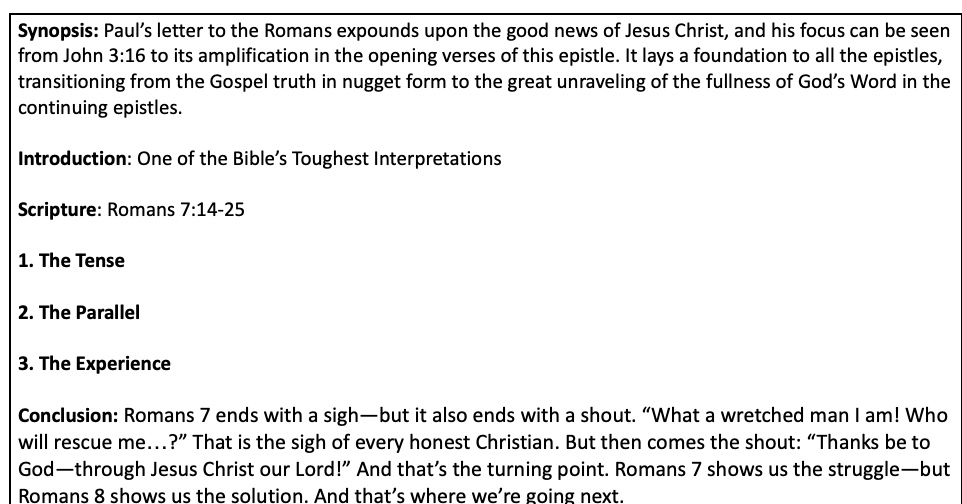
Romans 7 ends with a sigh—but it also ends with a shout. “What a wretched man I am! Who will rescue me…?” That is the sigh of every honest Christian. But then comes the shout: “Thanks be to God—through Jesus Christ our Lord!”
And that’s the turning point. Romans 7 shows us the struggle—but Romans 8 shows us the solution. And that’s where we’re going next.Thank you for joining me today on The Robert J. Morgan Podcast. And speaking of tools that may help you in your Christian growth, check out my newest books—The Origin of Hymns and Meditating God’s Way.