What the Book of Romans Can Do For Your Mind
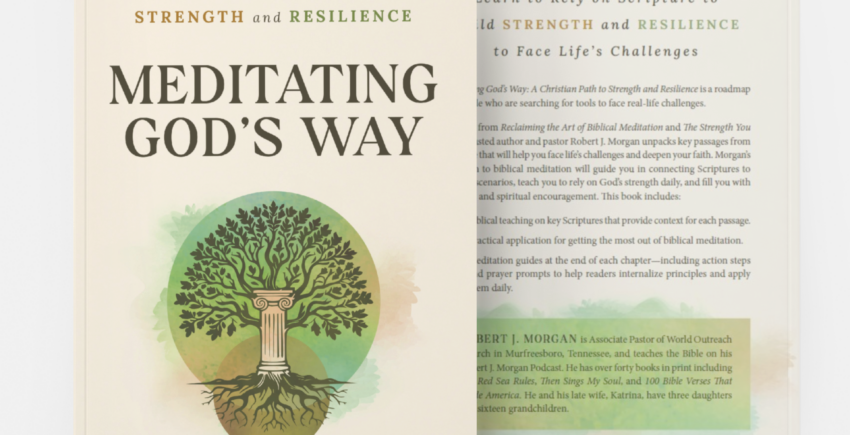
I’ve been looking forward to the release of my new book, Meditating God’s Way. The subtitle is: A Christian Path to Strength and Resilience. The importance of reclaiming the lost art of biblical meditation is summarized here in the book of Romans in chapter 12:1 – 2, so let’s begin there.
Therefore, I urge you, brothers and sisters, in view of God’s mercy, to offer your bodies as a living sacrifice, holy and pleasing to God—this is your true and proper worship. Do not conform to the pattern of this world, but be transformed by the renewing of your mind. Then you will be able to test and approve what God’s will is—His good, pleasing and perfect will. – Romans 12:1-2
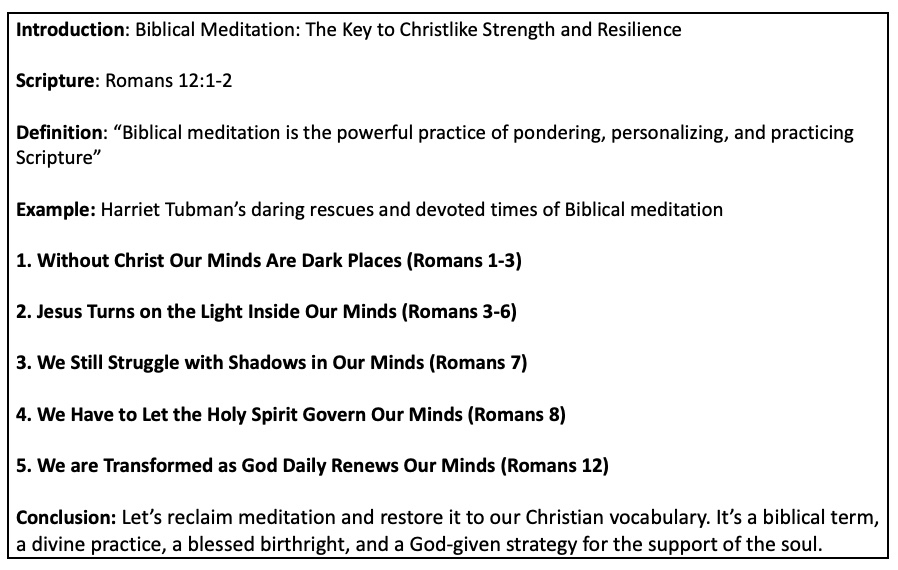
Introduction
One day in 1970 as I walked across the quadrangle of the college I attended in Bristol, Tennessee, I heard exciting news. Maharishi Mahesh Yogi was coming – or maybe he was sending a representative – to teach us Transcendental Meditation. When the day came, we packed the room for the mysterious robed man, and he taught us a few rudimentary TM techniques. He told us to sit properly, breathe deeply, and empty our minds. The swami’s visit piqued my interest in meditation, but he lost me somewhere between karma and mantra, and I didn’t fall into Zen.
The next year I transferred to another school, Columbia International University, where I met a group of people who also extolled the value of meditation, but they viewed it differently, as a biblical habit. We should constantly memorize, visualize, and personalize God’s Word, they said. I studied the Navigators’ hand illustration. Getting a grip on God’s Word requires the four fingers of hearing it, reading it, studying it, and memorizing it. But the thumb that strengthens the grip is meditation. Once we have a grip on the Bible, our feet go into action, putting into practice what we’re learning.
I was told meditation is God’s way of accelerating His transformation process in my life, and the key verse about this is Romans 12:2: “Be transformed by the renewing of your mind.” Our lives are transformed by meditation.
How interesting, I thought. One year I learned about Transcendental Meditation and the next year I learned something better—Transformational Meditation, God’s process of infusing our personalities with the powerful currents of His Word.
Well, since the riotous 1970s, a thousand variations of Transcendental Meditation have pervaded our noisy and anxious culture like a religion of relaxation. As a result, many Christians shy away from the term “meditation,” shun its techniques, and forfeit its transforming power.
Definition
I believe it’s time to reclaim the habit, but from the right sources and with the best techniques. There is healing and holy power in pondering, picturing and personalizing passages of Scripture from God’s Word. And that’s my simple definition for true meditation: Biblical meditation is the powerful practice of pondering, personalizing and practicing Scripture.
It’s as simple as that. While there’s value in breathing exercises and relaxation techniques, biblical meditation is more than contemplating the sensation of air passing through the tips of our noses. It doesn’t involve draining our heads of content but filling our minds with truly transcendent thoughts – the specific Bible verses and passages God brings to our minds at certain times. That’s part of the ministry of the Holy Spirit, whose job is to remind us of everything Jesus has said to us (John 14:26).
Biblical meditation is thinking Scripture—not just reading Scripture or studying Scripture or even thinking about Scripture—but thinking Scripture, contemplating, visualizing, and personifying the precious truths God has given us. In the process, our minds become God-conditioned. The Holy Spirit regulates our mental climate. We start looking at things as He does, which is the essence of wisdom – seeing life from His point of view. Our attitudes become healthier and our emotions fall into line.
Example
Let me give you an example. Harriet Tubman was a spy who, even in extreme danger, displayed raw, calm courage.
Born into slavery in the 1820s, Harriet was nearly killed when her master hurled a metal object in her direction. She mounted a daring escape in 1849, then spent years rescuing hundreds out of slavery and leading them to safety. Her code name was Moses, because she never lost a single escapee. During the Civil War she became a secret agent for the Union Army, working behind enemy lines to scout out the territory. Despite a bounty on her head, she seemed to operate with a sixth sense.
Her inner gyroscope was biblical meditation. A devout follower of Christ, she spent much time learning, memorizing, and meditating on various verses in the Bible, such as her beloved Isaiah 16:3: “Hide the fugitives, do not betray the refugees.” As she pondered her passages, she turned them into prayer; and in prayer she learned to practice God’s presence.
“I prayed all the time,” she told her biographer, “about my work, everywhere; I was always talking to the Lord. When I went to the horse trough to wash my face and took up the water in my hands, I said, ‘Oh, Lord, wash me, make me clean.’ When I took up the towel to wipe my face and hands, I cried, ‘Oh, Lord, for Jesus’ sake, wipe away all my sins!’ When I took up the broom and began to sweep, I groaned, ‘Oh, Lord, whatsoever sin there be in my heart, sweep it out, Lord, clear and clean.’”
In this way, Harriet forged a personality of action and audacity. She built a mindset that transcended her background and transformed her life. The same can be true for us. As we habitually hide God’s Word in our hearts, claim those special verses that seem to have our names on them, ponder and picture them and turn them into unceasing praise and prayer, we’ll practice the presence of God, and He will transform us into agents of audacity for His glory.
Let’s start with the basics. According to Romans 12:2, we are transformed by the renewing of our minds as God changes the way we think. That verse is part of a chain of texts in Romans that provides a biblical basis for understanding the power of meditation. These verses explain what’s wrong with our minds, why we struggle with our thoughts, and how we can bring health and healing to our brainwaves and inner selves.
1. Without Christ Our Minds Are Dark Places
Romans 1 – 3
The book of Romans is the theological epicenter of the Bible. The writer, the apostle Paul, devoted the first main section of the book (the bulk of Romans 1-3) to explaining why people face so much hopelessness. They don’t know God, and the problem is related to the mind. Without Christ our minds are dark as midnight.
Referring to fallen humanity, Paul wrote: “Their thinking became futile and their foolish hearts were darkened…. They exchanged the truth of God for a lie… Furthermore, just as they did not think it worthwhile to retain the knowledge of God, so God gave them over to a depraved mind…. They have no understanding….” (Romans 1:21, 25, 28, 31, emphasis mine).
Imagine a university where the library was open only on moonless nights and all lights were prohibited. The students had access to the books, desks, and study carrels; but they had to pursue their studies in total blackness. Expensive volumes filled the reading rooms—some of them rare and valuable—and the students were free to move among the bookshelves and pull down any books they wanted. But everything was done in darkness—no lamps, no candles, no flashlights, no light of any kind. Total blackout.
That’s a picture of a world trying to learn, trying to think, and trying to meditate without the light of the life of Christ. The Bible says that apart from God’s grace in Christ, our minds are corrupt (Titus 1:15); depraved (2 Timothy 3:8); anxious (Deuteronomy 28:65); cunning (Psalm 64:6); closed (Isaiah 44:18); warped (Proverbs 12:8); puffed up with idle notions by their unspiritual minds (Colossians 2:18), always learning but never able to come to a knowledge of the truth (2 Timothy 3:7). Every inclination of the thoughts of the human heart is only evil all the time (Genesis 6:5).
How can that be? The human brain is the greatest marvel of God’s creation—more complex than the largest star or the smallest atom. Like a finely tuned engine, our brains are designed for only one fuel—Truth. The Truth that comes from God. The Truth that pervades His creation. The Truth found in His perfect character and infallible Word.
Early in the human story something went wrong with our minds and hearts, and they were contaminated by faulty fuel. Our thinking became futile. Our foolish hearts were darkened. Our brains became depraved and we no longer saw reality from God’s perspective, and in this way we became separated from Him. This is the life of everyone without Christ. This explains why societies easily descend into moral corruption and why the world is so conflicted.
Have you ever noticed how every temptation comes via our thoughts, and every sin is birthed in our minds? Dr. J. Oswald Sander said, “The mind of man is the battleground on which every moral and spiritual battle is fought.”
Someone observed that self-control is primarily a matter of mind-control. The most important thing about us is what dominates our minds at any given moment. Every destructive action begins as a thought and every sinful habit has its origins in the furrows of our brains.
2. Jesus Turns On the Light Inside Our Minds
Romans 3-6
Jesus came as the light of the world. Romans 3:23-25 says: “This righteousness is given through faith in Jesus Christ to all who believe… for all have sinned and fall short of the glory of God, and all are justified freely by His grace through the redemption that came by Christ Jesus. God presented Christ as a sacrifice of atonement, though the shedding of His blood—to be received by faith” (verses 23-25).
Romans 5 summarizes it: “Therefore, since we have been justified through faith, we have peace with God through our Lord Jesus Christ, through whom we have gained access by faith into this grace in which we now stand” (Romans 5:1-2).
The only way to change your life is to change your mind, and that requires changing who rules and leads your heart. When Christ becomes your Savior and Lord, He turns on the light inside you.
When we come to Him, He shines His wisdom into our hearts and illumines our thoughts. He helps us focus on God and gain perspective. Romans 6:17 says, “But thanks be to God that, though you used to be slaves to sin, you have come to obey from your hearts the pattern of teaching that has now claimed your allegiance” (emphasis mine).
3. We Still Struggle With Shadows in Our Mind
Romans 7
Yet even after receiving Christ as Savior, we still struggle with our thoughts. Shadows dance on the walls of our minds. We are conflicted. Paul himself admitted in Romans 7 that his sinful nature waged war “against the law of my mind… making me a prisoner of the law of sin at work within me” (Romans 7:23, emphasis mine). In our regular podcast episodes we are right in the middle of this passage, currently.
We can easily relate to Paul’s confession, for this is the universal testimony of every believer. I’ve been a follower of Christ for many years, but I still struggle with my thoughts, which can easily become anxious, covetous, lustful, angry, resentful, fearful, or depressed. This is especially true today, when pornography, for example, is never more than a screen away. When purchases are only a click away. When bad news is as close as the phone in our pocket.
The process of spiritual growth is primarily mental—it involves rewiring our brains to correspond to the circuit board of Scripture. It involves increasing the wattage of the light that shines in our hearts and minds. “For God, who said, ‘Let light shine out in the darkness,’ made His light to shine in our hearts to give us the light of the knowledge of God’s glory displayed in the face of Christ” (2 Corinthians 4:6).
4. We Have to Let the Holy Spirit Govern Our Minds
Romans 8
To help with this we have a Master Electrician – the Holy Spirit. He understands the wattage and voltage of our minds. He knows when the lines are overloaded or when we blow a fuse. He knows when our energy runs low or our emotions short circuit or the bulbs burn out. He knows how to switch currents from negative to positive.
It’s all described in Romans 8, one of the most power-packed chapters in the Bible. Here we learn how the Holy Spirit takes the redemption of Christ and uses it to rewire our hearts with biblical truth. He grounds us in the Word. He is the great Transformer. He connects us to the megavolts of heaven’s generators.
Romans 8:5 says: “Those who live according to the flesh have their minds set on what the flesh desires; but those who live in accordance with the Spirit have their minds set on what the Spirit desires. The mind governed by the flesh is death, but the mind governed by the Spirit is life and peace” (emphasis mine).
Jesus of Nazareth died and rose again to bring our minds under new management; and as the Spirit governs our thought-lives they experience life and light. This is resurrection thinking. This is biblical thinking, and this is where meditation comes in.
5. We Are Transformed as God Daily Renews Our Minds
Romans 12
Rewiring our minds is a spiritual operation. We’re redeemed at Calvary, but the process of repairing the mind isn’t a one-time event. It’s progressive, which is explained in Romans 12: “Therefore, I urge you, brothers and sisters, in view of God’s mercy, to offer your bodies as a living sacrifice…. Do not conform to the pattern of this world, but be transformed by the renewing of your mind. Then you will be able to test and approve what God’s will is—His good, pleasing, and perfect will” (verses 1-2, emphasis mine).
To fulfill God’s good plan and accomplish His will, you must stop thinking the way the world thinks and start thinking the way He does.
How? Our greatest ongoing tool and technique is biblical meditation.
As we ponder, picture, and personalize God’s Word, our minds are reconditioned – rewired, remolded, and remodeled. We begin looking at life through His lens, viewing the world from His perspective. As our thoughts become happier and holier and brighter, so do we. Through the process of meditation, the Holy Spirit rewires our brains to receive the electrical currents of His Word, and our minds hum with energy from above and glow with heaven’s sunshine.
Want a more radiant countenance? Greater cheerfulness? More inner peace and emotional strength? Your thinking leads the way. It begins with your thoughts.
Do you want to have greater resistance to temptation, more wisdom in decision-making, and increased influence among your friends? It goes back to your mental patterns, back to meditation.
The words “meditate” and “meditation” occur 21 times in the Bible; the words “think,” “thinking,” and “thoughts,” 252 times. “Mind” is mentioned 163 times, and the word “ponder” is found nine times.
We practice biblical meditation by noting, quoting, and devoting ourselves to whatever passage of Scripture we’ve been reading or studying, based on the premise that God’s Word is flawless, faultless, and unfailing. It heals and helps the mind while shoring up the soul. It lessens anxiety, reduces stress, and generates peace.
As we meditate, God changes and guides our thoughts, helps us process our griefs and sorrows, enables us to soak in the wonder of His greatness, and prepares us for what He has planned for us.
Your mind can discover the Romans progression—from darkened thinking to enlightened thinking and from shadowy thinking to spiritual thinking, and on to transformational thinking. Biblical meditation is Christ-centered and it’s only possible when we proclaim Jesus as the Master of our Minds.
Conclusion
Meditation is not new; it is not New Age. God devised it, not the gurus; and it’s based on the Bible, not on Buddha. Biblical meditation is an antidote to the unprecedented stress of our age. In a world where everyone is overwhelmed and undervalued, our survival, sanity, and saintliness depend on reclaiming the lost art of biblical meditation. This habit can dramatically lessen your anxiety in life, reduce your stress, bring new success to your days, and leave you with ocean pools of inner peace. Meditation is God’s process for creating unflagging people who reflect His energy and excellence. In a shallow age, biblical meditation deepens our souls.
You can learn to do it now. You can incorporate it into your day like sunshine. Biblical Meditation is an ancient habit developed by the Author of Scripture to benefit His children, and it’s time we took it back. The Creator of the cosmos is the Maker of both the mind and the meditative process. His approach to mindfulness is having a mind full of His Word. That’s why the Bible says:
- “Let the word of Christ dwell in you richly” – Colossians 3:16.
- “Let this mind be in you which was also in Christ Jesus” – Philippians 2:5.
- “Let the words of my mouth and the meditation of my heart be acceptable in Your sight” — Psalm 19:14.
If you’re a bit allergic to meditation, get over it. Bible-lovers needn’t apologize for advocating meditation, for we have thousands of years of precedents. The heroes of Scripture considered meditation the king of habits.
- In the age of the patriarchs, Isaac went out at dusk to meditate in the fields (Genesis 24:63).
- The Lord told Joshua about the Law of God: “Meditate on it day and night…. Then you will be prosperous and successful” (Joshua 1:7-8).
- The Psalmist pictured those who meditate day and night as fruitful trees by rivers of water (Psalm 1:2).
- Jeremiah said, “When your words came, I ate them; they were my joy and my heart’s delight” (Jeremiah 15:16).
- The Virgin Mary treasured God’s words and pondered them in her heart (Luke 2:19).
- Jesus advised His followers to “hear the word, accept it, meditate on it, act on it, and bear fruit” (Mark 4:20).
- The apostle Paul told us to think about things that are true, noble, and gracious, and to meditate on those things (Philippians 4:8).
- The writer of Hebrews told us to “fix our thoughts on Jesus” (Hebrews 3:1).
Throughout Christian history, the greatest thinkers, leaders, workers, and writers have extolled the practice of biblical meditation.
- The inimitable Puritan, Thomas Watson, wrote, “What madness is it to hear Christians say they have no time to meditate! What is the business of their lives but meditation?”
- In his classic book, The Saints’ Everlasting Rest, Richard Baxter urged his readers to begin this habit, saying, “The duty which I press upon thee so earnestly, and in the practice of which I am now to direct thee, is the set and solemn acting of all the powers of thy soul in meditation….”
- St. Jerome called meditation his “paradise.”
- Saint Basil called it the “treasury where all the graces are locked up.”
- Charles Haddon Spurgeon, the Prince of Preachers, said, “Gigantic souls must have meditation to support them.”
- My friend, Kay Arthur, called meditation the “highest form of spirituality.”
Biblical meditation, then, is God’s way of bestowing calmness to our frenetic minds and quietness to our busy schedules. It’s His way of importing His truth into our conscious, subconscious, and unconscious minds as we cultivate the “mindset of Christ Jesus” (Philippians 2:5).
Through meditation, the timeless words of Scripture become flesh-and-blood—you! God transforms the pages of His book into the personalities of His believers. Think of it as the ultimate Bible translation, God’s Word translated into human personality as we gradually become walking and talking versions of Jesus, conformed into His image.
It’s an easy habit to begin. It’s as portable as your brain, as available as your imagination, as near as your Bible, and the benefits are immediate. I’ve written this to give you some whys and hows about it, and to show you how meditation will draw you closer to the Lord and give you fresh insights into His ways, His will, and His Word.
Let’s reclaim meditation and restore it to our Christian vocabulary. It’s a biblical term, a divine practice, a blessed birthright, and a God-given strategy for the support of the soul.
I want to conclude with a quotation from one of my favorite books, J. I. Packer’s Knowing God. Packer wrote, “Meditation is a lost art today, and Christian people suffer grievously from their ignorance of the practice. Meditation is the activity of calling to mind, and thinking over, and dwelling on, and applying to oneself, the various things that one knows about the works and ways and purposes and promises of God. It is an activity of holy thought, consciously performed in the presence of God, under the eye of God, by the help of God, as a means of communion with God.”
Like water flowing through a fountain or oil through a machine, Scripture should be circulating through our minds all the time. We should always be praying:
May the mind of Christ my Savior,
Live in me from day to day,
By His love and power controlling
All I do and say.
I say all of this and much more in this new book Meditating God’s Way: a Christian Path to Strength and Resilience. You can order it now wherever you order your books and I hope that you will check it out and order a copy for yourself and another for a friend. Meditating God’s way.