
Romans 7:7-13
Hello everyone!
Have you ever been walking through a building and you saw a sign that says, Wet Paint—Do Not Touch? Why is it almost impossible to keep from touching it? That may be a small thing, but it reveals something very deep about human nature. And that’s the question Paul is going to address today in Romans 7.
It is very difficult to rush through the book of Romans when you are teaching it. At my age, I don’t know if I will ever again have the opportunity of preaching all the way through the sixteen chapters of Romans; so, while I don’t want to take forever, I also don’t want to rush. This is our 19th segment, and we are coming to Romans 7:7-13. So if you can grab a Bible, turn there with me.
For our review today, I don’t know of anything better than to quote the summary that Dr. Douglas J. Moo gives in his commentary, The Letter to the Romans: Second Edition. It is part of the New International Commentary on the New Testament, published by Eerdmans. Dr. Moo says, “Romans 7 is one of the most famous chapters in the Bible. Scholars, preachers, and lay people alike are fascinated by Paul’s vivid description of human struggle and frustration in verses 7 through 25. Along with this fascination has come vigorous debate over the identity of the person depicted in these verses — unregenerate Paul, regenerate Paul, the backsliding Christian, and the like. Various identifications have in turn given rise to — or, often, been dictated by — significantly different theologies of sanctification.”
But, he says, that is not the main point of the chapter. Dr. Moo continued, “The main topic is the Mosaic Law. Paul makes two basic points. First, using the analogy of marriage, Paul argues that a person’s bondage to the law must be severed in order that he or she may be put into a new relationship with Christ.”
And that was what we looked at last time, Romans 7:1-6. Dr. Moo goes on, “This, the positive teaching of the chapter, gives rise to the question about the origin and nature of the law. These Paul answers in [verses 7-25], where he shows that the law is from God, but that it has nonetheless become an unwitting tool of sin, being used to confirm and imprison in death.”
And that is what we are tackling today. Last time we learned that when we come to Christ we die to the law in the sense of its ability to save us. Verse 4 says: So, my brothers and sisters, you died to the law through the body of Christ, that you might belong to another. That is, to Christ. And in verse 6 he said, But now, by dying to what once bound us, we have been released from the law so that we serve in the new way of the Spirit.
Paul was a brilliant Jewish rabbi and he knew what the Jewish people thought about the law. They had been drawn into a covenant with almighty God at Mount Sinai, and he had given them the rules by which they were to live. These rules were summarized in 10 powerful commandments, and broken down into smaller units. The Jewish rabbis taught that there were 613 commandments. Of these, 365 of them were negatives (“You shall not”). And 248 of them were positive commands, telling them the things they were to do.
In Jewish thinking and theology, the way to have a relationship with God was to keep these commands. But Paul is trying to rewire their thinking on this point. He is going to tell us that the Mosaic Law was not given as a ladder we can climb to Heaven. It was instead given as a yardstick to show us how far short we fall. It was intended to show us how sinful we are so that we’ll seek salvation through the other way God provided—faith in His Son.
Scripture
That is the primary theme of Romans 7. So let’s read Romans 7:7-13:
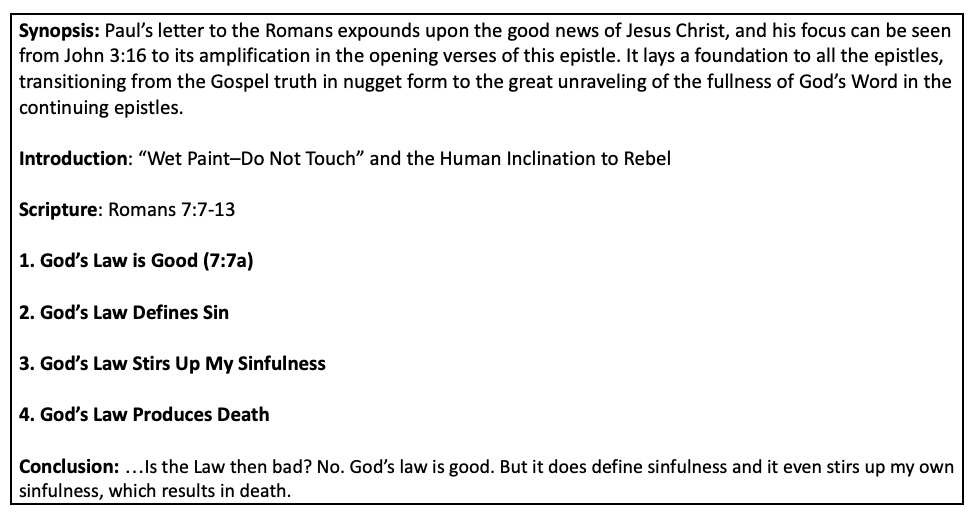
7 What shall we say, then? Is the law sinful? Certainly not! Nevertheless, I would not have known what sin was had it not been for the law. For I would not have known what coveting really was if the law had not said, “You shall not covet.” 8 But sin, seizing the opportunity afforded by the commandment, produced in me every kind of coveting. For apart from the law, sin was dead. 9 Once I was alive apart from the law; but when the commandment came, sin sprang to life and I died. 10 I found that the very commandment that was intended to bring life actually brought death. 11 For sin, seizing the opportunity afforded by the commandment, deceived me, and through the commandment put me to death. 12 So then, the law is holy, and the commandment is holy, righteous and good. 13 Did that which is good, then, become death to me? By no means! Nevertheless, in order that sin might be recognized as sin, it used what is good to bring about my death, so that through the commandment sin might become utterly sinful.
God’s Law is Good (Verse 7a)
First, we must understand that God’s Law is good. Look at the first part of verse 7: What shall we say, then? Is the law sinful? Certainly not!
If we scan the whole chapter, we’ll notice that Paul has a very positive view of God’s Law, the Mosaic Law, and the Torah. In verse 22, he calls it “God’s Law” and says, “For in my inner being I delight in God’s law.” In verse 12, he calls it holy, saying, “So then, the law is holy, and the commandment is holy, righteous, and good.” In verse 14, he calls it spiritual, saying, “We know that the law is spiritual.”
I have come to believe the law is the codification of God’s perfect character as it relates to humans. The Law says, “Do not give false testimony against your neighbor.” Why? Because God is a God of truth and honesty and integrity. That is part of His essential character. So in our relationships with others, we should reflect that and be truthful, honest, and people of integrity. So the law reflects the character of God in terms of basic human behavior. So it is God’s law. We should delight in it. It is holy, righteous, and good. It is spiritual.
So that brings up a question, which lies at the heart of the passage. Why do we need to die to the Law, as the first paragraph tells us? If the law is so good, why has it become such a negative factor in the program and process of salvation?
God’s Law Defines Sin
Well, that’s why Paul is explaining. Look at verse 7 again: What shall we say, then? Is the law sinful? Certainly not! Nevertheless, I would not have known what sin was had it not been for the law. For I would not have known what coveting really was if the law had not said, “You shall not covet.”
How do we know we are sinful people? We may have a vague notion based on our conscience or on some inherent understanding of right and wrong. But it’s the law that defines what sin is.
God’s Law Stirs Up My Sinfulness
Next, Paul says that the law goes even further. It stirs up my sinfulness. When I read the Ten Commandments, something within me wanted to break them. Look at verse 8: But sin, seizing the opportunity afforded by the commandment, produced in me every kind of coveting.
Again to quote Dr. Moo: “How is it that the law can give sin the occasion to stir up all these desires? To some extent, the old adage about ‘forbidden fruits’ can explain what Paul means: people, told not to do something, immediately conclude that there must be something fun about it and are motivated all the more, or even perhaps for the first time, to do it. Ancient moralists noted this phenomenon, and we are all familiar with it; witness the result of a parent telling her child, ‘Now do not go outside and jump in that mud puddle!’”
Going back to my opening illustration, why do we want to touch a door or a railing or a park bench that has a sign that says, “Wet Paint! Do Not Touch”?
God’s Law Produces Death
So let’s follow Paul’s line of reasoning. The Law is good and holy. It defines sin and identifies sinfulness. It even stimulates and stirs up my sinfulness. Now his next point is the result of all of that. Death! The law results in my condemnation to death.
Verses 9-11 say: Once I was alive apart from the law….
Paul doesn’t mean he was spiritually alive apart from the law, but that until he became aware of God’s laws and requirements, he was unaware and unconcerned and living it up with a false sense of security. But then he did become aware of God’s demands.
Dr. John Murray wrote, “The word alive cannot be used here in the sense of life eternal or life unto God. He is speaking of the unperturbed, self-complacent, self-righteous life which he once lived before the turbulent motions and conviction of sin.”
Once I was alive apart from the law but when the commandment came, sin sprang to life and I died. I found that the very commandment that was intended to bring life actually brought death. For sin, seizing the opportunity afforded by the commandment, deceived me, and through the commandment put me to death.
In other words, the law is like a good instrument that sin hijacks and uses against me. The problem isn’t the law. It’s the power of sin that weaponizes the law.
When I encounter a difficult paragraph in the Bible, I often go to some of the simpler, more dynamic, paraphrases or translations and read it there.
Here’s the way the Living Bible puts it: “That is why I felt fine so long as I did not understand what the law really demanded. But when I learned the truth, I realized that I had broken the law and was a sinner, doomed to die. So as far as I was concerned, the good law which was supposed to show me the way of life resulted instead in my being given the death penalty. Sin fooled me by taking the good laws of God and using them to make me guilty of death.”
The New Living Translation says: “At one time I lived without understanding the law. But when I learned the command not to covet, for instance, the power of sin came to life, and I died. So I discovered that the law’s commands, which were supposed to bring life, brought spiritual death instead. Sin took advantage of those commands and deceived me; it used the commands to kill me.”
The translation called the Voice says: “There was a time when I was living without the law, but the commandment came and changed everything: sin came to life, and I died. This commandment was supposed to bring life; but in my experience, it brought death. Sin took advantage of the commandment, tricked me, and exploited it in order to kill me.”
So Paul’s teachings are relatively clear in this paragraph. The law of God is good, holy, and a reflection of His character. But that means it shows me what is truly wrong with me. It defines sin. Furthermore, it stirs up my own rebellious heart. As a result, it produces death, of which the only remedy is the grace of our Lord Jesus Christ. As he will say in Romans 8: “Therefore, there is no condemnation to those who are in Christ Jesus, because through Christ Jesus the law of the Spirit who gives life has set us free from the law of sin and death. For what the law was powerless to do because it was weakened by the flesh, God did by sending His own Son in the likeness of sinful flesh to be a sin offering. And so He condemned sin in the flesh, in order that the righteous requirement of the law might be fully met in us, who do not live according to the flesh but according to the Spirit.”
Conclusion
Norm Miller is a remarkable man. As a young man he was hired as a traveling salesman for Interstate Batteries, and he worked his way through the ranks to become Chairman Emeritus of the company. He is in his eighties now, but he can look back over a life filled with ministry. He has been a business leader for Christ. Some years ago, he was asked about his testimony and this is what he said.
I became a Christian in May 1974 when I was 35. At that age, I had already reached my goals I had set in college, but I considered myself an empty failure in regard to happiness and anxious about life. A friend began to tell me about the Word of God. I challenged him to prove to me that it was the Word of God. I began to study to see if a person of intellect could accept it. I studied not the Bible but ancient manuscripts and archaeology and looked at the fulfillment of prophecy. It was too much. Then I began to study the Bible to see what it said to me. I realized I was a sinner in rebellion against God, that his Son, Jesus, had paid the price for my sins and was a bridge to God. I embraced Christ as my Lord and Savior in 1974, and he is my Lord and Savior. That has given me freedom, peace, and joy and an ability to love people where before I had liked people but was shallow and cold, and I saw them as here today and gone tomorrow. My relationship with Christ has changed my heart. It has been a great adventure and a wonderful fulfillment.
Notice that when he began reading the Bible, he said he realized he was a sinner in rebellion against God. That’s what Paul is telling us here. Let me go back and list the points Paul has made so far in Romans 7. These are the main points or headings from my podcast last week and today.
The law has authority only over those who are alive. We died to the law. We now belong to another, and it’s the Holy Spirit who is now working in us to produce what the law could not.
Is the Law then bad? No. God’s law is good. But it does define sinfulness and it even stirs up my own sinfulness, which results in death.
But he is going to continue in the last part of chapter 7 and the first part of chapter 8 to say there is an answer and only one answer—it is in Jesus Christ. Romans 7 leaves us in tension, but Romans 8 will lead us into triumph. That’s what Norm Miller was talking about when he said: ?Then I began to study the Bible to see what it said to me. I realized I was a sinner in rebellion against God, that his Son, Jesus, had paid the price for my sins and was a bridge to God. I embraced Christ as my Lord and Savior in 1974, and he is my Lord and Savior. That has given me freedom, peace and joy.”
Next time we will focus on the rather difficult final passage of Romans 7 which serves as the prelude for the most glorious chapter on the Holy Spirit in the entire Bible—Romans chapter 8.