1 Timothy 4:15
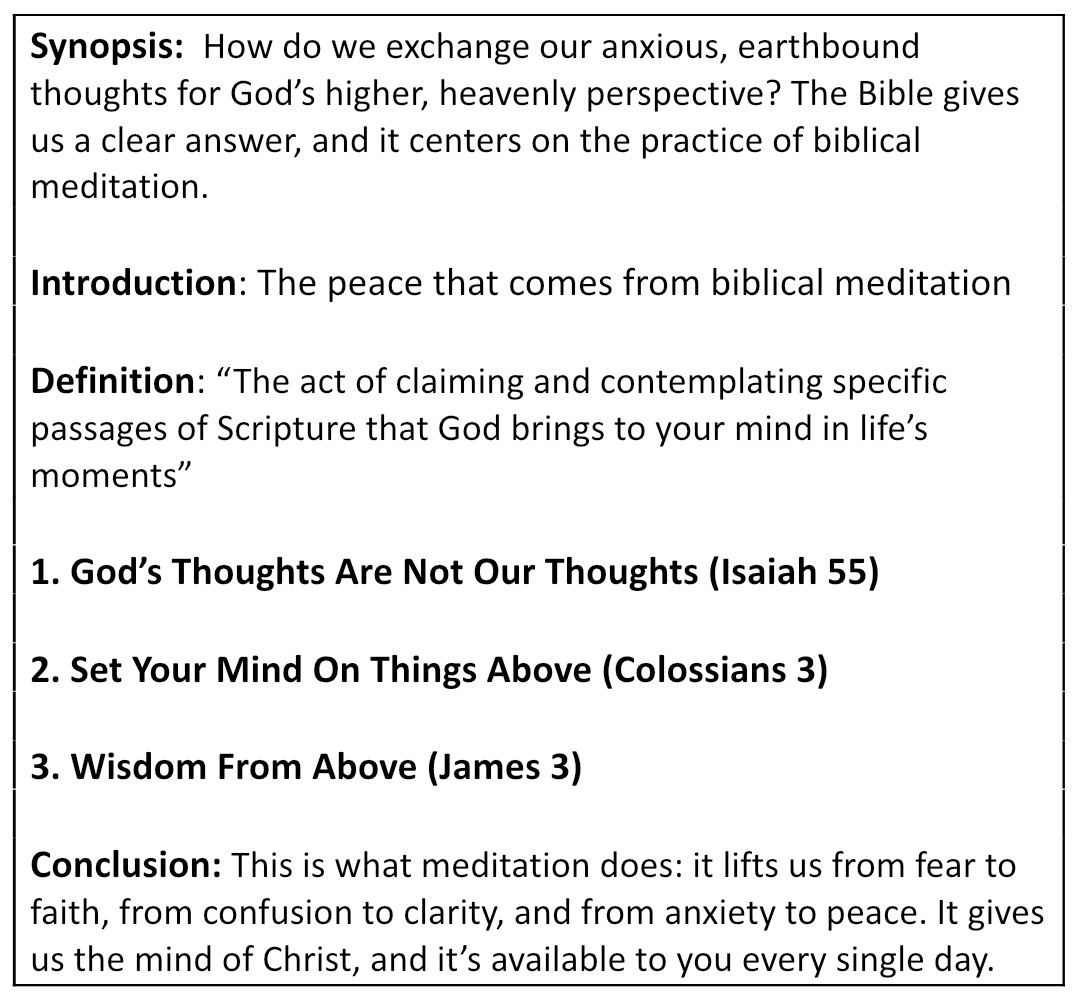
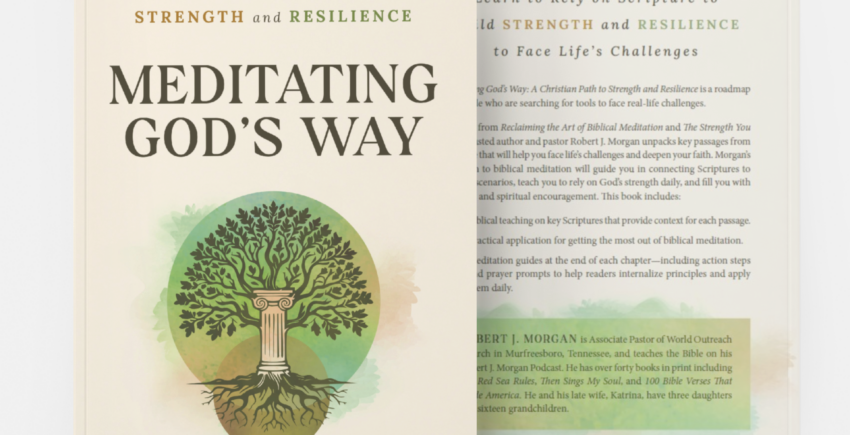
Today I want to share a message that is very close to my heart—and closely tied to my new book, Meditating God’s Way: A Christian Path to Strength and Resilience. Today, I want to step aside and explore a theme that runs throughout Scripture and connects directly to what I’ve been writing about recently. It’s this: how do we exchange our anxious, earthbound thoughts for God’s higher, heavenly perspective? The Bible gives us a clear answer, and it centers on the practice of biblical meditation.
Our key verse is 1 Timothy 4:15: “Meditate on these things; give yourself entirely to them, that your progress may be evident to all.”
INTRODUCTION
I remember one of the most difficult decisions I have ever made, and I still sometimes wonder if I made the right choice. In my mind I know that I did, but in my heart I still have lingering feelings about it. I had been pastoring the same church for 36 years, but I could no longer continue fulfilling my complete duties in light of my wife’s illness and the growing demand that I had for the broader ministry God was given me.
After thirty-six years as a senior pastor, I recently realized I needed to shift roles. I wasn’t resigning or retiring, but I could no longer carry the full weight of leadership in the same way. The night before I shared that news with my congregation, I was uneasy. My stomach was tight, my mind was racing, and I didn’t know how people would respond.
So I found a quiet place, leaned back, closed my eyes, and began doing something I’ve learned over the years. I started quoting Scripture—one verse, then another, then another—moving through passages I had committed to memory. And as I did, something remarkable happened. My anxiety began to fall away like leaves dropping from an autumn tree. The next morning, I stood in the pulpit with a calmness I can only describe as supernatural, as if I were standing in my own backyard with my grandchildren. That’s the power of biblical meditation.
DEFINITION
Let me give you a simple definition. Biblical meditation is the act of claiming and contemplating specific passages of Scripture that God brings to your mind in life’s moments. It’s how God’s thoughts begin to replace our thoughts. It’s how we move from the lowlands of fear to the highlands of faith.
Jennifer Rothschild once described her fear of flying after the events of September 11. She had to travel frequently, but she was deeply afraid. Airports were tense, planes felt uncertain, and anxiety followed her everywhere. One day in prayer, a verse came to her mind: “When I am afraid, I will trust in You.” As she began meditating on it, she noticed something profound. The phrase “When I am afraid” described her condition, but “I will trust” expressed her decision. Her volition could change her condition. That’s what meditation does—it helps us replace lower thoughts with higher ones.
The Bible gives us three key passages that explain how to move from our thoughts to God’s thoughts: Isaiah 55, Colossians 3, and James 3. Together, they form a pathway for renewing the mind.
1. GOD’S THOUGHTS ARE NOT OUR THOUGHTS (Isaiah 55)
In Isaiah 55, God tells us plainly, “My thoughts are not your thoughts, neither are your ways My ways.” God sees everything perfectly, completely, and eternally. He knows every detail of the universe and every detail of your life—past, present, and future. Nothing confuses Him, nothing surprises Him, and nothing escapes His notice.
And yet, in His grace, He has given His thoughts to us in Scripture. Isaiah says His Word comes down like rain, watering the earth and producing life. When we meditate on Scripture, those divine thoughts begin to soak into our souls. They reshape us, steady us, and lift us above the confusion of our circumstances. Meditation is the process by which God’s thoughts become our thoughts, allowing us to see life from His perspective.
2. SET YOUR MIND ON THINGS ABOVE (Colossians 3)
The apostle Paul builds on this idea in Colossians 3 when he tells us, “Set your minds on things above, not on earthly things.” But how do we actually do that? He gives the answer in the same chapter: “Let the word of Christ dwell in you richly.”
This is more than casual Bible reading. It means letting Scripture take up residence in our hearts. Charles Spurgeon once explained that the Word must not only enter into us but saturate us—it must soak into our innermost being. It’s not enough to have the Bible on the shelf; it must live within the soul.
There’s a remarkable story about a man named Solomon Ginsburg, a Jewish believer who traveled extensively for the Gospel. At one point, he faced a difficult travel decision during a season of dangerous storms. As he prayed, a verse kept returning to his mind: “The Lord your God has watched over your journey.” He meditated on that promise and chose to proceed with his trip. His journey was safe. Later, he discovered that had he delayed, he would have arrived in time to board the Titanic.
Now, I don’t claim to understand all the ways God leads us, but I do know this: when we meditate on Scripture, God’s wisdom begins to shape our thinking and guide our decisions in ways we cannot fully explain.
3. WISDOM FROM ABOVE (James 3)
James 3 introduces us to two kinds of thinking—wisdom from below and wisdom from above. Earthly thinking is driven by anxiety, selfishness, and instability. But wisdom from above is pure, peaceable, gentle, full of mercy, and full of good fruit.
How do we gain that kind of wisdom? James tells us earlier in his letter that we must receive the Word, look intently into it, continue in it, and put it into practice. That phrase “look intently” carries the idea of bending down and examining something closely—like Peter peering into the empty tomb. That’s a picture of meditation.
Let me give you a very simple example from my own life. Not long ago, I was in California for speaking engagements. One night I woke up restless, my mind racing with vague anxieties. I suddenly remembered I was on the sixth floor of a hotel and began thinking about earthquakes. It was irrational, but very real in that moment.
But I’ve learned what to do in those situations. Half awake, I began quoting Scripture: “God is our refuge and strength, a very present help in trouble.” As I repeated those words, peace returned, my thoughts settled, and I was able to fall back asleep. That’s biblical meditation—not just in theory, but in everyday life.
We all need God’s thoughts, God’s perspective, and God’s wisdom. Meditation is the means by which those become ours. The Bible tells us in 2 Corinthians 10:5 that we are to take every thought captive and make it obedient to Christ. That happens as we deliberately and consistently fill our minds with His Word.
CONCLUSION:
When I began working on this subject, I called my friend Dr. Roy King and asked if he had ever experienced the transforming power of sustained biblical meditation. He told me about a time early in his life when he struggled with deep depression. Nothing seemed physically wrong, but emotionally he was in a very dark place.
A friend gave him simple advice: stay in Ephesians 1:3–14. Don’t move on. Study it, meditate on it, and remain there until it becomes real to you. At first, he did it mechanically, but one night, sitting alone in the early hours, that passage suddenly came alive. He began to see what it meant to be forgiven, redeemed, adopted, and sealed by the Spirit.
In that moment, everything changed. He said it was as if a voice spoke into his heart: “You should never call yourself worthless again.” That night marked a turning point in his life because God’s thoughts replaced his own.
That’s what meditation does. It lifts us from fear to faith, from confusion to clarity, and from anxiety to peace. It gives us the mind of Christ, and it’s available to you every single day.
That’s why I’ve written Meditating God’s Way: A Christian Path to Strength and Resilience. I believe this is one of the most needed—and most neglected—disciplines in the Christian life today. You can order it wherever books are sold, and I hope you’ll get a copy for yourself and another for a friend.